Send us your application, voltage, capacity, battery size, quantity, and branding needs. BYingPower will review your project and recommend the right LiFePO4 battery solution for golf carts, RVs, marine systems, solar storage, forklifts, or lead-acid replacement.
Custom battery pack review for your application
OEM/ODM and private-label battery guidance
BMS, charger, terminals, heating, and packaging support
Faster quote path for samples and bulk orders
4th Floor, Building A, No. 2, Longjiang 2nd Road, Xie Keng, Qingxi Town, Dongguan Province,China.
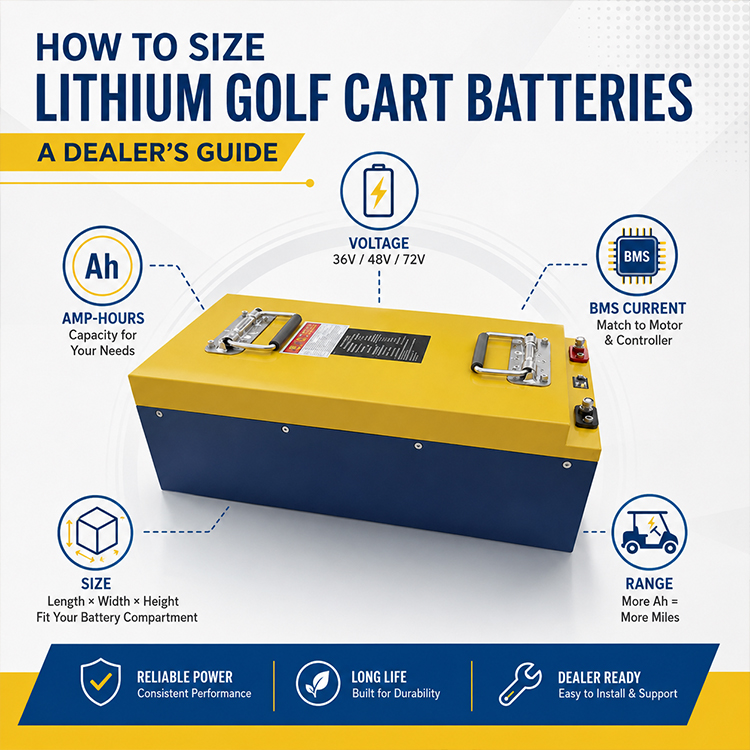
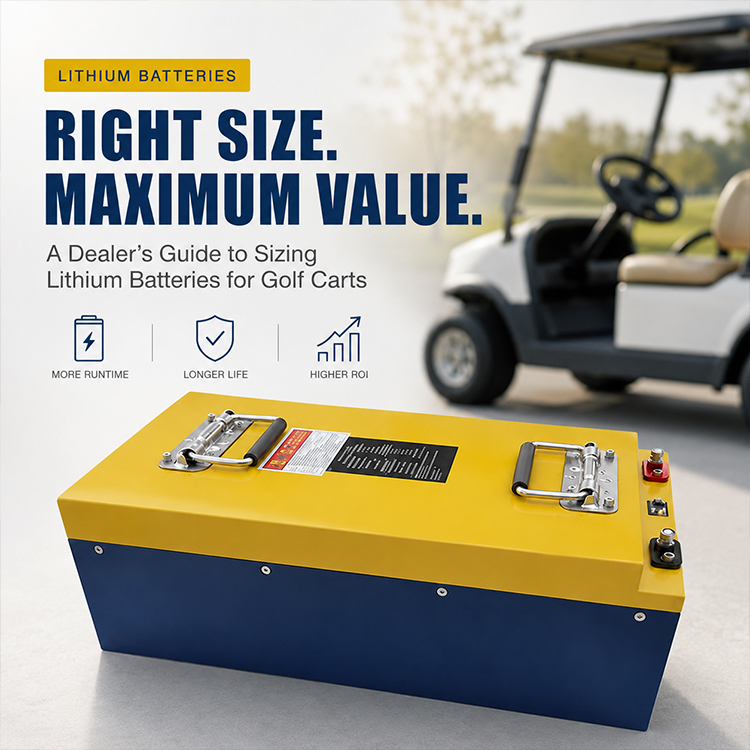
How to Size Lithium Golf Cart Batteries for Dealers
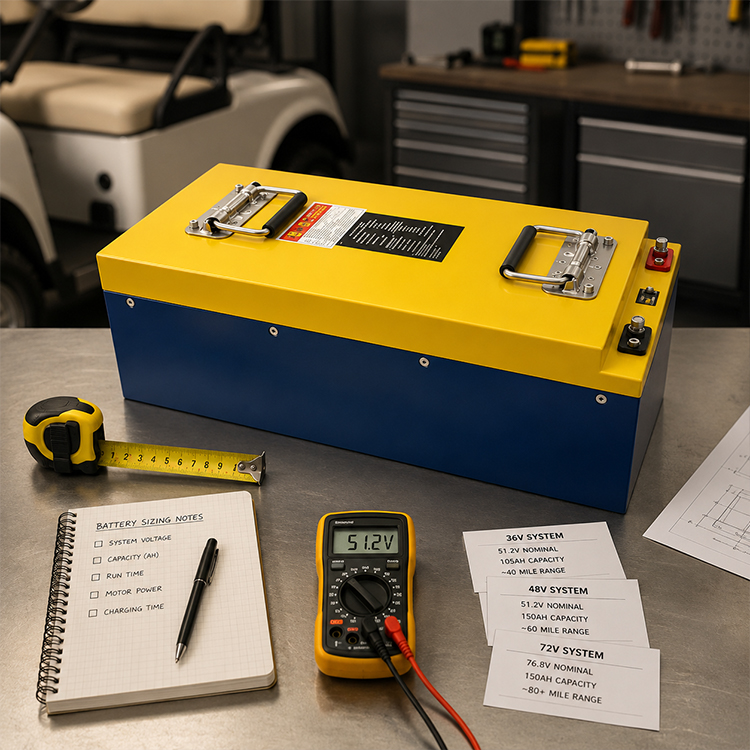
Sizing lithium golf cart batteries is not about guessing 100Ah, 150Ah, or 200Ah and hoping the BMS survives. Dealers need a clean method: measure the cart, calculate usable watt-hours, verify peak current, match the charger, and protect margin by selling the right pack the first time.
The Dealer’s Problem Is Not Lithium. It Is Bad Sizing.
Most golf cart battery complaints start before the battery is installed.
Read that again.
I have watched dealers lose profit because they let a customer walk in, say “I need a 48V lithium golf cart battery,” and then treated that phrase like a complete specification, when it was really just the opening sentence of a technical interview involving controller amperage, passenger load, terrain, tire size, charger profile, storage temperature, and the customer’s very human habit of blaming the dealer when range disappoints.
Here is the hard truth: Lithium Golf Cart Batteries are easier to sell than they are to size.
And that gap is where warranty claims breed.
A golf cart dealer should not size a LiFePO4 pack by copying the old lead-acid amp-hour label. A 48V 100Ah lead-acid bank and a 51.2V 100Ah LiFePO4 pack may look similar to a retail buyer, but they behave differently under load. Lead-acid voltage sags. LiFePO4 holds voltage flatter. Lead-acid loses usable capacity when pushed hard. LiFePO4 pushes current with less drama—until the BMS says stop.
That is the knife edge.
For customers comparing standard cart platforms, I would anchor the product conversation around CoreSpark’s Golf Cart Battery category first, then narrow the buyer into voltage-specific options like 48V Golf Cart Battery or 51.2V Golf Cart Battery once the cart, controller, and range target are known.
Table of Contents
Start With Voltage, But Do Not Worship It
Voltage is the first gate. Not the full answer.
Most dealer mistakes begin with the phrase “48V system.” In the field, that can mean a legacy pack of six 8V lead-acid batteries, four 12V batteries, or a lithium replacement pack built around a 16S LiFePO4 architecture with a nominal voltage of 51.2V. Same customer language. Different electrical behavior.
So what should dealers check?
Start with the controller label, the old battery layout, charger output, solenoid rating, motor rating, and whether the cart has been modified with larger tires, rear seats, lift kits, utility beds, sound systems, lights, or hill-duty use. A cart hauling two golfers on flat pavement is not the same animal as a lifted six-seater climbing resort roads with a cooler, tools, and a driver who treats the pedal like an on/off switch.
Small detail. Big invoice.
For lithium iron phosphate, the real pack math often looks like this:
Cart System
Common Lead-Acid Layout
Common LiFePO4 Match
Dealer Note
36V cart
Six 6V lead-acid batteries
38.4V LiFePO4 or compatible 36V lithium pack
Verify controller low-voltage cutoff and charger compatibility
48V cart
Six 8V or four 12V lead-acid batteries
51.2V LiFePO4, often 100Ah–200Ah
Most common dealer upgrade path
72V cart
Six 12V lead-acid batteries
76.8V LiFePO4
Higher current discipline required
Fleet cart
Mixed age lead-acid banks
Standardized lithium pack spec
Best handled with repeatable model-level documentation
Do not sell voltage alone.
Sell fit.
CoreSpark’s own site points dealers toward 48V, 51.2V, and 76.8V golf cart battery options for dealer and replacement programs, which is exactly the right internal path for a sizing article because it matches how carts are actually quoted: first system voltage, then capacity, then BMS and charger package. For broader replacement education, the company’s lead-acid replacement batteries page also fits naturally because many golf cart customers still think in old lead-acid terms.
The Amp-Hour Trap: Why 100Ah Can Be Too Small, Just Right, or Oversold
Amp-hours are useful. They are also abused.
A dealer asking “how many Ah lithium battery does a golf cart need?” is asking the wrong first question. The better question is: how many usable watt-hours does this cart need under the customer’s real duty cycle?
The formula is plain:
Watt-hours = nominal voltage × amp-hours
So a 51.2V 100Ah LiFePO4 pack stores about 5,120Wh on paper. A 51.2V 150Ah pack stores about 7,680Wh. A 51.2V 200Ah pack stores about 10,240Wh.
Sounds simple, right?
Not quite.
Terrain, tire size, vehicle weight, motor controller current, stop-start driving, passenger load, and driving style can tear up neat battery math. I have seen dealers quote a 100Ah lithium pack because the customer “only drives around the neighborhood,” then discover the neighborhood is basically a hill test with teenagers, oversized tires, and night lighting.
The battery did not fail. The sizing process failed.
Here is the practical dealer filter I would use:
Buyer Scenario
Suggested Capacity Direction
Why It Matters
2-seat cart, flat golf course, moderate use
48V/51.2V 100Ah range
Good baseline for light use
4-seat neighborhood cart, mixed roads
48V/51.2V 105Ah–150Ah
Extra margin reduces range complaints
6-seat lifted cart, hills, accessories
150Ah–200Ah or custom review
Weight, current draw, and terrain demand more usable energy
Rental fleet or resort use
Standardized 150Ah+ planning
Uptime and repeatability matter more than lowest price
Utility cart, cargo, patrol, maintenance
Custom BMS/current review
Peak load can matter more than Ah label
If you sell only on amp-hours, you invite ugly conversations later.
And dealers hate ugly conversations.
BMS Current Is Where Amateur Quotes Get Exposed
The BMS is the bouncer.
It decides who gets in, who gets cut off, and when the party ends. A lithium golf cart battery may advertise 100Ah, 150Ah, or 200Ah, but the BMS current rating tells you whether the pack can tolerate acceleration spikes, hills, upgraded controllers, and heavy accessories without nuisance shutdowns.
This is why “how to size lithium golf cart batteries” cannot stop at capacity.
A 51.2V 105Ah pack with a 200A BMS may be a better cart battery than a bigger-looking pack with a weak discharge rating. For dealers, that matters because customers do not say “my BMS protection logic activated under transient peak load.” They say “your battery died.”
Brutal? Yes. Accurate? Also yes.
CPSC’s 2026 micromobility hazard report found lithium-ion battery fire fatalities within broader e-bike, scooter, and hoverboard incident data, including battery-related fire deaths from 2017 through 2024; golf carts are not the same product class, but the lesson carries over: battery packs are systems, not boxes, and charging plus integration discipline matters .
That is why I do not love bargain-bin conversion kits with vague BMS ratings, mystery chargers, and no serious documentation. Dealers should ask for:
Continuous discharge current
Peak discharge current and duration
Low-temperature charge protection
Cell balancing method
Short-circuit protection
Overcharge and over-discharge protection
CAN, RS485, Bluetooth, or display support if fleet diagnostics matter
Charger voltage and charge-current match
UN38.3 test summary availability for shipping
PHMSA states that lithium batteries transported in commerce must meet applicable Hazardous Materials Regulations by air, highway, rail, or water, and its lithium battery guide was updated for the May 10, 2024 HM-215Q requirements.
That is not paperwork fluff. That is dealer risk control.
The Lithium Golf Cart Battery Size Chart Dealers Actually Need
Most charts online are too clean.
They pretend a cart is a cart. It is not.
A proper lithium golf cart battery size chart should include voltage, capacity, usable energy, customer profile, and current-risk notes. Here is the version I would give to a dealer team before they answer the phone.
Lithium Pack Type
Approx. Stored Energy
Best-Fit Customer
Dealer Warning
36V/38.4V 100Ah
Around 3.8kWh
Older 36V carts, light-duty driving
Confirm controller compatibility before promising drop-in fit
48V/51.2V 100Ah
Around 5.1kWh
Standard 2-seat or light 4-seat carts
May be undersized for hills, lifted carts, or heavy accessories
48V/51.2V 105Ah
Around 5.4kWh
Common Club Car, EZGO, Yamaha upgrades
Good dealer baseline when BMS rating is strong
48V/51.2V 150Ah
Around 7.7kWh
4-seat carts, neighborhood use, moderate hills
Higher ticket, fewer range complaints
48V/51.2V 200Ah
Around 10.2kWh
6-seat carts, resort fleets, utility carts
Verify tray size, weight distribution, charger output, and cable rating
72V/76.8V 100Ah+
Around 7.7kWh+
Higher-voltage performance or utility carts
Current, controller, and charger review is non-negotiable
For buyers comparing 48V and 51.2V language, CoreSpark’s 48V vs 51.2V Golf Cart Batteries: Dealer Guide is the cleanest supporting internal page because it addresses the exact confusion customers bring into a showroom.
And yes, this is where I would cross-link to OEM/ODM LiFePO4 Battery Capabilities for dealers building a private-label line, because once you standardize 105Ah, 150Ah, or 200Ah configurations, you need pack design, charger matching, casing, BMS communication, labeling, and documentation to stay consistent across repeat orders.
Charger Matching: The Quiet Cause of Loud Warranty Claims
Bad chargers ruin good lithium sales.
A LiFePO4 battery does not want to be treated like an old flooded lead-acid bank. It does not need equalization. It does not want a mystery repair mode. It does not want a charger that overshoots voltage, floats aggressively, or fails to wake the BMS properly after protection.
This is boring.
It makes money.
A dealer should never quote a lithium golf cart battery without asking what charger is currently installed. Better yet, sell the pack and charger as a matched system unless there is verified compatibility. I know that sounds like salesmanship. It is also risk control.
The U.S. Consumer Product Safety Commission warned in 2024 about certain “universal” e-bike chargers after 47 fire reports and more than $100,000 in property damage, which is not a golf cart case but is a very useful reminder that charger compatibility is not a casual accessory choice.
So ask the ugly charger questions before the invoice:
Is the charger lithium-compatible?
What is the output voltage?
What is the charge current?
Does it have lead-acid equalization or desulfation?
Can it wake a sleeping BMS?
Is the connector correct?
Does the customer expect onboard charging or removable charging?
Is the cart stored below 0°C?
If the answer is vague, the quote is not ready.
What Dealers Should Ask Before Quoting Lithium Golf Cart Batteries
Here is the phone script I would use.
Not fancy. Effective.
Cart and Electrical System
Ask for cart make, model, year, system voltage, existing battery layout, charger model, controller rating, motor upgrades, and whether the cart is stock or modified. A lifted cart with 23-inch tires is not “just a golf cart.” It is a rolling load increase.
Customer Use
Ask how far the customer drives per day, whether the cart carries two, four, or six passengers, whether it climbs hills, whether it runs at night, and whether it is used for golf, neighborhood driving, resort rental, patrol, maintenance, farm work, or utility hauling.
Battery Compartment
Measure the tray.
Please.
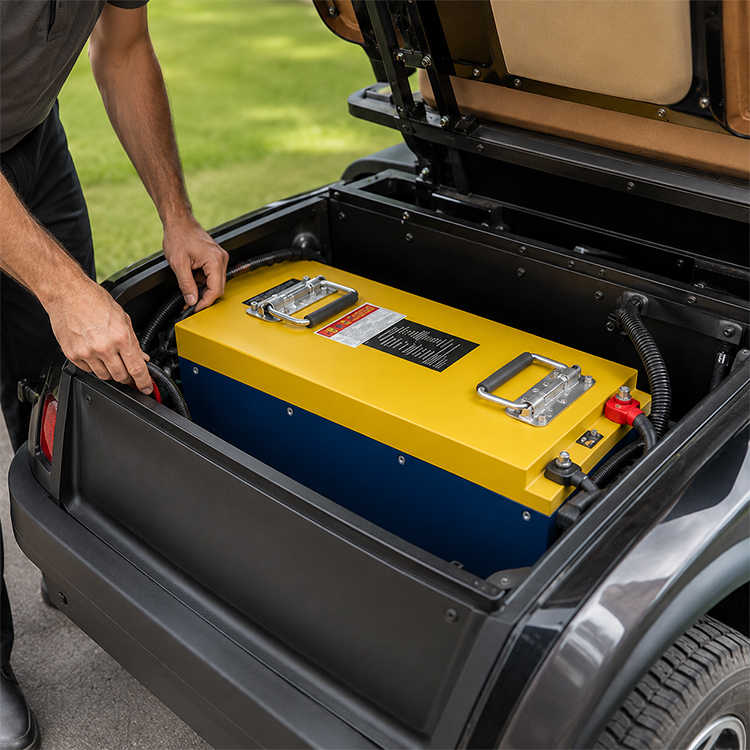
Do not trust a photo with no tape measure. Lithium packs can reduce weight, but physical casing, terminal position, hold-down method, cable routing, and waterproofing still decide whether the installation is clean or embarrassing.
Margin of Safety
I like capacity margin. I like current margin even more.
NREL battery aging work has repeatedly shown that duty cycle, temperature, state of charge, and cycling behavior affect lithium-ion degradation, including studies with cells aged under varied temperatures, depth of discharge, duty cycle, and C-rate conditions.
Translation for dealers: do not size every battery to the ragged edge. Customers do not operate carts in lab conditions.
Lead-Acid Replacement Is a Sales Opportunity, But Also a Trap
The lead-acid market trained buyers to think in battery count.
Six 8V batteries. Four 12V batteries. Six 6V batteries. Replace the boxes and move on.
Lithium asks for a better conversation.
A dealer can often position LiFePO4 around lower maintenance, lighter weight, deeper usable capacity, flatter voltage, and longer service life. That is the good part. But the old battery compartment may have corroded cables, weak hold-downs, wrong fuses, outdated chargers, and customers who think “drop-in” means “no one has to check anything.”
That word sells. It also lies.
EPA notes that lead-acid battery recycling is highly established in the U.S., with the agency estimating about a 99% recycling rate for lead in batteries in 2018; lithium-ion recycling and damaged-battery handling are more complicated, especially for damaged, defective, or recalled packs.
So dealers should sell the upgrade, but they should also manage end-of-life expectations, transportation rules, and customer education. If you are writing this as a dealer-facing page, link naturally to CoreSpark’s guide on how to replace lead-acid with LiFePO4 safely because that topic catches the exact buyer who is halfway convinced but still technically under-informed.
My Dealer Sizing Method: Five Steps Before You Quote
Step 1: Identify the Real Voltage Platform
Do not trust the customer’s first answer. Confirm the old battery bank, charger, controller, and motor label. For 48V carts, explain why 51.2V LiFePO4 is commonly discussed in the same conversation, because 16 cells in series at 3.2V nominal equals 51.2V.
Step 2: Convert Range Demand Into Watt-Hours
Use watt-hours instead of only amp-hours. A 51.2V 100Ah pack is about 5.12kWh. A 51.2V 150Ah pack is about 7.68kWh. A 51.2V 200Ah pack is about 10.24kWh. Then reduce your confidence if the cart is lifted, overloaded, used on hills, or driven hard.
Step 3: Check Continuous and Peak Current
Match the BMS to the controller and use case. Do not sell a pack that survives gentle driving but trips under acceleration. For dealer programs, a 200A BMS class may be a more credible baseline for many golf cart conversions than vague low-current packs, but the actual choice must match the controller and motor.
Step 4: Match the Charger
A lithium battery quote without a charger answer is incomplete. Put that on the wall.
Step 5: Document the Installation
Photos, serial numbers, charger model, cable condition, fuse rating, battery fit, customer use profile, and delivery date. Boring paperwork saves arguments later.
For B2B buyers building repeatable projects, CoreSpark’s LiFePO4 battery case studies page is useful because it frames battery projects around application review, sample validation, custom pack design, BMS options, and production consistency—not just catalog shopping.
FAQs
How do you size lithium golf cart batteries?
Sizing lithium golf cart batteries means matching the cart’s voltage, usable watt-hour demand, peak motor current, charger profile, physical battery tray, and customer duty cycle before choosing amp-hours. Dealers should confirm whether the cart is 36V, 48V, 51.2V, 72V, or 76.8V, then select capacity and BMS rating based on real use.
In practice, start with system voltage, then calculate stored energy using nominal voltage × amp-hours. After that, adjust for terrain, passenger count, tire size, accessories, and controller rating. A light-duty 48V cart may work well with 100Ah–105Ah, while a lifted six-seater or resort cart may need 150Ah–200Ah or a custom review.
How many Ah lithium battery does a golf cart need?
A golf cart usually needs 100Ah to 200Ah of lithium capacity depending on voltage, range target, passenger load, terrain, tire size, and controller demand. For many 48V or 51.2V carts, 100Ah–105Ah is a common starting point, while heavier neighborhood, utility, and fleet carts often justify 150Ah or more.
Do not treat amp-hours as the whole answer. A 51.2V 100Ah battery stores about 5.12kWh, while a 51.2V 150Ah battery stores about 7.68kWh. That extra 2.56kWh can be the difference between a happy customer and a range complaint after hills, rear seats, and night accessories get involved.
Is a 48V lithium golf cart battery the same as a 51.2V lithium battery?
A 48V lithium golf cart battery is often sold in the same market as a 51.2V LiFePO4 pack, but they are not always electrically identical. A 51.2V LiFePO4 battery typically uses 16 cells in series at 3.2V nominal per cell, so dealers must verify controller, charger, and accessory compatibility before quoting.
The customer may say “48V” because that is what the old lead-acid cart was called. The dealer should translate that into the correct lithium architecture. This is why 48V and 51.2V education matters: the words overlap in sales conversations, but the charger settings and system behavior still need confirmation.
What matters more for golf cart battery sizing: Ah or BMS current?
BMS current can matter more than amp-hours when the cart has high acceleration demand, hills, heavy passenger load, oversized tires, or upgraded controllers. Amp-hours describe energy capacity, but BMS current decides whether the battery can safely deliver continuous and peak power without tripping under real driving conditions.
A large-capacity battery with a weak BMS can still disappoint. Dealers should check continuous discharge current, peak discharge current, peak duration, short-circuit protection, temperature protection, and communication features. If the BMS trips during acceleration, customers will blame the battery even when the real problem was poor sizing.
Can dealers replace lead-acid golf cart batteries with lithium directly?
Dealers can replace lead-acid golf cart batteries with lithium only after confirming voltage, charger compatibility, BMS current rating, cable condition, fuse protection, physical fit, and controller behavior. The phrase “drop-in replacement” should never mean “skip inspection,” because lithium packs behave differently from flooded, AGM, or gel lead-acid banks.
The safest dealer process is to document the old battery layout, measure the tray, inspect wiring, verify charger output, check controller rating, install proper restraints, and test under load. Lithium conversions can be excellent business, but casual swaps create the kind of warranty risk that eats the profit from the original sale.
Final Thoughts: Quote the Battery Like a Dealer, Not a Guessing Machine
The best lithium golf cart battery sale is not the biggest Ah number.
It is the cleanest match.
Dealers who win this market will stop selling “48V lithium batteries” as a generic upgrade and start selling measured systems: correct voltage, enough usable watt-hours, strong BMS current, matched charger, clean installation, and documented customer use. That is how you reduce returns, protect margin, and earn repeat fleet business.
If you are sourcing lithium golf cart batteries for dealer resale, private-label programs, or fleet replacement projects, send CoreSpark the cart voltage, target capacity, controller current, charger requirements, battery tray dimensions, order quantity, and branding needs so the pack can be sized before the quote—not after the complaint.
Newsletter Updates
Enter your email address below and subscribe to our newsletter
BYingPower provides OEM, wholesale, and custom LiFePO4 battery packs for golf carts, RVs, forklifts, solar storage, marine power, and lead-acid replacement applications. We support battery brands, distributors, dealers, system integrators, and OEM buyers with reliable lithium battery solutions, smart BMS options, private-label services, and export documentation support.