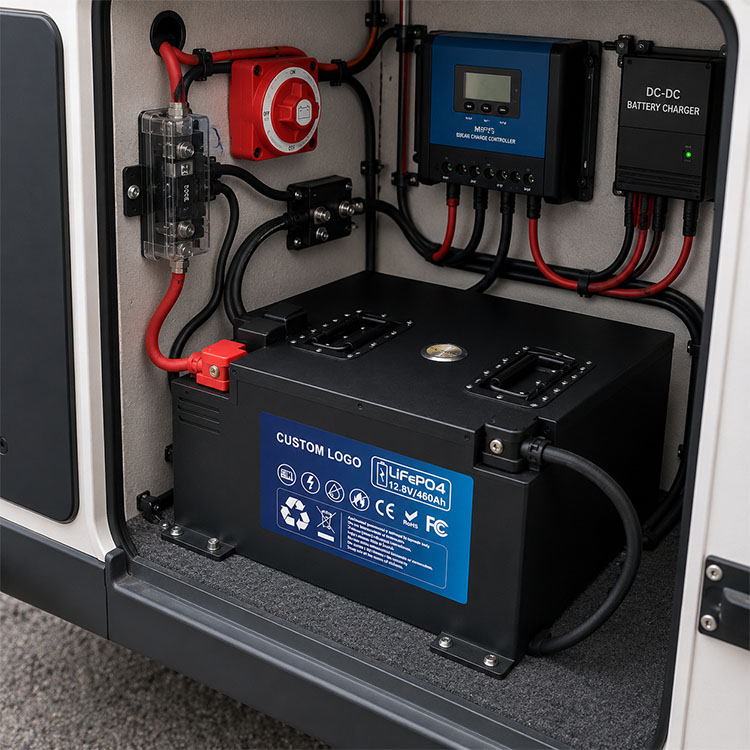
Send us your application, voltage, capacity, battery size, quantity, and branding needs. BYingPower will review your project and recommend the right LiFePO4 battery solution for golf carts, RVs, marine systems, solar storage, forklifts, or lead-acid replacement.
Custom battery pack review for your application
OEM/ODM and private-label battery guidance
BMS, charger, terminals, heating, and packaging support
Faster quote path for samples and bulk orders
4th Floor, Building A, No. 2, Longjiang 2nd Road, Xie Keng, Qingxi Town, Dongguan Province,China.
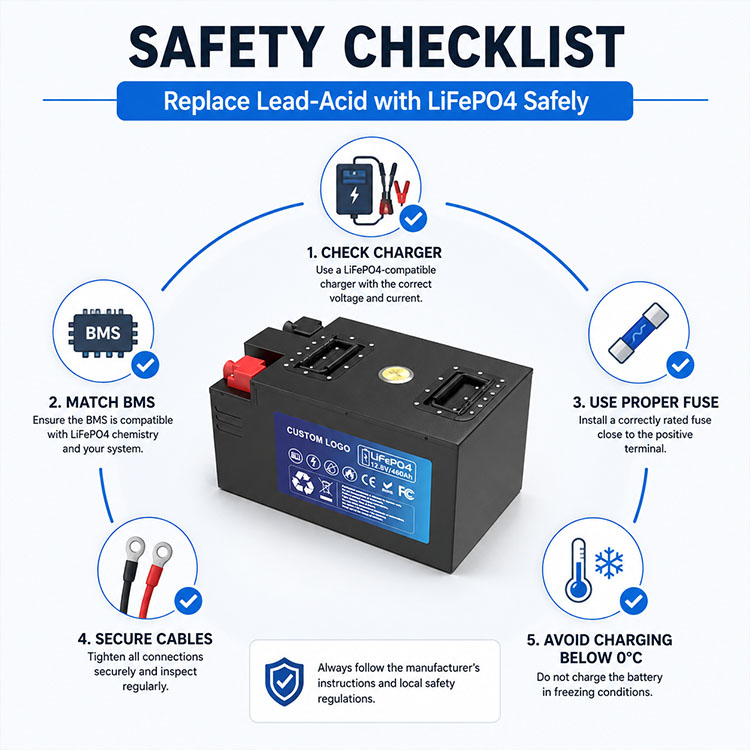
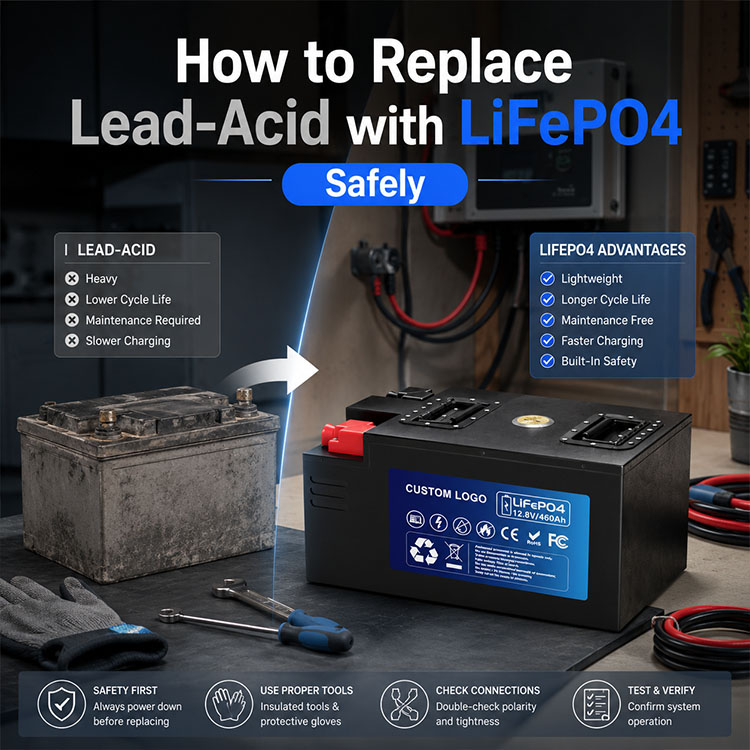
Replacing lead-acid with LiFePO4 is not a casual battery swap. This guide explains what professionals check before a lead acid to lithium battery conversion: voltage, charging profile, BMS rating, alternator protection, fuse sizing, temperature limits, and application-specific risks for RVs, golf carts, solar systems, and marine power.
The Uncomfortable Truth About “Drop-In” Lithium Batteries
Drop-in is marketing.
I’ve seen buyers treat a LiFePO4 battery like a lighter, cleaner, more expensive lead-acid box, slide it into the same tray, connect the same charger, reuse tired cables, and then act shocked when the BMS trips, the alternator gets hot, or the system behaves like it has a ghost in the wiring.
So why does this mistake keep happening?
Because “replace lead acid battery with LiFePO4” sounds simple. In the real world, it is only simple after you verify the charging source, discharge load, cable path, fuse rating, operating temperature, battery management system, and physical installation. Skip those checks and the battery is not the problem. The installation is.
The best LiFePO4 battery replacement is not just a chemistry upgrade. It is a system correction.
If you are replacing old AGM, GEL, flooded lead-acid, or sealed lead-acid batteries in an RV, golf cart, marine setup, UPS cabinet, solar storage box, mobility scooter, or cleaning machine, start with the battery category first. For direct replacement planning, CoreSpark’s lead-acid replacement batteries page is the internal path I would use for buyers comparing voltage platforms and application fit.
Table of Contents
Why LiFePO4 Wins — And Where Installers Still Get Burned
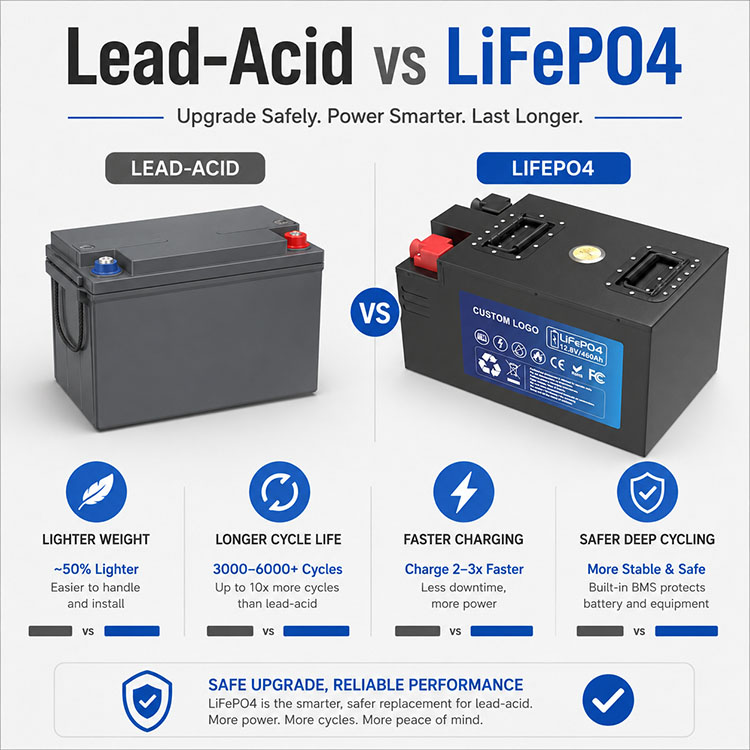
LiFePO4 means lithium iron phosphate. Chemically, it is usually written as LiFePO4 or LFP, using iron phosphate as the cathode material. Compared with older lead-acid batteries, it usually delivers higher usable capacity, lower weight, faster charging, flatter voltage, and longer cycle life.
That sounds great.
But the hard truth is that LiFePO4 is less forgiving of lazy integration. Lead-acid batteries sag, complain, gas, corrode, and die slowly. LiFePO4 batteries hold voltage firmly until the BMS decides enough is enough. That sudden BMS cutoff can confuse inverters, motor controllers, chargers, solar controllers, and low-voltage alarms that were originally designed around the slow decline of lead-acid chemistry.
According to a U.S. Consumer Product Safety Commission High Energy Density Batteries Status Report, staff found more than 25,000 overheating or fire-hazard incidents across more than 400 battery-powered product types in data reviewed from January 2012 to July 2017. That does not mean LiFePO4 is unsafe. It means battery systems punish bad assumptions.
And yes, regulators take battery failures seriously. In January 2025, the CPSC announced that Fitbit agreed to pay a $12.25 million civil penalty after reports of overheating Ionic smartwatches and burn injuries. Different product class, same industry lesson: battery defects, charging behavior, thermal design, and reporting discipline matter.
I do not trust “it should work” in battery installations.
Neither should you.
Lead Acid vs LiFePO4 Battery: The Numbers That Actually Matter
Most buyers compare price first. That is backwards. The first comparison should be usable energy, charging behavior, and system risk.
Factor
Lead-Acid Battery
LiFePO4 Battery
Nominal 12V pack voltage
About 12V
About 12.8V from 4 cells in series
Typical usable depth of discharge
Often limited to around 50% for longer life
Often 80–100%, depending on battery design
Voltage curve
Slopes downward during discharge
Stays flatter, then drops near cutoff
Weight
Heavy
Often 40–70% lighter, depending on model
Charging profile
Bulk, absorption, float common
Lithium profile preferred; float may be reduced or disabled
Maintenance
Flooded types need ventilation and water checks
No watering; BMS protection required
Cold charging
More tolerant, though capacity drops
Do not charge below 0°C unless battery has low-temp protection or heating
Failure behavior
Gradual capacity loss, sulfation, corrosion
BMS cutoff, protection trips, possible charger/inverter mismatch
Here is the part sellers whisper: a 100Ah lead-acid battery is not equal to a 100Ah LiFePO4 battery in real service. If you only use 50Ah from the lead-acid battery to protect its life, but safely use 80Ah to 100Ah from a properly specified LiFePO4 pack, the lithium battery is doing more work even when the label looks the same.
That is why a 12V LiFePO4 battery swap can shrink the bank size in some applications. Not always. But often.
For RV, camper, solar, marine, and backup systems, CoreSpark’s 12V LiFePO4 battery category is the natural internal link because most lead-acid replacement searches begin with 12V platforms before expanding to 24V, 48V, or custom packs.
The Safe Replacement Checklist I Would Use Before Touching a Wrench
1. Confirm the real system voltage
Do not guess.
A “12V system” may be one 12V battery, two 6V golf cart batteries in series, four 12V batteries in a 48V cart, or a battery bank feeding an inverter that has its own low-voltage cutoff. In golf carts, you may see 36V, 48V, 51.2V, 60V, or 72V systems. In RVs, 12V and 24V are common. In industrial equipment, custom voltage is normal.
Before selecting a lithium iron phosphate battery upgrade, measure and document:
Existing battery bank voltage
Series and parallel layout
Charger output voltage
Maximum discharge current
Peak surge current
Cable gauge
Fuse or breaker rating
Available tray size
Terminal orientation
Ventilation and enclosure design
If the project involves a cart fleet, do not pretend a consumer 12V battery is an industrial conversion plan. Start with the application. For cart dealers and fleet operators, CoreSpark’s golf cart battery category is a better fit than a generic 12V listing.
2. Match capacity by usable energy, not label Ah
A common mistake is replacing four tired 100Ah lead-acid batteries with one 100Ah LiFePO4 battery and then blaming lithium when runtime disappoints. Amp-hours are not magic. Watt-hours are the cleaner number.
Use this basic formula:
Watt-hours = Nominal voltage × Amp-hours
A 12.8V 100Ah LiFePO4 battery stores about 1,280Wh. A 12V 100Ah lead-acid battery may store roughly 1,200Wh on paper, but if you only use half of it to preserve cycle life, the usable energy is closer to 600Wh. That is why LiFePO4 often feels stronger in deep-cycle work.
But surge matters too. A microwave, inverter, winch, trolling motor, hydraulic pump, compressor, or cart controller can demand far more current for short bursts than the average load suggests.
Ask the ugly question: can the BMS handle the peak current?
3. Stop using the wrong charger
This is where many “safe LiFePO4 battery installation” guides get soft. I won’t.
A lead-acid charger may work in some cases, but “may work” is not a professional standard. LiFePO4 wants a charging profile that usually reaches about 14.2V–14.6V for a 12.8V pack, avoids aggressive equalization, and does not hold the battery forever at a high float voltage. Some lead-acid chargers have desulfation modes. Those modes are poison for lithium compatibility.
Do not equalize LiFePO4.
Do not use repair mode.
Do not assume an old solar controller understands lithium because it has a battery icon on the screen.
For export, OEM, private-label, or system-integrated battery projects, charger matching is part of the product, not an accessory afterthought. That is why I would point serious buyers to CoreSpark’s OEM/ODM LiFePO4 battery capabilities when the pack, BMS, charger, labels, documentation, and enclosure need to be aligned before shipment.
4. Respect the BMS like it is the real boss
The BMS is not decoration. It is the control layer between a stable battery and an expensive mistake.
A proper battery management system should protect against overcharge, over-discharge, short circuit, overcurrent, high temperature, and low-temperature charging. Better packs may include Bluetooth, CAN, RS485, SOC reporting, balancing logic, or heater control.
But here is the catch: the BMS rating must match the application.
A 100A BMS may be fine for lighting, pumps, fans, and modest inverter use. It may be wrong for a 3,000W inverter surge, golf cart acceleration, hydraulic equipment, or a high-current trolling motor. If the BMS trips under load, the customer sees a “dead battery.” The installer sees the truth: poor specification.
5. Recalculate cable and fuse sizing
Lithium does not sag like lead-acid. It can deliver current hard and fast. That is one reason it performs so well. It is also why undersized wiring, tired lugs, corroded busbars, cheap breakers, and mystery fuses become dangerous.
I’ve opened battery boxes where the new lithium pack was blamed for heat, but the real villain was a cable lug that looked like it had been crimped with garden pliers.
Use properly rated:
Marine-grade or application-rated cable
Correct fuse class for DC interruption
Clean busbars
Tight terminals
Insulated covers
Strain relief
Proper crimping tools
Heat-shrink labels
Battery hold-down brackets
A lithium battery should not be free to bounce, rub, or twist inside a compartment. Vibration destroys good intentions.
6. Protect alternators and legacy charging systems
This matters in RVs, vans, boats, and service vehicles.
LiFePO4 has lower internal resistance than lead-acid. That means it can demand high charging current from an alternator for longer periods. A standard alternator may overheat if it is forced to behave like an industrial battery charger. The usual fix is a DC-DC charger or a properly designed external regulator.
Can you connect it directly and get away with it?
Sometimes.
Is that the standard I would use on a customer vehicle or a product line?
No.
For RV distributors and off-grid builders, CoreSpark’s RV LiFePO4 battery range belongs in the conversation because RV systems often combine shore charging, alternator charging, solar charging, inverter loads, and cold-weather storage in one messy electrical ecosystem.
Real-World Warnings the Lithium Industry Does Not Like to Say Out Loud
Lithium iron phosphate is safer than many lithium-ion chemistries, especially nickel-heavy chemistries, because LFP cathodes are more thermally stable. The Associated Press reported after the 2023 Venice electric bus crash that experts described lithium iron phosphate batteries as less prone to catastrophic fires than some other chemistries because the oxygen-phosphorus bond helps keep oxygen in place during overheating events: AP analysis on LFP battery fire behavior.
That is good news.
It is not a free pass.
In March 2023, CPSC announced a recall of about 7,250 RELiON InSight Series 48V lithium batteries, used in golf carts, low-speed vehicles, AGVs, and UTVs, because the batteries could overheat and pose thermal burn and fire hazards: CPSC RELiON 48V battery recall. That recall is the kind of case professionals should study. Not because all lithium batteries are bad. Because voltage class, BMS design, manufacturing control, and real application loads matter.
Air transport rules tell the same story. The FAA’s PackSafe lithium battery guidance limits most passenger-carried rechargeable lithium-ion batteries to 100Wh, with airline approval needed for certain 101–160Wh spare batteries. Meanwhile, IATA’s 2026 lithium battery guidance document repeatedly references state-of-charge limits around 30% for certain air shipments.
Regulators are not doing that because batteries are harmless.
They are doing it because energy storage is controlled risk.
The Step-by-Step Method to Replace Lead-Acid Battery with LiFePO4
Step 1: Photograph and label the old battery bank
Before disconnecting anything, take photos from multiple angles. Label each cable. Mark series links, parallel links, positive outputs, negative returns, charger leads, inverter leads, solar controller inputs, temperature sensor wires, and accessory taps.
This step feels boring until someone loses track of one small wire that controls a charger, monitor, relay, lift motor, or safety interlock.
Step 2: Remove lead-acid batteries safely
Turn off loads. Disconnect charging sources. Remove the negative connection first, then positive. Use insulated tools. Wear eye protection and gloves, especially around flooded lead-acid batteries. Neutralize acid residue if present. Do not reuse corroded hardware just because it still threads.
Old lead-acid batteries should go to a proper recycling channel. They are heavy, toxic, and recyclable.
Step 3: Clean and inspect the compartment
Look for acid damage, rust, softened insulation, cracked trays, heat discoloration, loose brackets, water paths, and bad ventilation. LiFePO4 does not vent hydrogen under normal use like flooded lead-acid, but the compartment still needs mechanical protection, moisture control, and access for inspection.
If the old tray is sized around Group 24, Group 27, Group 31, GC2, or 8D cases, check the new lithium case dimensions before the battery arrives. “Almost fits” is not a fit.
Step 4: Install the LiFePO4 battery with proper restraints
Place the battery in the correct orientation according to the manufacturer’s instructions. Secure it. Do not crush the case. Do not rely on cable tension to hold anything in place. Avoid mounting near exhaust pipes, engine heat, sharp brackets, fuel lines, or standing water.
For mobile systems, vibration resistance matters as much as chemistry.
Step 5: Connect with correct polarity and torque
Connect positive first, then negative. Use the manufacturer’s torque specification. Loose terminals cause heat. Over-tightened terminals can damage posts or internal connections. Add terminal covers where possible.
If installing multiple LiFePO4 batteries in parallel, use same-brand, same-model, same-age batteries when possible. Match cable lengths. Balance the layout. Do not mix lithium and lead-acid batteries in the same bank unless a qualified system design specifically supports it.
Step 6: Program the charger, solar controller, inverter, and monitor
Set the system for lithium parameters. Typical values vary by battery model, but the broad targets for a 12.8V LiFePO4 battery often include:
Bulk/absorption: around 14.2V–14.6V
Float: often disabled or set lower, around 13.4V–13.6V if required
Equalization: off
Temperature compensation: off unless manufacturer says otherwise
Low-voltage cutoff: matched to BMS and load requirements
Battery monitor: reset for lithium capacity and charge efficiency
Read the battery manual. I know, nobody wants to. Read it anyway.
Step 7: Test under real load
Do not declare victory after seeing 13.3V on a meter.
Run the actual loads: inverter, pump, motor, lights, compressor, cart controller, heater fan, or solar charging input. Watch current, voltage, cable temperature, charger behavior, and BMS app data if available. Test charging and discharging. Confirm no breaker nuisance trips. Confirm the charger stops correctly.
A safe installation is proven under load, not admired in a photo.
Cold Weather Is Where Cheap Installs Expose Themselves
LiFePO4 batteries should generally not be charged below 0°C unless the battery has low-temperature charge protection, a self-heating function, or an external thermal management plan. Discharging in cold weather is usually more tolerant, but charging below freezing can cause lithium plating inside the cell. That damage may not announce itself immediately. It may simply shorten life and raise risk later.
So if the battery will live in a winter RV, boat, cabin, outdoor solar cabinet, utility cart, or warehouse vehicle, ask this before purchase:
Does the BMS block low-temperature charging?
Is there internal heating?
What current does the heater draw?
Can the charger detect temperature?
Where is the temperature sensor located?
Is the enclosure insulated?
What is the lowest storage temperature?
Will the battery be charged by solar while unattended in freezing weather?
A battery that is safe in Arizona may be wrong for Alberta.
The Professional Buyer’s Spec Sheet
If you are sourcing batteries for resale, OEM installation, fleet retrofit, or private-label distribution, do not buy from photos. Buy from specifications.
Specification
Why It Matters
Chemistry
Confirms LiFePO4/LFP rather than vague “lithium”
Nominal voltage
Must match the system: 12.8V, 25.6V, 48V, 51.2V, etc.
Rated capacity
Determines stored energy and runtime
Continuous discharge current
Must exceed normal load
Peak discharge current
Must support motor/inverter surge
Charge current limit
Protects cells and BMS
Low-temp charge protection
Needed for cold climates
BMS functions
Defines safety behavior
Communication
Bluetooth, CAN, RS485, LCD, or none
Cycle-life rating
Must state test conditions, not just a big number
Certifications/documents
UN38.3, MSDS/SDS, IEC/UL-related documents where applicable
Case size and terminal type
Determines true drop-in fit
Charger recommendation
Prevents warranty fights
Warranty terms
Reveals how much confidence the supplier really has
For bulk buyers, I would also request sample validation before mass orders. CoreSpark’s LiFePO4 battery case studies page fits naturally here because serious B2B projects need application review, sample testing, BMS selection, charger matching, labeling, packaging, and repeat-order consistency.
The Installation Mistakes I Would Call Out in a Factory Audit
Some mistakes are so common they deserve names.
The “Same Charger Forever” Mistake
The installer keeps a flooded lead-acid charger with equalization mode and hopes the lithium battery will tolerate it. Maybe it does for a while. Maybe the BMS keeps blocking charge. Maybe the customer gets poor capacity and blames the cell factory.
The “Bigger Ah Fixes Everything” Mistake
The buyer adds capacity but ignores discharge current. A 300Ah pack with an undersized BMS can still fail in a high-surge application.
The “Parallel Chaos” Mistake
Different batteries, different ages, different cable lengths, same bank. This is not engineering. It is gambling with busbars.
The “No Fuse Near the Battery” Mistake
A short circuit does not care how clean your installation looks. Every positive battery output should be protected according to system design and cable ampacity.
The “Cold Solar Charge” Mistake
A solar controller wakes up at dawn and charges a frozen lithium pack because nobody planned low-temperature protection. Quiet damage. Expensive lesson.
FAQs
Can I replace lead acid battery with LiFePO4?
Yes, you can replace a lead-acid battery with LiFePO4 when voltage, charger profile, BMS current rating, cable size, fuse protection, physical dimensions, and temperature limits are all compatible with the original system. The replacement is safe only when the lithium battery is treated as part of a full electrical system, not just a box swap.
For a 12V lead-acid battery, the usual replacement is a 12.8V LiFePO4 battery with four cells in series. For 24V systems, use a 25.6V LiFePO4 pack. For 48V carts and equipment, 48V or 51.2V lithium platforms are common, but controller and charger compatibility must be checked first.
Do I need a special charger for LiFePO4 battery replacement?
A LiFePO4 battery replacement usually needs a lithium-compatible charger that uses the correct bulk/absorption voltage, avoids equalization, and does not hold the battery at an aggressive lead-acid float setting. Some lead-acid chargers may work temporarily, but a matched lithium charger is the safer professional choice.
For a 12.8V LiFePO4 battery, many manufacturers specify charging around 14.2V–14.6V. The exact value depends on the battery model. If your old charger has desulfation, repair, pulse, or equalization modes, do not use those settings on LiFePO4.
Is LiFePO4 safer than lead-acid?
LiFePO4 is generally safer in daily deep-cycle use because it does not spill acid, does not require watering, produces no hydrogen gas under normal operation like flooded lead-acid, and uses a thermally stable iron phosphate cathode. However, it still requires correct charging, BMS protection, wiring, fusing, and temperature control.
The mistake is thinking “safer chemistry” means “no risk.” Poor installation can still overheat cables, trip the BMS, damage cells, or create fire hazards around accessories. Chemistry helps, but system design wins.
Can I use LiFePO4 in an RV or off-grid solar system?
Yes, LiFePO4 is well suited for RV and off-grid solar systems because it offers high usable capacity, low weight, fast charging, long cycle life, and stable voltage under load. The safe installation must include lithium-compatible solar controller settings, inverter compatibility, proper fusing, and cold-temperature charge protection.
RV systems are tricky because they may charge from shore power, alternator, solar, generator, and DC-DC chargers. Each charging source must be checked. The battery does not know where the current came from. It only knows whether the voltage, current, and temperature are acceptable.
What happens if I charge LiFePO4 below freezing?
Charging LiFePO4 below 0°C can cause lithium plating inside the cells unless the battery includes low-temperature charge protection or an approved heating system. This internal damage may reduce capacity, shorten cycle life, and increase long-term safety risk even if the battery appears to work normally afterward.
Cold-weather users should buy batteries with low-temp cutoff or self-heating functions. Solar systems are especially risky because charging may begin automatically in the morning while the battery compartment is still frozen.
Can I mix lead-acid and LiFePO4 batteries?
You should not mix lead-acid and LiFePO4 batteries in the same battery bank unless the system is specifically engineered for separate charging and isolation. The two chemistries have different voltage curves, charging behavior, internal resistance, and protection needs, which can cause imbalance and poor performance.
A proper hybrid system may use DC-DC charging, battery isolators, or separate banks. Randomly paralleling lithium and lead-acid batteries because the terminals fit is not a safe conversion strategy.
Final Thoughts: Replace the System, Not Just the Battery
If you want to replace lead acid battery with LiFePO4 safely, stop thinking like a shopper and start thinking like an installer. The battery chemistry is only one part of the job. The real work is checking voltage, capacity, current, charger behavior, BMS limits, cable protection, cold-temperature exposure, and application load.
Here is my blunt recommendation: before you buy or specify a LiFePO4 battery replacement, write down your application, system voltage, existing battery layout, charger model, maximum load, installation space, operating temperature, and quantity requirement. Then match the battery to the system instead of forcing the system to tolerate the battery.
For distributors, RV builders, golf cart dealers, solar integrators, and OEM buyers, send those details through CoreSpark’s custom LiFePO4 battery quote channel and ask for charger matching, BMS review, and model-level documentation before you approve samples or bulk orders. A safe lithium upgrade starts before the invoice.
Newsletter Updates
Enter your email address below and subscribe to our newsletter
BYingPower provides OEM, wholesale, and custom LiFePO4 battery packs for golf carts, RVs, forklifts, solar storage, marine power, and lead-acid replacement applications. We support battery brands, distributors, dealers, system integrators, and OEM buyers with reliable lithium battery solutions, smart BMS options, private-label services, and export documentation support.