Send us your application, voltage, capacity, battery size, quantity, and branding needs. BYingPower will review your project and recommend the right LiFePO4 battery solution for golf carts, RVs, marine systems, solar storage, forklifts, or lead-acid replacement.
Custom battery pack review for your application
OEM/ODM and private-label battery guidance
BMS, charger, terminals, heating, and packaging support
Faster quote path for samples and bulk orders
4th Floor, Building A, No. 2, Longjiang 2nd Road, Xie Keng, Qingxi Town, Dongguan Province,China.
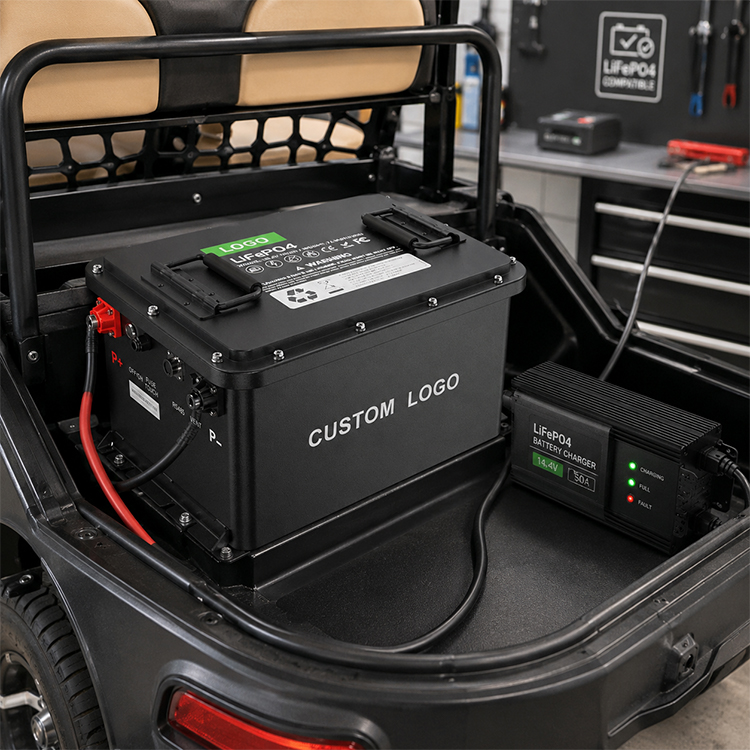
LiFePO4 Charger Compatibility for Replacement Markets
Replacement markets love the phrase “drop-in lithium.” I don’t. A LiFePO4 battery may fit the tray, but the wrong charger profile can ruin performance, trigger BMS cutoffs, create warranty fights, and damage dealer trust.
The Dirty Secret Behind “Drop-In” Lithium Replacements
Specs lie sometimes.
I’ve watched battery replacement projects go sideways not because the LiFePO4 battery was bad, not because the cells were fake, and not because the dealer misread capacity, but because everyone treated the charger as an accessory instead of a control point in the entire power system. What did they expect?
The replacement market has a habit of selling comfort words: “drop-in,” “maintenance-free,” “lead-acid replacement,” “smart BMS,” “plug and play.” Fine. Those phrases move inventory. But the LiFePO4 charger is where the physics gets blunt.
A lithium iron phosphate battery is not a sealed lead-acid battery with better marketing. It uses LiFePO4 chemistry, a flatter discharge curve, a different charging voltage window, and a BMS that may shut down when the charger behaves like it is still talking to flooded lead-acid. That matters in golf carts, RV power systems, marine trolling motors, forklifts, mobility scooters, solar storage, and any aftermarket battery channel where installers are replacing old lead-acid packs under time pressure.
CoreSpark’s own product structure tells the same story. The site separates 12V LiFePO4 Battery, Golf Cart Battery, RV LiFePO4 Battery, and Lead Acid Replacement Batteries because the replacement buyer is not buying a cell chemistry in isolation. They are buying a voltage platform, a runtime promise, a charger expectation, and a warranty risk.
And here is my hard opinion: any supplier who sells LiFePO4 replacement batteries without asking about the existing charger is not doing technical sales. They are gambling with your after-sales department.
Table of Contents
Why Charger Compatibility Is Not a Minor Detail
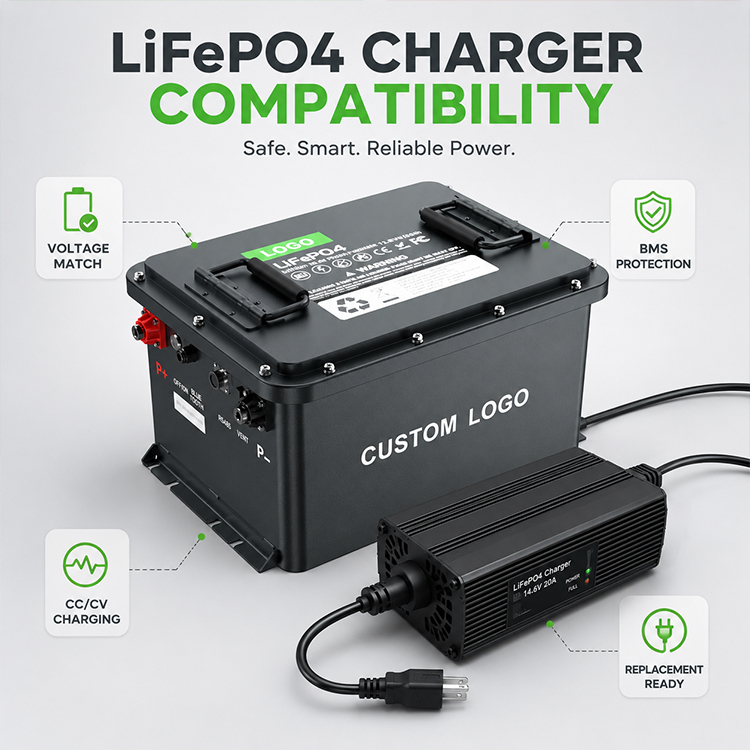
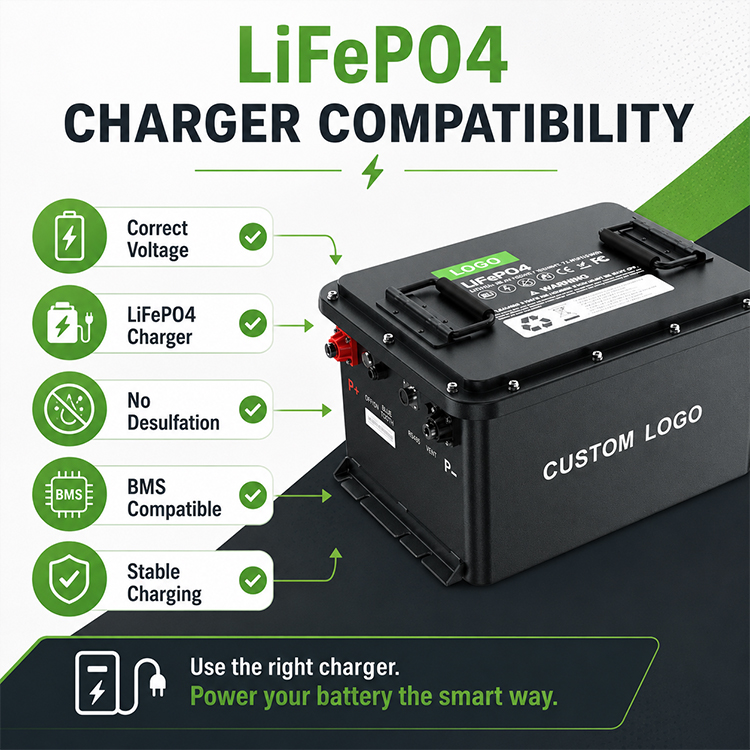
A compatible LiFePO4 charger must match the battery’s nominal voltage, charge voltage, current limit, communication needs, temperature behavior, connector, and BMS protection logic. Miss one of those, and the battery may still “work” on day one while quietly creating warranty noise by month six.
The U.S. Consumer Product Safety Commission made the charger issue painfully public in 2024 when it warned consumers not to buy or use certain “universal” chargers for micromobility products. The agency said that from January 1, 2023 to May 16, 2024, it received 156 reports of fire and thermal incidents involving universal chargers, including injuries and property damage; the warning is blunt that a charger may physically fit and still be electrically incompatible. See the CPSC universal charger fire warning.
That report is about micromobility, not every RV or golf cart battery. Still, the principle transfers: connector fit is not compatibility. Voltage profile is compatibility. Battery approval is compatibility. Thermal behavior is compatibility.
The National Fire Protection Association gives the consumer-facing version of the same warning: use the charger supplied with the product or approved by the manufacturer. Its lithium-ion battery safety guidance is not written for battery engineers, but I would rather see dealers follow boring safety advice than explain a melted harness to a fleet buyer.
For B2B replacement markets, the better question is not “Can the old charger turn on?” The question is: will that charger terminate properly, avoid equalization mode, avoid desulfation pulses, stay inside BMS limits, and charge the pack repeatedly without nuisance shutdown?
The Voltage Numbers Dealers Should Memorize
LiFePO4 charging voltage is predictable, which is good news. The bad news is that too many replacement channels still speak in lazy nominal-voltage language. “12V battery” is not enough. A 12V LiFePO4 charger normally charges a 4-series LiFePO4 pack at about 14.6V. A 24V pack is usually around 29.2V. A 48V or 51.2V LiFePO4 golf cart battery commonly wants around 58.4V.
Small mismatch. Big consequences.
Replacement Platform
Typical LiFePO4 Pack Structure
Common LiFePO4 Charger Voltage
Where It Shows Up
Compatibility Risk
12V LiFePO4 battery
4S, 12.8V nominal
14.4V–14.6V
RV, marine, solar, UPS, camper systems
Lead-acid float or desulfation mode may confuse the BMS
24V LiFePO4 battery
8S, 25.6V nominal
28.8V–29.2V
trolling motors, small solar systems, mobility equipment
Existing SLA charger may undercharge or pulse incorrectly
36V LiFePO4 golf cart battery
often 12S, 38.4V nominal
about 43.8V
Club Car, EZGO, utility carts
Old golf cart charger may rely on lead-acid voltage rise logic
48V / 51.2V LiFePO4 battery
16S, 51.2V nominal
about 58.4V
golf carts, floor machines, low-speed vehicles
Connector match can hide wrong charge curve
72V / 76.8V LiFePO4 battery
24S, 76.8V nominal
about 87.6V
higher-power carts, industrial mobility
Higher voltage increases the cost of mistakes
The best charger for LiFePO4 battery replacement programs is not always the most expensive one. It is the one with the right CC/CV profile, the right output voltage, the right current, the right connector, the right enclosure rating, and—when the application needs it—the right CAN, RS485, or Bluetooth integration.
That is why CoreSpark’s OEM/ODM capabilities page matters in this topic. Charger matching, BMS selection, terminals, casing, display units, and communication options should be part of the same engineering conversation, not separate email threads after the first sample fails.
Can You Use a Lead-Acid Charger for LiFePO4? The Answer Nobody Likes
Sometimes, yes. Often, no.
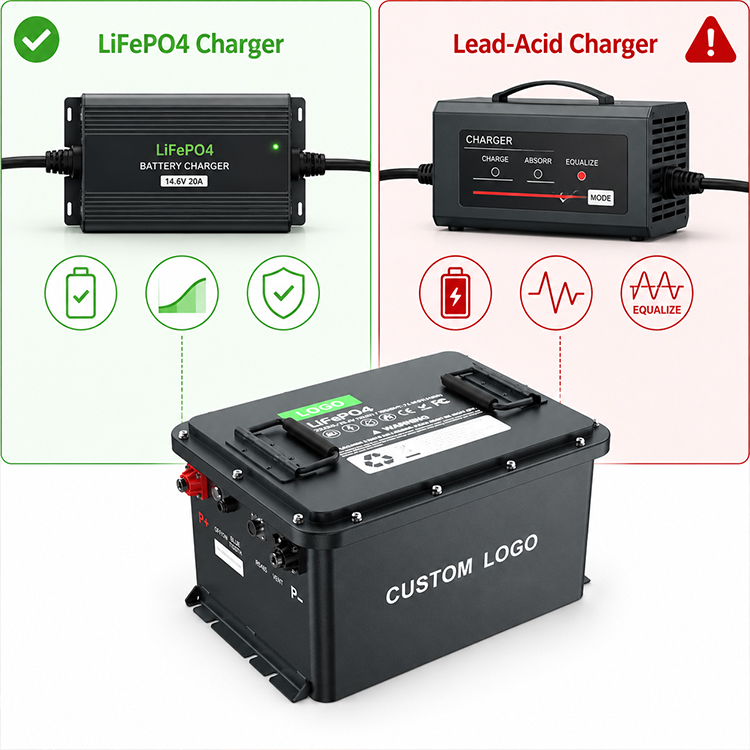
A lead-acid charger may charge a LiFePO4 battery if the voltage range is suitable, there is no equalization mode, there is no high-voltage desulfation pulse, the current stays within battery limits, and the charger terminates cleanly. But I would not build a serious replacement-market program on “may.”
Why? Because replacement markets are messy. A distributor may sell into five installer networks. One golf cart dealer may see chargers from Delta-Q, Lester, DPI, OEM-branded units, no-name imports, and 15-year-old shop chargers with cracked labels. An RV owner may have a converter-charger set for flooded lead-acid. A marine customer may use a multi-bank charger with AGM settings. A forklift customer may run opportunity charging during shifts.
But the battery is blamed.
This is where the aftermarket battery charger conversation becomes commercial, not just technical. If the customer keeps the wrong charger and the LiFePO4 pack undercharges, they complain about runtime. If the charger trips the BMS, they complain about reliability. If the charger uses a repair pulse, the supplier gets a warranty claim that should have been prevented in the sales process.
For Lead Acid Replacement Batteries, the real selling point is not just longer cycle life. It is controlled migration: battery, BMS, charger, mounting, wiring, and documentation moving together.
The Replacement Markets Where Charger Mistakes Hurt Most
Golf carts and low-speed vehicles
Golf cart replacement is the danger zone because buyers expect a clean swap. They remove six or eight lead-acid batteries, install one or more LiFePO4 packs, and expect the dashboard, charger port, range meter, and onboard charger to behave like nothing changed.
It rarely works that neatly without planning.
For golf carts, the LiFePO4 replacement battery charger has to match system voltage: 36V, 48V, 51.2V, 60V, 72V, or 76.8V. It also has to handle the cart’s connector type, onboard versus offboard design, enclosure exposure, charge current, and sometimes communication. CoreSpark’s Golf Cart Battery range shows the voltage spread clearly, including 25.6V, 48V, 51.2V, and 76.8V categories.
My unpopular view: golf cart dealers should stop treating chargers as a line-item discount. A cheap wrong charger can erase the margin on an entire lithium upgrade kit.
RV, camper, and marine systems
RV and marine replacement markets are quieter, but not simpler. A 12V LiFePO4 charger may be a wall charger, onboard converter, solar charge controller, DC-DC charger, alternator charging module, or inverter-charger. That means “charger compatibility” is really five compatibility checks hiding under one phrase.
For RV and off-grid buyers, the charger should support LiFePO4 charging voltage, avoid long float behavior where unnecessary, and respect low-temperature charging protection. A LiFePO4 battery with low-temperature cutoff may refuse charging below 0°C unless it has heating support. That is not a defect. That is the BMS doing its job.
CoreSpark’s RV LiFePO4 Battery category fits this discussion because RV buyers often combine 12V 100Ah, 12V 200Ah, 12V 300Ah, 460Ah, or larger battery banks with solar and shore-power chargers.
Industrial and export replacement programs
Forklift, cleaning equipment, warehouse vehicles, and OEM replacement programs are less forgiving. They involve repeat orders, fleet downtime, export paperwork, and stricter buyer audits.
The IATA 2026 lithium battery guidance states that lithium cell and battery types must pass applicable UN Manual of Tests and Criteria Subsection 38.3 tests to be permitted in transport, and it also details test-summary availability requirements for manufacturers and distributors.
That is not a charger profile document. But it is a reminder that replacement markets are supply-chain markets. A battery pack that ships globally, sells through distributors, and lands in industrial equipment needs documentation discipline. Charger compatibility belongs in that same discipline.
The Compatibility Checklist I Would Put in Every Dealer Packet
Do not ask only for amp-hours. Ask for the whole charging environment.
A professional LiFePO4 charger compatibility check should include these items before quotation, especially for wholesale, dealer, and OEM replacement programs:
Existing battery type: flooded lead-acid, AGM, gel, SLA, or lithium.
Replacement pack voltage: 12.8V, 25.6V, 38.4V, 51.2V, 76.8V, or custom.
Required charge voltage: 14.6V, 29.2V, 43.8V, 58.4V, 87.6V, or project-specific.
This is exactly where buyers should use CoreSpark’s Contact Us process instead of guessing from a picture. Send voltage, capacity, equipment model, old charger label, connector photos, quantity, and target market. Boring? Yes. Profitable? Also yes.
Replacement-Market Economics: The Charger Is a Margin Protector
I’ll say the quiet part: many lithium replacement sellers underprice the charger discussion because they want the battery order.
That is short-term thinking. In replacement markets, the charger protects margin in three ways.
First, it reduces false warranty claims. A battery that never reaches full charge because the old lead-acid charger terminates early will look like a weak battery to the end user.
Second, it reduces installer callbacks. A charger that trips BMS protection creates the impression that lithium is unreliable, even when the pack is correctly protecting itself.
Third, it supports premium positioning. A distributor selling a matched LiFePO4 charger, battery, BMS, display, and cable kit is not competing with random online battery listings. They are selling a replacement system.
For battery brands, distributors, dealers, and OEM buyers, this matters more than squeezing another two dollars from the charger BOM. The replacement market rewards systems that install cleanly and punish suppliers who hide behind vague compatibility claims.
FAQs
What is LiFePO4 charger compatibility?
LiFePO4 charger compatibility means the charger’s voltage, current, charging curve, connector, temperature behavior, and BMS interaction are approved for the specific lithium iron phosphate battery pack being used, so the battery can charge fully without over-voltage, undercharge, nuisance cutoff, overheating, or warranty-damaging stress.
In practical terms, a 12V LiFePO4 charger usually needs a lithium-specific CC/CV profile around 14.4V–14.6V. Larger systems scale from there: 24V around 29.2V and 48V/51.2V around 58.4V.
Can I use a lead acid charger for LiFePO4?
A lead-acid charger can sometimes charge a LiFePO4 battery if its voltage is within the lithium pack’s approved range, it has no equalization or desulfation pulse, and its current and termination behavior stay inside the BMS limits, but it should not be assumed compatible without supplier confirmation.
The risky features are repair mode, high-voltage equalization, long float behavior, and chargers that depend on lead-acid voltage response. For commercial replacement markets, I recommend selling a matched LiFePO4 charger whenever possible.
What voltage should a 12V LiFePO4 charger use?
A 12V LiFePO4 charger normally uses a charging voltage of about 14.4V to 14.6V for a 4-series lithium iron phosphate pack with 12.8V nominal voltage, using a constant-current and constant-voltage profile rather than a flooded lead-acid charging algorithm.
Some battery manufacturers specify slightly different limits depending on cell design, BMS settings, temperature protection, and cycle-life targets. Always follow the battery supplier’s datasheet before applying a generic charger.
Why does charger compatibility matter in lead-acid replacement markets?
Charger compatibility matters in lead-acid replacement markets because the battery tray, nominal voltage, and connector may match while the old charger profile remains wrong for LiFePO4 chemistry, causing undercharging, BMS shutdown, shortened service life, customer complaints, or rejected warranty claims.
That is why replacement programs should treat the LiFePO4 charger as part of the kit. The pack, charger, BMS, cables, terminals, display, and manual should be checked together.
What is the best charger for LiFePO4 battery replacement projects?
The best charger for LiFePO4 battery replacement projects is a manufacturer-approved lithium iron phosphate charger that matches pack voltage, charge current, connector type, environmental rating, BMS protection limits, and communication requirements for the specific application, whether it is RV, marine, golf cart, forklift, solar, or mobility equipment.
“Best” does not mean universal. For B2B buyers, the best charger is the one that reduces installer mistakes, warranty disputes, and repeat-order instability.
Your Next Steps: Stop Selling Batteries Without the Charging Story
If you are building a replacement battery program, do not start with the price sheet. Start with the charger.
Send the battery voltage, old charger model, connector photos, equipment type, target country, capacity target, and expected order volume to CoreSpark before locking the battery specification. For replacement markets, a matched LiFePO4 charger is not an upsell. It is insurance against bad installs, angry dealers, and warranty claims that should never have existed.
For bulk programs, private-label battery lines, golf cart conversions, RV battery distribution, or lead-acid replacement projects, request a charger-and-BMS compatibility review through CoreSpark Battery’s contact page and make the charging profile part of the quotation—not an afterthought.
Newsletter Updates
Enter your email address below and subscribe to our newsletter
BYingPower provides OEM, wholesale, and custom LiFePO4 battery packs for golf carts, RVs, forklifts, solar storage, marine power, and lead-acid replacement applications. We support battery brands, distributors, dealers, system integrators, and OEM buyers with reliable lithium battery solutions, smart BMS options, private-label services, and export documentation support.