Send us your application, voltage, capacity, battery size, quantity, and branding needs. BYingPower will review your project and recommend the right LiFePO4 battery solution for golf carts, RVs, marine systems, solar storage, forklifts, or lead-acid replacement.
Custom battery pack review for your application
OEM/ODM and private-label battery guidance
BMS, charger, terminals, heating, and packaging support
Faster quote path for samples and bulk orders
4th Floor, Building A, No. 2, Longjiang 2nd Road, Xie Keng, Qingxi Town, Dongguan Province,China.
A Golf Cart BMS is not a mystery box. When a lithium golf cart battery shuts off, the pack is usually protecting itself from bad sizing, voltage sag, charger mismatch, temperature limits, or controller surge. Here is the blunt diagnostic guide most sales pages avoid.
The Dirty Secret Behind “Dead” Lithium Golf Cart Batteries
Most Golf Cart BMS complaints start with one sentence: “The battery just shut off.”
It didn’t.
The battery made a decision faster than the driver, the charger, the dealer, and sometimes the installer could understand. A lithium golf cart battery BMS is not a passive fuse. It watches voltage, current, temperature, cell balance, charge behavior, and short-circuit risk. When one of those values crosses the programmed line, it cuts output. Hard. No apology.
I’ll say the unpopular part first: many golf cart BMS cut off problems are not battery failures. They are specification failures sold as battery failures because nobody wants to admit the pack was undersized, the controller was too aggressive, the charger was wrong, or the old lead-acid wiring was treated like it was still “good enough.”
That myth costs money.
When we talk about a LiFePO4 golf cart battery platform, especially in 48V, 51.2V, 72V, or 76.8V systems, we are not talking about a dumb energy box. We are talking about a managed electrical system. The BMS is the bouncer at the door. If the motor controller asks for too much current, it throws the load out. If one cell group dips below limit, it shuts the party down. If the charger behaves like a 1998 lead-acid dinosaur, the BMS may refuse charge.
And then someone blames “lithium.”
Table of Contents
Why the Golf Cart BMS Cuts Off: The Failure Map Nobody Prints on the Box
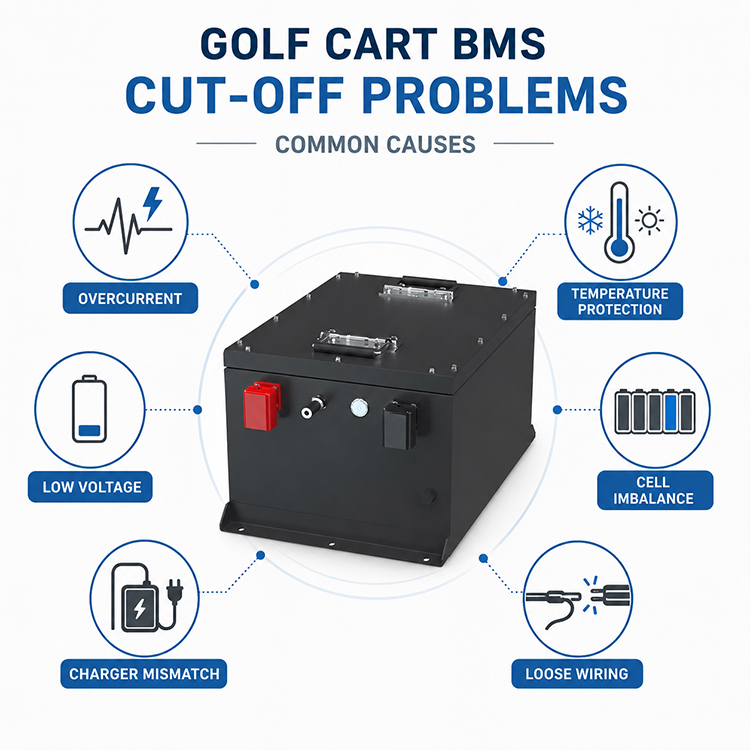
A Golf Cart BMS cut-off is a protective shutdown triggered when the battery management system detects a condition that could damage cells, wiring, electronics, or the entire LiFePO4 battery pack. In practical terms, it is the battery saying: current is too high, voltage is too low, charging is unsafe, temperature is outside limits, or the system design is wrong.
Here is the field map I would use before touching a replacement pack, warranty form, or controller setting.
Symptom
Likely BMS Trigger
What It Usually Means
Field Test
Practical Solution
Cart shuts off during acceleration or hill climbing
Overcurrent protection
Motor controller surge exceeds BMS discharge limit
Check peak current with clamp meter or BMS app
Use higher-current BMS, reduce controller current, check cable resistance
Cart dies near low SOC but voltage looks “okay” after rest
Cell under-voltage
One weak or imbalanced cell group sags under load
Compare cell group voltage under load
Full balance charge, inspect cell group health, avoid deep discharge
Battery will not charge in cold weather
Low-temperature charge protection
BMS blocks charging below safe threshold, often near 0°C / 32°F
Read BMS temperature data
Warm pack, use heated battery, verify charger temp sensor logic
Charger starts then stops
Over-voltage or charger mismatch
Lead-acid charger, equalization pulse, or high voltage cutoff conflict
Measure charger output at battery terminals
Use LiFePO4 charger matched to pack voltage
Random shutdown after rain or washing
Short-circuit, leakage, connector corrosion
Moisture path, bad connector, poor enclosure seal
Inspect harness, terminals, enclosure, BMS plug
Dry system, replace corroded parts, improve IP protection
Bluetooth app shows SOC jumping
SOC calibration drift
Shunt estimate is wrong or pack was not fully charged
Compare pack voltage, Ah counter, cell balance
Full charge cycle, app reset, BMS recalibration
48V cart feels weak after lithium upgrade
Voltage platform mismatch
15S/48V and 16S/51.2V assumptions got mixed
Confirm nominal and charge voltage
Match controller, charger, display, and pack voltage
Here is where dealers get trapped: a “48V golf cart battery” can mean different things depending on chemistry and cell count. A 16S LiFePO4 pack is commonly called 51.2V nominal because each LFP cell is about 3.2V nominal. A 15S LFP pack sits closer to 48V nominal. A legacy lead-acid 48V cart was never designed around the same voltage curve, current delivery, or BMS trip behavior.
That is why the 48V vs 51.2V golf cart battery decision is not a marketing debate. It is a controller, charger, SOC display, torque curve, and warranty debate.
The BMS Is Not the Villain. Your Load Profile Might Be.
I don’t trust “continuous current” numbers until I see the surge behavior.
A 48V golf cart battery BMS might be rated at 100A continuous, 200A peak for a few seconds, or 300A peak under manufacturer-defined conditions. Fine. But a lifted cart with big tires, steep terrain, two adults, a cargo load, soft sand, and an aggressive AC motor controller can ask for current in sharp bursts. The pack may be technically healthy and still shut off.
That is not magic. It is math.
A 5kW load on a 51.2V pack draws roughly 98A before losses. A 10kW acceleration spike draws roughly 195A before cable loss, controller loss, and temperature effects. Add a tired cable lug, an undersized fuse holder, or a cheap breaker, and the BMS sees stress the sales sheet never modeled.
So ask the question nobody asks early enough: is this battery sized for the cart’s peak current, not just its amp-hour rating?
If you are sourcing for a dealer program, fleet retrofit, or private-label cart battery line, the safer path is to treat the BMS, charger, display, enclosure, and communication protocol as one system. CoreSpark’s custom BMS and charger matching support is the kind of page I would put in front of a buyer before they order 200 packs and inherit 200 angry phone calls.
Real-World Battery Safety Data: Why Cut-Offs Exist for a Reason
Some people want the BMS to “stop being sensitive.”
I hate that advice.
A nuisance trip is annoying. A battery that refuses to protect itself is worse. Regulators have been saying the quiet part out loud for years: lithium battery failures are system failures, not just cell failures. The CPSC’s 2017–2024 micromobility report counted 533 reported fatalities across micromobility products, with 310 e-bike fatalities and 19 e-bike fatalities tied to 13 lithium-ion battery fire incidents. Different vehicle class, same lesson: charge control, pack quality, and protection electronics matter.
The charger problem is even uglier. In September 2024, CPSC warned against certain “universal” e-bike chargers after 47 fire reports and more than $100,000 in damage, and it said it had received 156 reports of fire and thermal incidents involving universal micromobility chargers in the first four and a half months of 2024 alone, according to CPSC Commissioner Richard Trumka’s charger warning.
Now move that mindset into golf carts. A charger mismatch on a 48V or 51.2V LiFePO4 golf cart battery is not a small accessory mistake. It can trigger over-voltage protection, failed charge initiation, false full-charge behavior, or repeated BMS lockout.
The NTSB has also documented why lithium battery events are treated differently from ordinary electrical faults. Its Safety Risks to Emergency Responders from Lithium-Ion Battery Fires in Electric Vehicles report describes thermal runaway, reignition risk, stranded energy, and the now-famous 2011 Chevrolet Volt case where a vehicle caught fire three weeks after a crash test. That is not golf cart content, no. But it is battery-system content, and professional buyers should pay attention.
Then there is the legal pressure. New York City’s Local Law 39 pushed micromobility devices and batteries toward accredited lab certification, and in 2024 the city announced stronger enforcement powers against repeat sellers of uncertified batteries, including penalties up to $2,000 per device type and authority to close repeat-violating retailers, as explained in the city’s uncertified battery enforcement announcement.
Want the standard behind much of this discussion? UL 2271 covers batteries for light electric vehicle applications, including electrical energy storage assemblies used in LEVs. For golf cart battery buyers, that standard matters because the market is moving away from “trust me” battery claims and toward documented pack-level safety behavior.
The 48V Golf Cart Battery BMS Problem: Current, Voltage, and Bad Assumptions
The phrase “48V golf cart battery BMS” looks simple in search data. In the shop, it is messy.
A lead-acid 48V cart may use six 8V batteries or four 12V batteries. The voltage drops gradually under load. The driver feels the cart getting weak. The controller may tolerate sag because the old battery bank behaves like a tired sponge.
LiFePO4 does not act like that. It holds voltage flatter, delivers current harder, and then the BMS may cut off fast when a limit is crossed. That can make a lithium golf cart battery shut off “without warning,” even though the warning existed inside the BMS data the whole time.
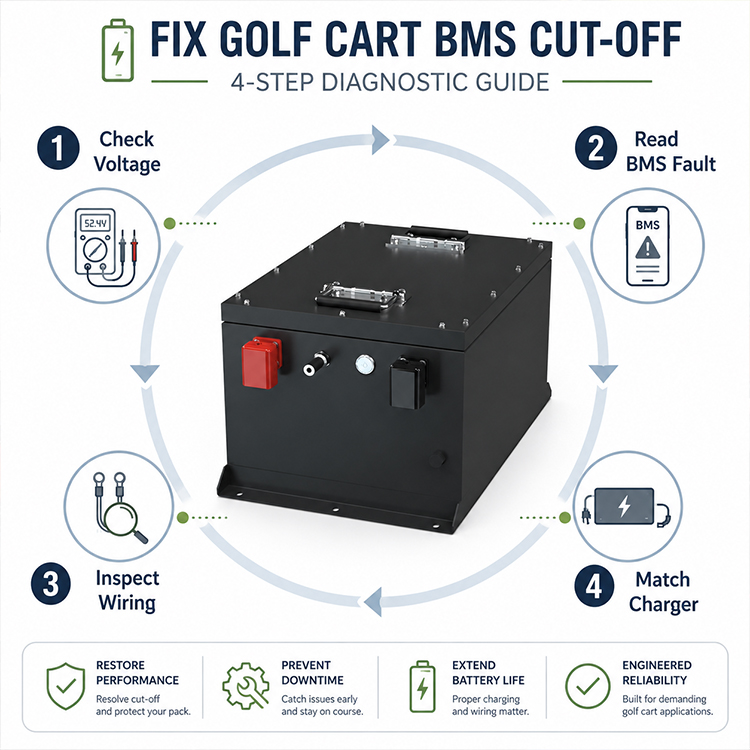
Here is my blunt diagnostic order:
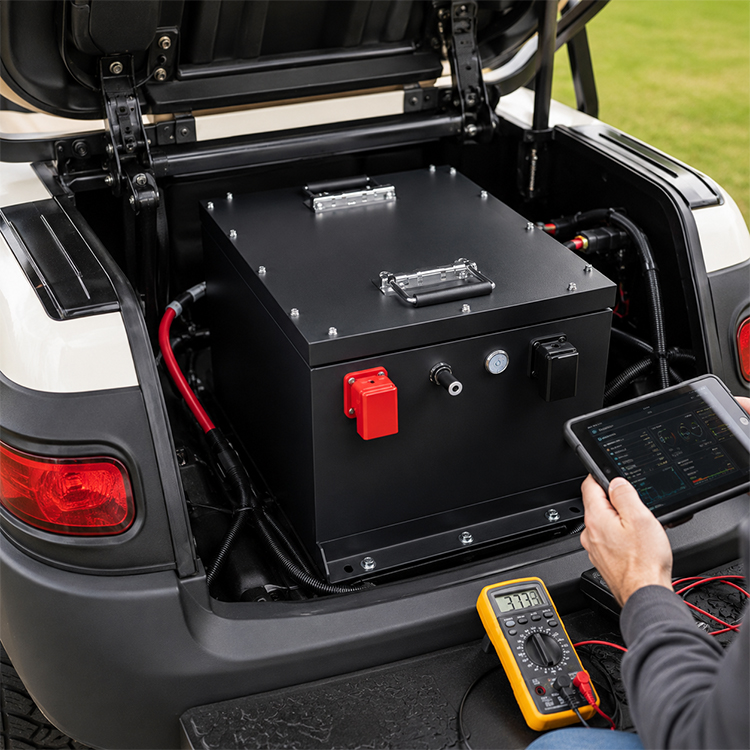
Check Pack Voltage Before You Chase Ghosts
A full 16S LiFePO4 pack may charge around 58.4V depending on manufacturer settings. A 15S LiFePO4 pack will use different charge limits. A lead-acid charger profile may overshoot, hold float incorrectly, or run an equalization mode that lithium does not want.
Do not guess.
If the cart is using a CoreSpark-style 48V golf cart battery category, confirm the exact model voltage, cell series count, BMS limit, charge voltage, and communication options before pairing it with an existing charger.
Compare Continuous Current Against Real Terrain
Flat pavement is not a test. A hill with a passenger load is a test. Grass is a test. Sand is a test. A lifted cart with oversized tires is a warranty argument waiting to happen.
If the BMS cuts under acceleration, look for:
Controller peak current above BMS rating
Weak cable crimps causing voltage drop
Battery SOC too low for hard discharge
Cell imbalance causing one group to collapse early
Motor brake or regen event pushing voltage high
Undersized pack for vehicle weight and duty cycle
Stop Treating Amp-Hours Like a Personality Test
A 105Ah pack can still trip if its BMS cannot supply the current your controller demands. A 160Ah pack can still disappoint if the charger never reaches proper absorption voltage. A 200Ah pack can still fail in the field if it is built with poor cell matching or no serious vibration plan.
Amp-hours sell batteries. Current ratings keep carts moving.
How to Reset Golf Cart BMS Without Making the Problem Worse
Resetting a Golf Cart BMS should mean safely restoring the battery management system after it has entered protection mode, not forcing a damaged or unsafe battery back online. The correct reset method depends on the trigger, but it usually requires removing the load, disconnecting the charger, waiting, checking voltage and temperature, then reactivating with an approved charger or switch.
Short version: don’t just “wake it up” and drive away.
Use this practical reset sequence:
Turn the key off and remove the main load.
Disconnect accessories, inverter loads, lights, and DC-DC converters if possible.
Disconnect the charger.
Wait 5–15 minutes for BMS recovery, depending on the model.
Check pack voltage at the main terminals.
Check charger output before reconnecting.
Use the manufacturer-approved LiFePO4 charger.
If the BMS has Bluetooth, read the actual fault code.
Do not bridge terminals or bypass the BMS.
If the same fault returns, stop resetting and diagnose the root cause.
The phrase “how to reset golf cart BMS” gets searched because owners want a button. Professionals should want a reason.
If the fault is overcurrent, resetting without reducing current just repeats the trip. If the fault is low-temperature charge protection, resetting in freezing conditions risks cell damage. If the fault is over-voltage, resetting with the same charger is asking the battery to complain again. If the fault is cell under-voltage, repeated resets can push a weak group into deeper damage.
For lead-acid-to-lithium conversions, I would also cross-check CoreSpark’s guide on how to replace lead-acid with LiFePO4 safely, because many “BMS problems” begin at the conversion stage: wrong charger, old cable layout, no fuse review, poor voltage assumptions, and no load testing.
Solutions That Actually Work: From Cheap Fixes to Engineering Fixes
The cheap fix is usually not the fix.
Here is the hierarchy I trust.
Solution 1: Match the Charger to the Battery
A LiFePO4 golf cart battery needs a charging profile designed for lithium iron phosphate chemistry. That means no equalization mode, no desulfation pulse, no mystery “repair” setting, and no universal charger fantasy.
For a 16S / 51.2V LFP pack, the charger voltage must match the manufacturer’s charge specification. For a 15S / 48V LFP pack, it must match that different pack. One number off can cause early cutoff, no charge, over-voltage trip, or poor balancing.
Solution 2: Size BMS Current for Controller Reality
If the cart has a high-output controller, lifted suspension, heavy-duty tires, rear seat kit, cargo bed, or steep route, do not size the BMS for brochure driving.
I would rather see a correctly engineered 200A or 300A-capable pack in a high-demand cart than a cheaper 100A BMS pack that keeps tripping and teaches the customer to hate lithium. The pack must be matched to the controller’s continuous draw and peak demand, not the seller’s optimism.
Solution 3: Use BMS Data Instead of Guesswork
A smart Bluetooth BMS is not just a nice app screenshot. It can show pack voltage, cell group voltage, current, temperature, SOC, fault history, charge status, and protection events.
For fleets, that data is gold. If a cart shuts off at 38% SOC every time it climbs a hill, you can see whether the trigger is overcurrent, cell sag, temperature, or SOC calibration. A smart Bluetooth 48V lithium golf cart battery makes more sense when the buyer actually uses the data instead of treating Bluetooth like a sales badge.
Solution 4: Clean the DC Path
Lithium exposes bad wiring.
Check cable gauge, lug quality, torque, fuse rating, breaker quality, corrosion, busbar condition, and connector heating. A hot lug can create voltage drop under load. The BMS sees low voltage or high stress. The driver sees a shutdown.
Use a thermal camera if available. Or use the old-school method: run the cart under load, stop safely, and check suspect connections for abnormal heat. Carefully. Do not burn your hand proving a point.
Solution 5: Balance the Cells Properly
A pack that has been stored, shallow-cycled, or undercharged may need a full balance cycle. Cell balancing often happens near the top of charge, depending on BMS design. If the charger stops too early, the weak cell group never gets corrected.
That leads to the classic complaint: “The battery says it has charge, but the cart shuts off.”
The pack may have total voltage. One cell group may not.
Solution 6: Separate Accessories From the Main Traction Circuit
Lights, stereos, USB ports, sprayers, winches, coolers, and aftermarket accessories can create parasitic draw or uneven load paths. Use a proper DC-DC converter. Fuse it. Keep accessory wiring clean. Do not stack random ring terminals on the main battery post like a hardware-store sculpture.
Dealer-Level Checklist Before You Approve a Warranty Claim
Before calling a Golf Cart BMS defective, I would want this data:
Cart brand and model: Club Car, EZGO, Yamaha, Icon, Evolution, Garia, Tomberlin, or other
Whether the cart was recently washed, modified, lifted, or stored
No data, no diagnosis.
That sounds harsh. Good. The lithium battery industry has too much “send me a video” support and not enough forensic discipline.
FAQs
What is a Golf Cart BMS cut-off?
Golf Cart BMS cut-off is a protective shutdown where the battery management system opens the circuit because it detects overcurrent, under-voltage, over-voltage, high temperature, low-temperature charging, short circuit risk, or cell imbalance, preventing the LiFePO4 battery pack from operating outside its programmed safety limits.
In plain English, the BMS is protecting the pack from abuse or mismatch. The cart may feel dead, but the battery may simply be in protection mode until the fault clears or is corrected.
Why does my golf cart BMS cut off under acceleration?
A golf cart BMS usually cuts off under acceleration because the motor controller demands more peak current than the BMS allows, especially on hills, with oversized tires, low battery charge, weak cable connections, heavy passenger loads, or aggressive controller settings that create short high-current spikes.
This is one of the most common golf cart BMS cut off problems. The fix is not always a bigger battery. Sometimes it is a higher-current BMS, corrected controller programming, better cabling, or a pack matched to the real duty cycle.
How do you reset a golf cart BMS?
To reset a golf cart BMS, remove the load, turn the cart off, disconnect the charger, wait for the protection circuit to recover, check battery voltage and temperature, then reconnect using the approved LiFePO4 charger or wake-up method specified by the battery manufacturer.
Do not bypass the BMS. Do not jump random terminals. Do not keep resetting a pack that repeats the same fault. Repeated shutdowns are diagnostic evidence, not an inconvenience to ignore.
Can a 48V golf cart battery BMS be too small?
A 48V golf cart battery BMS can be too small when its continuous or peak discharge current rating is lower than the cart’s real motor-controller demand, causing shutdown during acceleration, climbing, hauling, soft-ground driving, or modified-cart operation even though the cells still have usable energy.
This is why 100Ah does not tell the whole story. A 100Ah pack with a weak BMS may perform worse in a cart than a smaller pack engineered with the right discharge rating.
Why does my lithium golf cart battery shut off even when it shows charge?
A lithium golf cart battery may shut off while showing charge because state-of-charge is an estimate, but the BMS reacts to real-time cell voltage, current, and temperature, so one weak cell group, voltage sag under load, SOC drift, or overcurrent spike can trigger protection before the display reaches zero.
This is common after shallow cycling, long storage, poor balancing, or using a charger that never lets the pack reach proper balance conditions.
Is BMS overcurrent protection bad for golf carts?
BMS overcurrent protection is not bad for golf carts; it is a safety function that disconnects the battery when discharge current exceeds the programmed limit, but frequent overcurrent trips mean the battery, controller, wiring, terrain, vehicle load, or installation design is not properly matched.
The protection is doing its job. The system designer may not have done theirs.
Final Thoughts: Stop Resetting the Symptom and Fix the System
A Golf Cart BMS cut-off is not a mystery. It is a message.
Sometimes that message is simple: charge the battery correctly. Sometimes it is more expensive: the BMS current rating is wrong for the cart. Sometimes it is embarrassing: the installer reused bad cables, ignored charger voltage, skipped load testing, and blamed the battery after the first hill climb.
My advice is direct: document the fault, read the BMS data, verify charger compatibility, measure current under real load, inspect the DC path, and match the pack to the vehicle instead of hoping lithium will tolerate lead-acid-era habits.
If you are building a golf cart battery product line, planning a dealer retrofit program, or troubleshooting repeated lithium golf cart battery shutdowns, send CoreSpark Battery your cart voltage, controller specs, target capacity, charger requirements, BMS current needs, and application details through their custom LiFePO4 battery project support. Get the battery, BMS, charger, and documentation aligned before the first shipment—not after the first warranty claim.
Newsletter Updates
Enter your email address below and subscribe to our newsletter
BYingPower provides OEM, wholesale, and custom LiFePO4 battery packs for golf carts, RVs, forklifts, solar storage, marine power, and lead-acid replacement applications. We support battery brands, distributors, dealers, system integrators, and OEM buyers with reliable lithium battery solutions, smart BMS options, private-label services, and export documentation support.