Send us your application, voltage, capacity, battery size, quantity, and branding needs. BYingPower will review your project and recommend the right LiFePO4 battery solution for golf carts, RVs, marine systems, solar storage, forklifts, or lead-acid replacement.
Custom battery pack review for your application
OEM/ODM and private-label battery guidance
BMS, charger, terminals, heating, and packaging support
Faster quote path for samples and bulk orders
4th Floor, Building A, No. 2, Longjiang 2nd Road, Xie Keng, Qingxi Town, Dongguan Province,China.
Lithium forklift batteries reduce acid handling and battery-change labor, but they introduce new risks: charger mismatch, impact damage, BMS bypassing, thermal runaway, toxic smoke, and weak emergency planning. Here is the warehouse safety checklist I would actually trust.
The Uncomfortable Truth About Lithium Forklift Batteries
Lithium is cleaner. But the warehouse that treats a LiFePO4 forklift battery like a magic black box — plug it in, run it hard, ignore fault codes, pressure-wash the connector, park it beside cardboard, and call that “modernization” — is not running a safer fleet; it is just moving the risk somewhere less visible.
So who owns the failure when the charger is wrong, the BMS alarm is ignored, and the night shift keeps operating anyway?
I like lithium forklift batteries. I would choose a well-specified LiFePO4 pack over a tired flooded lead-acid battery in many high-throughput warehouses. But I do not like lazy conversions. And I really do not like safety plans written by salespeople who have never watched a forklift limp back to charge with hot cables and a driver who says, “It smelled weird yesterday too.”
Forklift Battery Safety starts with an ugly assumption: the battery will be abused. It will be hit. It will be charged by tired people. It will sit in dust, humidity, vibration, and heat. If your safety plan only works under perfect behavior, it is not a safety plan.
OSHA’s powered industrial truck battery charging requirements still make the basics painfully clear: charging installations need designated areas, fire protection, charger protection from truck damage, ventilation where fumes are present, no smoking, no open flames, and control of tools or metallic objects near batteries. That language was written with traditional storage batteries in mind, but the operating lesson still applies to lithium fleets: design the charging process before the first truck plugs in.
Table of Contents
Why Warehouse Forklift Battery Safety Is Not Just a Battery-Room Problem
The battery room gets the attention because it has chargers, cables, warning signs, and sometimes a faint smell of neglect. But warehouse forklift battery safety is bigger than the charging station.
The National Safety Council reports that forklifts were the source of 84 work-related deaths in 2024 and 25,110 DART cases in 2023–2024 in the United States. That is not a niche maintenance issue. That is a people-and-operations problem wearing a steel counterweight. See the NSC’s forklift injury data before anyone says battery safety is “just maintenance.”
Heat wins quietly. A forklift battery system can look normal at 8:00 a.m., show slightly warm connector behavior by lunch, throw a BMS warning after repeated opportunity charging, and still be treated by operators as “probably fine” unless the warehouse has trained them to stop work before smoke, odor, swelling, or shutdown turns into an incident.
What is your rule when the battery says no but production says yes?
Miss one layer and the other two start pretending.
If you are still selecting batteries, start with the actual equipment range, not a generic chart. CoreSpark’s forklift lithium battery pack range shows why specifying matters: warehouse buyers are not choosing one universal battery, they are choosing among 24V, 36V, 48V, 72V, 80V-class systems, different Ah ratings, custom trays, and industrial duty cycles. That flexibility is useful. It is also dangerous when nobody checks truck weight, controller tolerance, charger output, and BMS communication together.
Lithium-Ion Forklift Battery Charging Safety: The Rules I Would Enforce
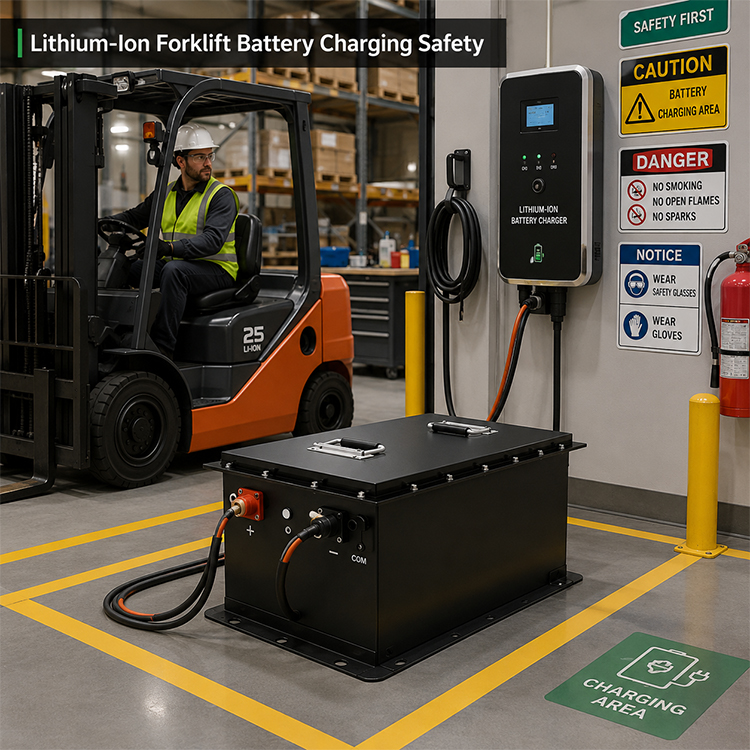
A safe lithium forklift charging area does not need to look dramatic. It needs to be boring, repeatable, and hard to misuse.
OSHA’s electric forklift eTool says a properly equipped battery charging area should have no smoking, warning signs, adequate fire protection, water for flushing and neutralizing electrolyte where applicable, eyewash capable of a 15-minute flow, emergency communication, ventilation, neutralization materials, suitable extinguishers, and protection for charging apparatus from truck damage. See OSHA’s electric forklift charging guidance.
Now here is my hard opinion: lithium does not excuse sloppy charger placement. It makes sloppy charger placement less obvious.
Lead-acid rooms were visibly messy — acid, caps, watering, corrosion, battery hoists. Lithium charging stations can look clean while hiding bad cable routing, wrong charger curves, undersized connectors, forklift impact exposure, or operators who treat fault codes like software pop-ups.
A warehouse charging policy should say, in plain English:
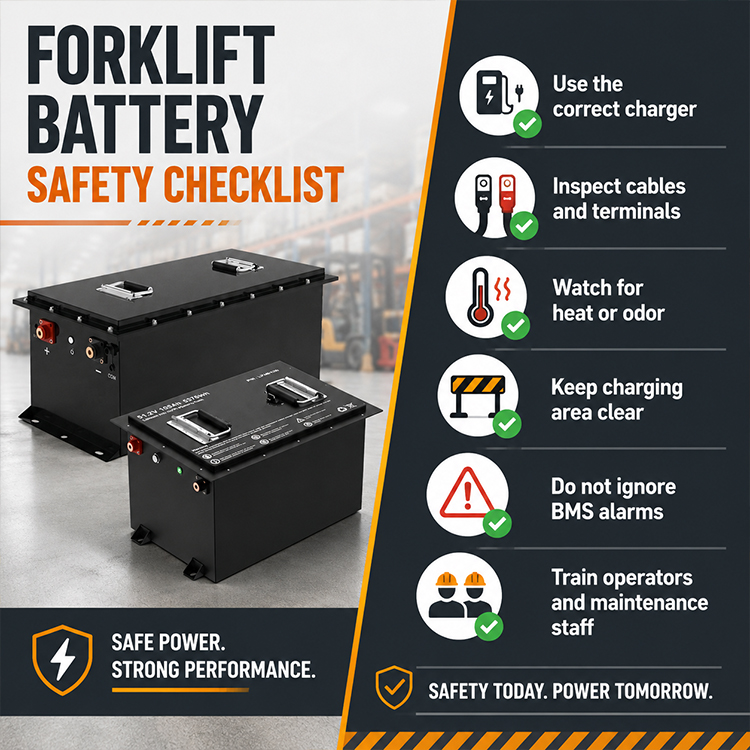
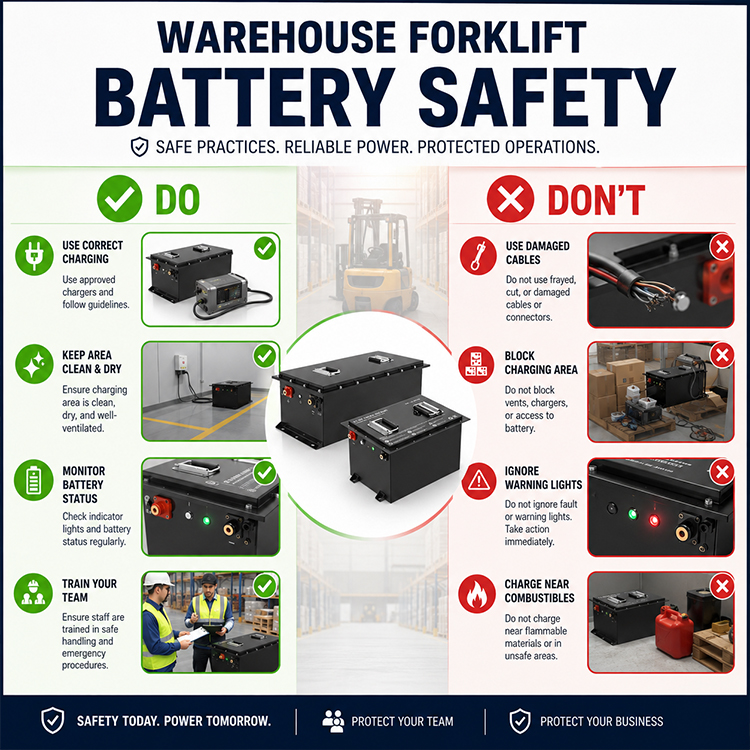
Charge only with the approved lithium charger matched to the battery.
Park the forklift correctly and apply the brake before charging.
Inspect the cable, plug, terminals, enclosure, and display before connection.
Keep pallets, stretch wrap, cartons, solvents, and trash away from chargers.
Do not charge after impact until maintenance checks the pack.
Do not bypass BMS warnings.
Stop charging if there is heat, odor, smoke, swelling, arcing, liquid, deformation, or fault lockout.
Keep charger guards, bollards, or physical barriers in place.
Record recurring alarms instead of “clearing and forgetting.”
If you are converting older trucks, the lead-acid to lithium forklift conversion checklist is the internal page I would put in front of the maintenance manager before purchasing. Voltage alone is not enough. A 48V lead-acid truck and a 51.2V LiFePO4 battery may be close on paper, but the controller, discharge curve, charger, counterweight, connector, and BMS logic decide whether the conversion is safe.
The Fire Risk Nobody Wants in the Sales Meeting
Lithium iron phosphate, or LiFePO4, is generally more thermally stable than high-energy nickel manganese cobalt chemistries. Good. That does not mean “fireproof.”
OSHA’s Lithium-ion Battery Safety fact sheet warns that thermal runaway can create fire, explosion, and hazardous chemical byproducts, including hydrogen fluoride (HF), hydrogen chloride (HCl), hydrogen cyanide (HCN), phosphoryl fluoride (POF3), carbon monoxide (CO), carbon dioxide (CO2), black carbon, and other hazardous particulates. That should change how warehouses write emergency plans.
Smoke is data. If a lithium forklift battery emits smoke, strange odor, hissing, popping, abnormal heat, or a repeated BMS shutdown, the correct response is not to drag it back to the charger, not to “try another plug,” and definitely not to let an operator finish the last two pallets before maintenance looks at it.
Why do warehouses still negotiate with warning signs?
The 2024 Aricell disaster in Hwaseong, South Korea, was not a forklift-battery incident, but it is a brutal lithium-battery case study. Reuters reported that the fire involved lithium battery explosions at a factory containing roughly 35,000 batteries, killed 23 workers, and later police linked the disaster to quality failures and failure to act on signs of dangerous defects. Read Reuters’ reporting on the deadly South Korea lithium battery plant fire and the later quality-failure investigation.
The lesson for warehouses is not “your forklift battery will do that.” That would be lazy fear marketing.
The lesson is sharper: lithium incidents punish weak process. Poor training, ignored defects, bad documentation, rushed production, and unclear emergency response do not stay small when stored energy and flammable materials are involved.
Lead-Acid vs LiFePO4 Forklift Safety: The Real Warehouse Trade
Lead-acid is dirty and familiar. Lithium is clean and unforgiving.
That sentence should be printed above every procurement spreadsheet.
SDS/MSDS, UN38.3, BMS logs, charger specs, fault history
Keep records tied to each truck and battery serial number
Here is where I push buyers hard: if your supplier cannot document nominal voltage, max charge voltage, continuous discharge current, peak discharge current, battery weight, BMS protections, communication protocol, charger model, enclosure rating, and operating temperature limits, you are not buying a safety system. You are buying optimism.
For example, a documented 48V 460Ah LiFePO4 forklift battery spec gives a better purchasing conversation than “48V lithium battery.” If the job needs a custom enclosure, charger, BMS communication, terminals, or private-label industrial packaging, CoreSpark’s custom LiFePO4 battery engineering page fits naturally into the safety discussion because customization is where many warehouse risks either get solved or quietly created.
My Forklift Battery Safety Checklist for Warehouse Managers
Do not start with the battery quote. Start with the risk map.
Before Installation
Confirm forklift make, model, serial number, rated capacity, and data plate.
Verify minimum and maximum battery weight.
Match voltage class: 24V, 36V, 48V, 72V, or 80V.
Confirm actual lithium nominal voltage, such as 25.6V, 38.4V, 51.2V, or 76.8V.
Check compartment size, tray design, hold-downs, lid clearance, and cable exit.
Require BMS protections: overvoltage, undervoltage, overcurrent, short circuit, overtemperature, low-temperature charge cutoff, cell balancing, and fault logging.
Confirm CAN, RS485, Bluetooth, display, or OEM communication needs.
Require SDS/MSDS, UN38.3 transport documentation where applicable, and charger documentation.
Charging Area Controls
Mark designated lithium forklift charging zones.
Protect chargers with bollards, barriers, or layout controls.
Keep fire equipment and emergency access clear.
Keep combustibles away from charging points.
Post no-smoking and no-open-flame signage.
Route cables off the floor or away from tire paths.
Prohibit extension-cord improvisation.
Require charger inspection intervals.
Record recurring faults, not just failures.
Operator Rules
No charging with damaged cables.
No charging after impact until inspected.
No bypassing BMS faults.
No pressure washing connectors.
No parking hot batteries beside combustible storage.
No using the wrong charger “just once.”
No continuing operation after smoke, odor, swelling, hissing, popping, or abnormal heat.
No undocumented battery swaps between trucks.
Maintenance Rules
Torque-check terminals on schedule.
Inspect connector discoloration, pitting, looseness, and heat marks.
Review BMS logs after shutdowns.
Track charger error codes.
Inspect enclosure damage after collision.
Verify cooling, ventilation, and ambient temperature limits.
Keep truck-specific battery records.
If the warehouse is buying a standard platform, a 51.2V LiFePO4 forklift battery platform can be evaluated against the truck plate, capacity target, charger plan, and communication needs. If it cannot be mapped to the truck, do not install it.
The Training Gap: Where Good Batteries Go to Die
Training fails softly. A warehouse can spend real money on lithium forklifts, smart chargers, BMS displays, documented packs, and custom battery trays, then still lose the safety benefit because the people plugging in the equipment were never taught what abnormal looks like.
What good is a smart battery if the shift treats alarms as background noise?
The old NIOSH forklift incident research is still worth reading because it shows how severe powered industrial vehicle injuries can be. The CDC record reports 916 powered industrial vehicle incidents, including 913 nonfatal injuries, 3 fatalities, pedestrian involvement in 35% of the most common incidents, and an average of 61 lost workdays per lost-workday case. Read the CDC/NIOSH forklift and powered industrial vehicle incident study.
Battery safety training should not be a five-minute charger demo. It should include:
What the BMS does and what it does not do.
How to identify charger mismatch.
What fault codes require lockout.
What connector heat or discoloration means.
What to do after a forklift impact.
When to isolate a battery.
Who can approve return-to-service.
How to call emergency response and what information to provide.
Why lithium smoke is treated differently from ordinary electrical odor.
My unpopular view: if operators are not allowed to understand the battery, they should not be allowed to charge it.
FAQs
What is forklift lithium battery safety for warehouses?
Forklift lithium battery safety for warehouses is the controlled system of battery selection, charging-area design, BMS monitoring, operator training, emergency response, and inspection routines used to prevent fire, electric shock, toxic smoke exposure, impact damage, and unsafe forklift operation around LiFePO4 or lithium-ion motive-power batteries.
In practice, it means the battery, charger, forklift, warehouse layout, and people must be managed as one system. A safe pack with a wrong charger is not safe. A good charger with damaged cables is not safe. A strong BMS with untrained operators is not safe.
How do you safely charge lithium forklift batteries?
You safely charge lithium forklift batteries by using the matched lithium charger, parking the truck with brakes set in a designated charging area, inspecting cables and connectors, keeping combustibles and ignition sources away, obeying BMS fault messages, and stopping immediately if heat, odor, smoke, or swelling appears.
Do not use old lead-acid chargers unless the battery manufacturer explicitly approves the charge profile. Do not charge after impact without inspection. And do not let production pressure override a battery fault.
Do OSHA forklift battery charging requirements apply to lithium batteries?
OSHA’s forklift battery charging rules apply to powered industrial truck battery operations in general, so warehouses should still use designated charging areas, truck positioning controls, ignition-source restrictions, charger protection, training, and emergency planning even when lithium batteries remove acid watering and routine lead-acid battery changes.
Lithium changes the hazard profile, but it does not remove employer responsibility. The safest warehouses combine OSHA’s charging-area discipline with lithium-specific controls for BMS alarms, charger matching, damaged-pack isolation, and toxic-smoke response.
Is LiFePO4 safer than lead-acid forklift batteries?
LiFePO4 is often safer than lead-acid in daily warehouse handling because it removes sulfuric acid watering, hydrogen gassing from normal flooded-battery charging, and heavy battery swapping, but it still carries stored-energy, thermal-runaway, charger-mismatch, connector-heating, and toxic-smoke risks if abused or poorly specified.
So yes, LiFePO4 can be the safer warehouse choice. But only when the pack is properly engineered, the charger is matched, the forklift weight requirements are met, and operators are trained to stop when the battery reports a fault.
What should be in a forklift battery safety checklist?
A forklift battery safety checklist should verify the truck data plate, battery weight, voltage class, charger match, BMS status, connector condition, cable routing, charging-area controls, fire access, operator training, incident response steps, and documented inspection intervals before the battery is installed or charged.
The checklist should be truck-specific, not generic. A 24V pallet truck, a 48V warehouse forklift, and an 80V heavy-duty lift truck do not deserve the same one-page form.
Final Thoughts: Stop Buying Batteries Like Accessories
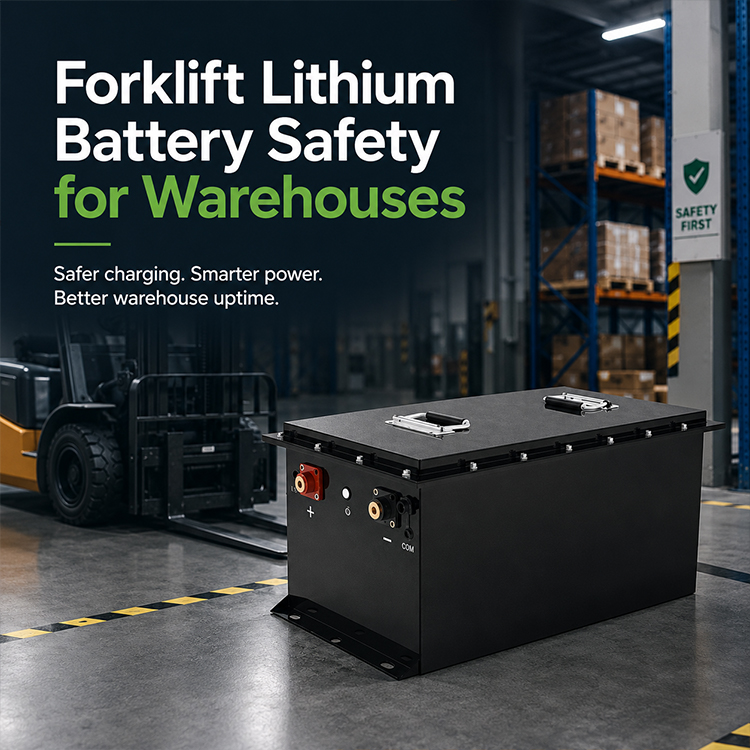
Forklift Lithium Battery Safety for Warehouses is not about fear. It is about refusing to let clean technology hide dirty process.
If you run a warehouse, audit one charging area this week. Look at cable routing, charger protection, combustible storage, fault-code records, operator training, impact reporting, and whether every lithium battery can be traced to the correct forklift and charger. Then ask the question nobody enjoys: “Would this still look safe at 2:00 a.m. with a tired operator and a shipping deadline?”
For OEM, wholesale, or warehouse lithium forklift projects, send the truck voltage, compartment size, battery weight requirement, charger details, shift schedule, and target capacity before asking for a price. Start with CoreSpark’s forklift battery pack options or request custom review through OEM/ODM LiFePO4 battery support. The safest battery quote is the one that forces the hard questions before the invoice.
Newsletter Updates
Enter your email address below and subscribe to our newsletter
BYingPower provides OEM, wholesale, and custom LiFePO4 battery packs for golf carts, RVs, forklifts, solar storage, marine power, and lead-acid replacement applications. We support battery brands, distributors, dealers, system integrators, and OEM buyers with reliable lithium battery solutions, smart BMS options, private-label services, and export documentation support.