Send us your application, voltage, capacity, battery size, quantity, and branding needs. BYingPower will review your project and recommend the right LiFePO4 battery solution for golf carts, RVs, marine systems, solar storage, forklifts, or lead-acid replacement.
Custom battery pack review for your application
OEM/ODM and private-label battery guidance
BMS, charger, terminals, heating, and packaging support
Faster quote path for samples and bulk orders
4th Floor, Building A, No. 2, Longjiang 2nd Road, Xie Keng, Qingxi Town, Dongguan Province,China.
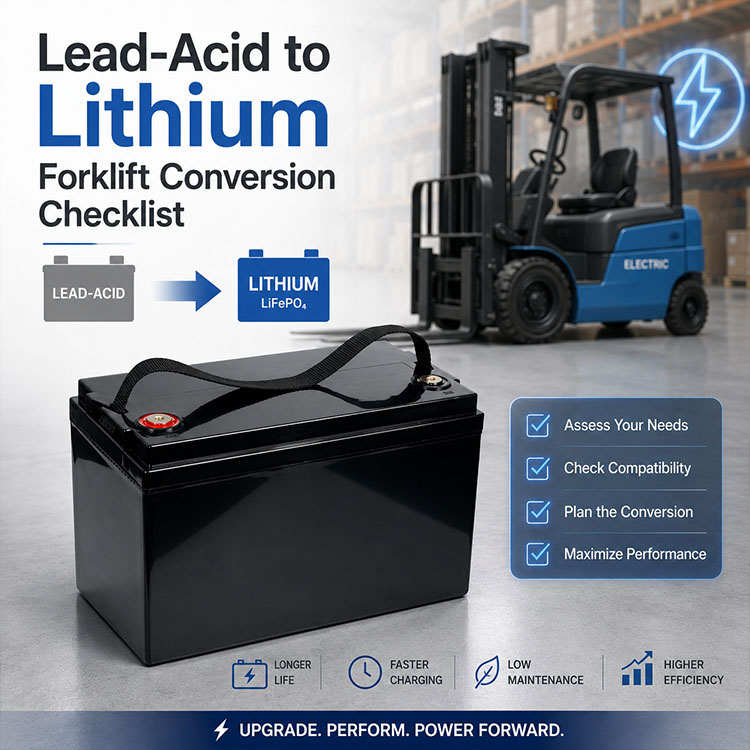
Lead-Acid to Lithium Forklift Conversion Checklist
Lead-acid to lithium forklift conversion is not a battery swap. It is a voltage, ballast, charger, BMS, safety, and compliance decision. This checklist shows what to verify before buying.
The Ugly Truth About Lithium Forklift Battery Conversion
Wrong pack.
That is how expensive forklift lithium battery conversion failures usually start: someone matches the nominal voltage, ignores the tray dimensions, assumes the old lead-acid battery weight is “close enough,” and then wonders why the truck throws faults, loses stability margin, or refuses to charge correctly. Why gamble with a machine that lifts 3,000 to 10,000 lb around people?
I’m pro-lithium. Strongly. But I’m not pro-blind retrofit.
A proper Lithium Forklift Battery Conversion is not just “remove lead-acid, install lithium-ion forklift battery replacement, plug in charger.” It is a controlled engineering check around voltage, capacity, counterweight, BMS communication, connector rating, charger curve, thermal limits, service access, and operator behavior.
The safety data is not theoretical. The National Safety Council reports that forklifts were the source of 84 work-related deaths in 2024 and 25,110 DART cases in 2023–2024 in the U.S., which should end the casual attitude around conversion work immediately. Read the latest forklift injury data from the National Safety Council before letting anyone call this a “simple battery job.”
Table of Contents
Start With the Truck, Not the Battery Catalog
The first checkpoint in any lead-acid to lithium forklift conversion is the forklift data plate. Not the sales brochure. Not the old battery sticker. The truck plate.
You need to confirm:
Truck model and serial number
Rated capacity
Minimum and maximum battery weight
Battery compartment dimensions
Voltage system: 24V, 36V, 48V, 72V, or 80V
Connector type and current rating
Controller compatibility
Charger location and AC input supply
Operating shift pattern
Ambient temperature range
This is where I see buyers get overconfident. A 48V forklift does not automatically accept every 51.2V LiFePO4 pack. A 36V lead-acid system does not always behave nicely with a lithium pack unless the BMS, discharge curve, connector, and charger are matched.
CoreSpark’s own forklift battery pack category shows why the range matters: forklift lithium options span 24V, 36V, 48V, 70V, 72V, 80V and capacities from smaller 100Ah packs to 600Ah–1000Ah industrial configurations. That flexibility is useful. It is also where bad specifying begins if nobody owns the checklist.
My Non-Negotiable First Check
Before pricing a “best lithium forklift battery conversion kit,” I would demand the battery compartment drawing, the old battery weight, the forklift plate photo, the charger label, and the daily amp-hour usage estimate.
No photo, no quote.
If the supplier cannot ask for those basics, they are not engineering a conversion; they are shipping a box and hoping your maintenance team absorbs the consequences.
Lead-Acid vs Lithium Forklift Battery: The Real Conversion Trade-Off
Lead-acid is primitive, heavy, messy, and familiar. Lithium is cleaner, faster, smarter, and less forgiving when specified badly.
That is the trade.
OSHA’s powered industrial truck guidance still treats battery charging and changing as a real hazard zone: trained personnel, brakes applied, designated charging areas, ventilation, fire protection, acid controls, and precautions against sparks or open flame are all part of the lead-acid operating burden. Their powered industrial truck battery charging guidance is not light reading, but it explains why lead-acid rooms became expensive little compliance islands.
Lithium removes watering, equalizing, acid exposure, and most battery-change labor. But it adds a different discipline: charger matching, BMS logic, thermal monitoring, fault-code handling, and shipping documentation.
Conversion Factor
Lead-Acid Forklift Battery
Lithium / LiFePO4 Forklift Battery
What to Verify Before Conversion
Nominal voltage
24V, 36V, 48V, 72V, 80V
Often 25.6V, 38.4V, 51.2V, 76.8V, or custom
Forklift battery voltage compatibility with controller
Weight
Usually heavy enough to act as counterweight
Often lighter unless ballast is added
Minimum battery weight on forklift data plate
Charging
Long charge + cooling window
Fast/opportunity charging possible
Lithium forklift charger requirements and charge profile
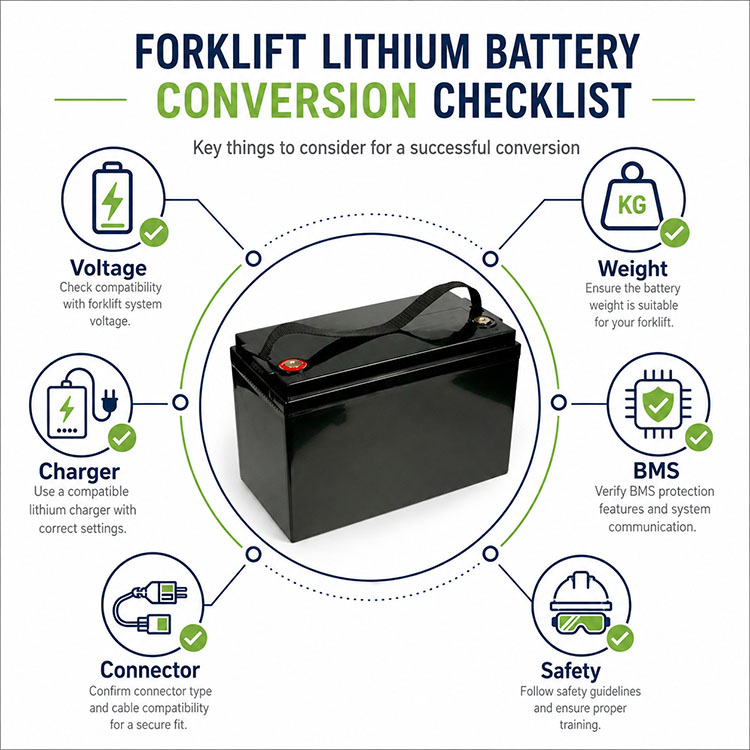
The Forklift Lithium Battery Conversion Checklist I Would Actually Use
1. Confirm Voltage Compatibility Before Anything Else
The first real step in how to convert a forklift to lithium battery is voltage mapping.
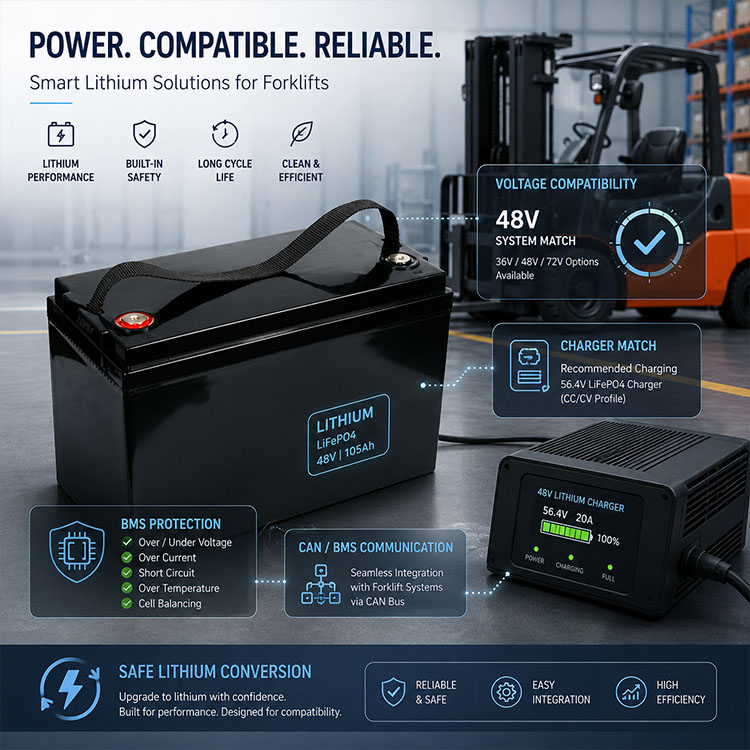
A nominal 48V lead-acid pack is not identical in behavior to a 51.2V LiFePO4 pack. Lithium voltage stays flatter through discharge. That is one of its strengths. But older forklift controllers, battery discharge indicators, and chargers may misread state of charge unless they are recalibrated or bypassed with a lithium-ready display.
Ask for these numbers in writing:
Nominal voltage
Maximum charge voltage
Discharge cut-off voltage
Continuous discharge current
Peak discharge current
BMS low-voltage protection point
Forklift controller voltage tolerance
CoreSpark’s factory custom 51.2V LiFePO4 forklift battery lists configurable 24V/36V/48V/60V/70V/72V/80V platforms, 100Ah–1000Ah capacity, ≥5000 cycles, and CAN/485 communication options. That is the kind of specification range a conversion buyer should be comparing against the truck plate, not against a generic online battery chart.
2. Match the Battery Weight, or Do Not Convert
Here is the hard part people skip: lead-acid weight is not wasted weight. It is counterweight.
Lithium is lighter. That sounds good until the truck’s rated capacity depends on battery mass inside the compartment. If the lithium pack comes in under the minimum battery weight stamped on the forklift data plate, the truck may not be compliant at rated load.
Simple rule: lithium pack weight plus ballast must meet the forklift manufacturer’s minimum battery weight.
And no, throwing loose steel into the battery box is not a professional solution. Ballast needs to be fixed, documented, corrosion-resistant, and service-safe.
3. Replace the Charger, Not Just the Battery
The old charger is usually wrong.
A lead-acid charger uses a charge profile built around flooded, AGM, or gel chemistry. A LiFePO4 forklift battery needs a lithium-specific charge curve, voltage limit, current limit, BMS handshake where applicable, and protection against charging outside permitted temperature limits.
For example, one CoreSpark 48V 460Ah LiFePO4 forklift pack lists a 58.4V charge voltage, 200A charge current, and 300–500A discharge current range, which shows why charger matching is not optional. A weak charger wastes lithium’s best advantage; a wrong charger can create failure. Use the supplier’s custom 48V 460Ah electric forklift lithium battery spec as a template for what should be documented.
4. Demand BMS Communication Details
A lithium forklift battery without a serious BMS is just a liability with terminals.
At minimum, I want to see:
Cell-level overvoltage protection
Cell-level undervoltage protection
Overcurrent protection
Short-circuit protection
High-temperature and low-temperature limits
CAN or RS485 communication
Fault logging
State-of-charge display
Charger communication compatibility
Service access process
For forklifts, I prefer LiFePO4 chemistry because it is generally more stable than high-energy NMC chemistries in industrial applications. But chemistry alone does not save a bad pack design.
OSHA’s lithium-ion battery safety fact sheet warns that lithium-ion batteries can create fire, explosion, and hazardous chemical byproduct risks during thermal runaway, and it specifically names lithium iron phosphate, LiFePO4, as one cathode chemistry among several lithium-ion types. Their lithium-ion battery safety guidance also points employers toward manufacturer instructions, cool/dry storage, training, emergency planning, and not mixing battery types during recycling.
5. Check the Connector and Cable Ratings
This is boring until it burns.
A converted forklift can pull brutal current during acceleration, mast lift, incline travel, and loaded travel. If the connector, cable gauge, crimp quality, fuse rating, or contact resistance is wrong, the failure may not appear during the first test drive. It appears after heat cycling, dust, vibration, and abuse.
Checklist items:
Anderson-style connector model or OEM connector type
Continuous amp rating
Peak amp rating
Cable gauge
Fuse or breaker rating
Cable bend radius
Strain relief
IP rating if washing or wet operation occurs
Lockout/tagout procedure for service
6. Recalculate the Charging Strategy Around Operations
Lithium changes charging behavior.
Lead-acid managers often think in “one battery, one shift, one long charge.” Lithium allows opportunity charging during breaks, lunches, staging windows, and shift changes. That can remove battery swaps and reduce spare battery inventory.
But here is the catch: opportunity charging only works when the charger location, AC supply, break schedule, and BMS current acceptance all line up. Otherwise, the fleet gets a lithium battery and keeps lead-acid habits.
Bad economics.
A forklift lithium battery conversion checklist should include actual operating math: number of trucks, shifts per day, average amp-hour draw per hour, lift cycles, travel distance, charger amperage, break duration, and peak charging demand on the facility electrical panel.
7. Update Training and Emergency Procedures
Lithium reduces acid handling. It does not remove the need for training.
The CDC/NIOSH case study of 916 forklift and powered industrial vehicle incidents across 54 plants found that pedestrians were involved in 35% of the most common incident type, while 41% of nonfatal injuries led to missed work and averaged 61 lost workdays per lost-workday case. That NIOSH forklift incident study is old, yes, but the operational lesson is still alive: the battery room is only one slice of forklift risk. Traffic separation, training, and controlled procedures matter.
Your conversion training should cover:
Lithium charger connection and disconnection
No charging with damaged cables
No bypassing BMS faults
No pressure washing open connectors
No charging below supplier-approved temperature
What alarms mean
What to do after impact damage
Emergency response for smoke, heat, odor, swelling, or fault lockout
Recycling and end-of-life handling
The Spec Sheet Buyers Should Force Suppliers to Sign
I do not trust vague battery quotes. Neither should you.
For a professional lead-acid to lithium forklift conversion, ask the supplier to confirm every line below before payment.
Required Spec
Minimum Acceptable Answer
Truck compatibility
Forklift model, voltage, compartment size, and minimum battery weight reviewed
Chemistry
LiFePO4 / LFP stated clearly
Nominal voltage
Matched to forklift system: 24V, 36V, 48V, 72V, or 80V class
Capacity
Ah and kWh both listed
Weight
Actual battery weight plus ballast plan if needed
Dimensions
L × W × H drawing with terminal location
Continuous discharge
Must meet forklift controller demand
Peak discharge
Must support lift and acceleration loads
Charge voltage
Lithium-specific value stated
Charger
Matched charger included or specified
BMS
Protection limits and communication method listed
Communication
CAN, RS485, Bluetooth, display, or OEM interface documented
Operating temperature
Charge and discharge ranges stated
Certifications
UN38.3, MSDS/SDS, transport documentation where applicable
Warranty
Years, cycle conditions, excluded misuse
After-sales support
Fault-code support and replacement policy
CoreSpark’s OEM/ODM LiFePO4 battery engineering page is the internal page I would send buyers to when the job needs custom voltage, capacity, BMS, charger, terminals, casing, and packaging support rather than a commodity battery shipment.
When Lithium Conversion Is a Bad Idea
I’ll say the quiet part.
Not every forklift deserves lithium.
If the truck is near end-of-life, has controller problems, runs one light shift per week, works in freezing zones without a heated battery system, or lacks maintenance discipline, lithium may not pay back. The battery will be better than the truck. That is not strategy; that is vanity purchasing.
Lithium makes the most sense when:
The fleet runs two or three shifts
Battery changing wastes labor
Lead-acid watering is inconsistent
Acid damage is common
Charging space is limited
Operators can opportunity charge
Downtime has a measurable cost
The buyer wants a cleaner premium product line
For distributors and equipment dealers, CoreSpark’s lead acid replacement batteries page is relevant because the same buyer psychology applies: customers are not only buying chemistry; they are buying lower maintenance, cleaner operation, and longer service intervals.
The Insider Checklist: Sign-Off Before Purchase
Use this as the actual conversion gate.
Truck and Battery Fit
Confirm forklift make, model, serial number
Photograph forklift data plate
Confirm battery compartment dimensions
Confirm required battery weight range
Confirm connector type
Confirm voltage class
Confirm controller compatibility
Confirm cable routing and service clearance
Electrical and BMS
Confirm nominal voltage and max charge voltage
Confirm continuous and peak discharge current
Confirm BMS protection limits
Confirm CAN/RS485/display requirements
Confirm state-of-charge integration
Confirm low-voltage cut-off behavior
Confirm fuse or breaker design
Confirm charger handshake where required
Charger and Facility
Replace old lead-acid charger unless supplier approves in writing
Confirm AC input: 110V, 220V, 380V, or 480V facility supply
Confirm charger output voltage and amperage
Confirm opportunity charging schedule
Confirm charger ventilation and cable protection
Confirm charging area signage
Confirm emergency shutoff access
Safety and Compliance
Update operator training
Update maintenance SOPs
Update emergency response plan
Inspect charging connectors weekly
Keep damaged lithium batteries out of service
Store spare packs in dry, cool locations
Follow shipping rules for lithium batteries
Keep SDS/MSDS and UN38.3 documents on file
If you are a dealer, distributor, or OEM buyer building a repeatable conversion program, do not quote from memory. Use the CoreSpark contact page to submit voltage, capacity, application, quantity, and customization requirements so the battery spec is built around the truck instead of guessed around the keyword.
FAQs
What is a lead-acid to lithium forklift conversion?
A lead-acid to lithium forklift conversion is the process of replacing a traditional flooded, AGM, or gel lead-acid forklift battery with a lithium-ion, usually LiFePO4, battery system that matches the forklift’s voltage, weight, compartment size, charger requirements, BMS protection, and duty cycle.
The work is part electrical retrofit, part safety review, and part operations redesign. Done right, it can reduce maintenance, shorten charging time, and support opportunity charging. Done wrong, it can create controller faults, stability issues, charger mismatch, and warranty problems.
How do I know if my forklift can use a lithium battery?
A forklift can use a lithium battery only if the replacement pack matches the truck’s rated voltage, battery compartment dimensions, required counterweight range, connector rating, controller tolerance, discharge current demand, and charger profile, while also meeting the manufacturer or supplier’s conversion guidance.
Start with the data plate and the existing battery tag. Then compare the lithium pack’s nominal voltage, maximum charge voltage, cut-off voltage, weight, dimensions, continuous discharge current, and peak current. If the lithium pack is lighter than the required minimum battery weight, ballast must be engineered properly.
Can I use my old lead-acid charger for a lithium forklift battery?
A lead-acid charger should not be used for a lithium forklift battery unless the battery supplier confirms in writing that the charger voltage, charge curve, current limit, termination behavior, and BMS communication are compatible with the specific lithium pack being installed.
Most conversions require a lithium-specific charger. Lead-acid chargers are built around different absorption, equalization, and float behavior. Lithium packs need tighter voltage control, correct current limits, and protection against charging outside the BMS-approved temperature range.
What is the biggest mistake in forklift battery voltage compatibility?
The biggest mistake in forklift battery voltage compatibility is assuming that nominal voltage alone proves fit, when the real conversion depends on maximum charge voltage, discharge curve, controller tolerance, BMS cut-off points, state-of-charge display behavior, and charger output voltage.
For example, a 48V lead-acid system and a 51.2V LiFePO4 system may both sit in the “48V class,” but they do not behave identically under charge and discharge. The forklift controller and battery indicator may need configuration or external display support.
Is LiFePO4 safer than other lithium-ion forklift batteries?
LiFePO4 is widely favored for forklift conversions because it offers strong cycle life, stable discharge behavior, and better thermal stability than some higher-energy lithium chemistries, but safety still depends on pack design, BMS quality, charger matching, enclosure protection, training, and emergency procedures.
Do not buy chemistry alone. Buy the system. A LiFePO4 pack with poor BMS logic, weak connectors, bad thermal sensing, or undocumented charger compatibility can still create operational risk.
What should be included in the best lithium forklift battery conversion kit?
The best lithium forklift battery conversion kit should include the correctly sized LiFePO4 battery pack, matched lithium charger, proper connector and cables, fixed ballast if required, BMS display or communication interface, mounting hardware, documentation, warranty terms, SDS/MSDS, UN38.3 transport documents, and installation guidance.
For industrial fleets, I would also ask for wiring diagrams, fault-code support, charger setup instructions, and written confirmation of compatibility with the forklift model. A kit without documentation is not a kit; it is inventory.
Your Next Steps
Do not start your Lithium Forklift Battery Conversion with price. Start with proof.
Send your forklift model, voltage, battery compartment size, old battery weight, charger label, shift schedule, and target capacity to a supplier that can review the whole system. If you need a custom LiFePO4 forklift pack, charger matching, BMS configuration, or OEM/ODM support, request an engineering review through CoreSpark Battery’s forklift battery pack program and make the supplier prove the conversion before you approve the purchase.
Newsletter Updates
Enter your email address below and subscribe to our newsletter
BYingPower provides OEM, wholesale, and custom LiFePO4 battery packs for golf carts, RVs, forklifts, solar storage, marine power, and lead-acid replacement applications. We support battery brands, distributors, dealers, system integrators, and OEM buyers with reliable lithium battery solutions, smart BMS options, private-label services, and export documentation support.