Send us your application, voltage, capacity, battery size, quantity, and branding needs. BYingPower will review your project and recommend the right LiFePO4 battery solution for golf carts, RVs, marine systems, solar storage, forklifts, or lead-acid replacement.
Custom battery pack review for your application
OEM/ODM and private-label battery guidance
BMS, charger, terminals, heating, and packaging support
Faster quote path for samples and bulk orders
4th Floor, Building A, No. 2, Longjiang 2nd Road, Xie Keng, Qingxi Town, Dongguan Province,China.
36V Golf Cart Battery: 50Ah vs 100Ah vs 105Ah Runtime Calculator
How much extra runtime does a 100Ah or 105Ah battery actually provide over 50Ah? This calculator converts battery capacity into realistic driving hours and estimated golf cart range.
When sellers advertise a 36V golf cart battery using only its amp-hour rating, they leave out the variables that decide whether the cart travels nine miles, 27 miles, or more than 40 miles: current draw, usable capacity, speed, hills, payload, tire pressure, temperature, controller behavior, and battery age.
So why do so many listings promise distance without stating any of them?
I reviewed the live CoreSpark catalog, its 36V battery specifications, current government battery guidance, laboratory research, and recent battery-market data. My conclusion is blunt: 100Ah is the meaningful capacity jump. Moving from 100Ah to 105Ah adds only 5% more theoretical runtime.
Five percent matters on a spreadsheet. On a golf course with two passengers, soft tires, repeated acceleration, and an uphill return trip? It can disappear almost entirely.
The First Hard Truth: Amp-Hours Are Not Range
Amp-hours measure electrical charge. They do not directly measure driving distance.
To compare 50Ah, 100Ah, and 105Ah batteries properly, convert capacity into watt-hours:
Battery energy in watt-hours = nominal voltage × amp-hours
There is an industry detail buyers frequently miss. A battery sold as a “36V LiFePO4 battery” is often a 12-cell-series pack with a nominal voltage of 38.4V, because each lithium iron phosphate cell is rated at approximately 3.2V.
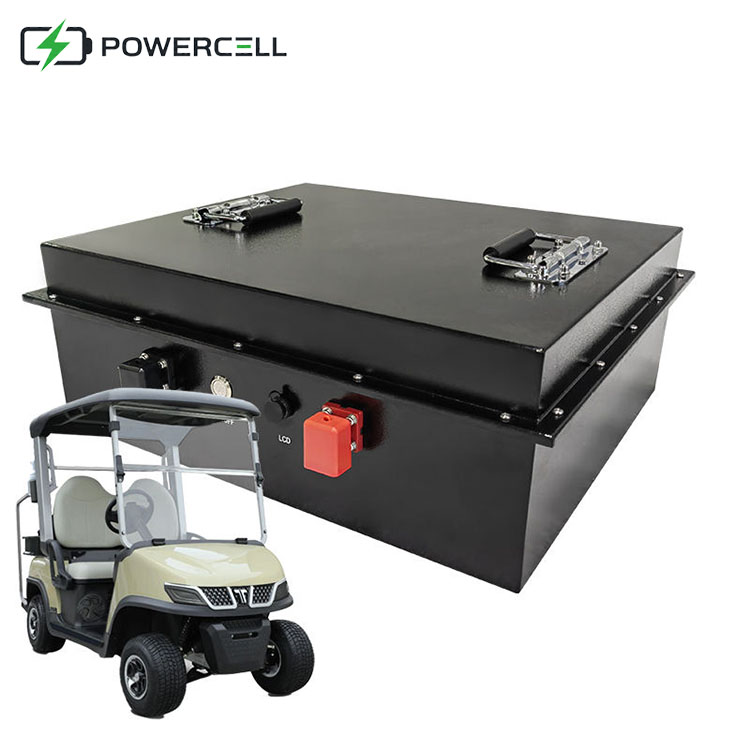
CoreSpark’s listed 36V 105Ah model, for example, specifies:
Nominal voltage: 38.4V
Charge voltage: 43.8V
Nominal capacity: 105Ah
Nominal energy: 4,032Wh
Continuous discharge current: 200A
Peak discharge current: 400A for 35 seconds
Pack weight: approximately 34kg
A separate CoreSpark listing states a 4,000-cycle rating for its 36V 105Ah LiFePO4 model. These are manufacturer specifications rather than independent test results, but they show why buyers should read the datasheet instead of relying on the “36V” label alone.
Using 38.4V nominal voltage, the three capacities contain:
Battery capacity
Nominal energy
Increase over 50Ah
Increase over 100Ah
50Ah
1.92kWh
Baseline
—
100Ah
3.84kWh
100% more
Baseline
105Ah
4.03kWh
110% more
5% more
That last number deserves attention.
A 105Ah battery does not provide a new class of range compared with 100Ah. It provides five extra amp-hours. I would not pay a large premium for that difference unless the 105Ah model also has a better BMS, stronger cells, a longer warranty, a better enclosure, Bluetooth monitoring, or dimensions that fit the cart more cleanly.
36V Golf Cart Battery Runtime Calculator
The most useful runtime calculation starts with average battery current, not motor nameplate power and not the controller’s maximum current rating.
Use this formula:
Runtime in hours = battery capacity × usable-capacity factor ÷ average current
For practical planning, I use a 90% usable-capacity factor:
Runtime = Ah × 0.90 ÷ average amperage
Then estimate range:
Estimated range = runtime × real average driving speed
Use average speed, not top speed. A cart capable of 20mph may average only 10–13mph after stops, turns, hills, pedestrian traffic, and loading.
Runtime and Range Comparison
The following table assumes:
90% usable battery capacity
A real average speed of 12mph
A healthy LiFePO4 battery
No extreme temperature restriction
Average current measured at the battery pack
Battery
Usable capacity
Runtime at 25A
Runtime at 40A
Runtime at 60A
Estimated range at 40A and 12mph
50Ah
45Ah
1.80 hours
1.13 hours
0.75 hours
13.5 miles
100Ah
90Ah
3.60 hours
2.25 hours
1.50 hours
27.0 miles
105Ah
94.5Ah
3.78 hours
2.36 hours
1.58 hours
28.4 miles
These figures are planning estimates, not guaranteed range claims.
At a 40A average draw, moving from 50Ah to 100Ah adds roughly 13.5 estimated miles under these assumptions. Moving from 100Ah to 105Ah adds approximately 1.4 miles.
That is the real comparison.
Example Calculation for a 100Ah Battery
Suppose a cart averages 40A from the battery and travels at a real average speed of 12mph:
100Ah × 0.90 ÷ 40A = 2.25 hours
2.25 hours × 12mph = 27 miles
Now add hills, four passengers, oversized tires, low tire pressure, cold weather, or repeated full-throttle acceleration. Average current may rise from 40A to 55A:
100Ah × 0.90 ÷ 55A = 1.64 hours
1.64 hours × 12mph = 19.6 miles
The same battery has apparently “lost” more than seven miles. It has not. The cart simply demanded more energy per mile.
50Ah vs 100Ah vs 105Ah: Which One Actually Fits?
50Ah: Light Duty, Short Routes, Lower Upfront Cost
A 50Ah 36V golf cart battery can make sense for:
Short neighborhood trips
Flat golf courses
Two-seat carts
Low annual mileage
Buyers with reliable charging access
Weight-sensitive builds
Utility carts used intermittently
But there is little reserve.
At a 60A average load, our conservative calculation gives about 45 minutes of runtime. That may be enough for a predictable route. It is less comfortable when the cart must return uphill, carry equipment, or complete several trips before charging.
My opinion: 50Ah is a route-specific battery, not a universal replacement.
100Ah: The Practical Sweet Spot
A 100Ah battery doubles the nominal stored energy of a 50Ah battery. That is a material upgrade, not marketing decoration.
It provides more breathing room for:
Four-seat carts
Moderate hills
Repeated daily use
Community transportation
Golf course fleet duty
Utility equipment
Longer intervals between charges
Battery aging over several years
For most buyers comparing the CoreSpark golf cart battery range, 100Ah is the capacity I would use as the starting point. The decision can then be adjusted according to cart weight, route length, maximum controller current, battery compartment size, and charging schedule.
105Ah: Slightly More Capacity, Potentially Better Hardware
A 105Ah battery contains only 5% more energy than a 100Ah battery at the same voltage.
That means:
5% more theoretical runtime
5% more theoretical range
About nine extra minutes at a 40A average draw
About 1.4 extra miles at a 12mph average speed under our assumptions
The capacity difference is modest. But the complete battery may still be better.
For example, CoreSpark’s 36V 105Ah Bluetooth LiFePO4 battery lists a 200A continuous BMS, 400A short-duration peak output, Bluetooth state-of-charge monitoring, and a 4.03kWh nominal energy rating. Those system-level specifications may matter more than the five additional amp-hours.
Buy the complete system. Not the badge.
Why Real-World Runtime Misses the Spreadsheet
Average Current Is the Hidden Number
A controller rated for 400A does not continuously draw 400A. Likewise, a 5kW motor does not continuously consume 5kW.
Current spikes during:
Initial acceleration
Hill climbing
Soft-ground driving
Heavy loading
Towing
Rapid speed changes
During steady travel on level pavement, current may fall considerably. This is why a Bluetooth battery monitor or clamp-meter test provides better range information than a motor label.
A heavier cart needs more energy to accelerate. A cart climbing a grade must also lift its total mass against gravity.
Passenger weight matters. So do rear seats, cargo boxes, lift kits, large tires, coolers, tools, and towing loads.
And tire pressure? Owners ignore it until range drops.
The controversial truth is that the 5% advantage of 105Ah over 100Ah can be smaller than the energy penalty caused by underinflated tires, aggressive driving, or one steep section of the route.
Temperature, Discharge Rate, and State of Charge Matter
The U.S. Department of Energy’s Alternative Fuels Data Center notes that lithium-ion batteries offer high energy efficiency, strong power-to-weight performance, long life, and low self-discharge. Those advantages help explain why LiFePO4 has become a common lead-acid replacement chemistry.
But lithium batteries are not immune to operating conditions.
An NREL battery degradation study models capacity and power fade using temperature, state-of-charge profile, and daily depth of discharge. In other words, how the battery is stored and cycled affects what it can deliver later.
A peer-reviewed 2024 study examined lithium-ion cells across discharge rates from 0.05C to 0.5C and temperatures from 20°C to 50°C. It found that higher current rates increased heat generation, reinforcing a basic engineering point: demanding more power creates more internal loss and thermal stress.
That is why runtime calculators should include a margin. Laboratory energy and usable road energy are not identical.
Lithium vs Lead-Acid: Equal Ah Does Not Mean Equal Road Time
A buyer replacing six 6V lead-acid batteries may assume that a 36V 100Ah lithium pack and a 36V 100Ah lead-acid bank provide identical usable energy.
They usually do not.
Lead-acid capacity ratings are sensitive to discharge rate. As current rises, available capacity can fall more sharply. Voltage also declines throughout discharge, and owners often avoid deep discharge to protect service life.
LiFePO4 typically maintains a flatter discharge voltage and allows a larger share of rated capacity to be used, provided the battery, BMS, controller, and charger are properly matched.
This does not mean every lithium conversion is automatically better. A poorly sized BMS can trip under acceleration. An incompatible charger can create charging problems. Undersized cables can heat up. A pack that physically fits may still have the wrong terminal layout or voltage limits.
Before converting, confirm:
Nominal and maximum charging voltage
Controller voltage range
Continuous and peak battery current
Charger chemistry and charging profile
Cable gauge and terminal type
Battery compartment dimensions
Pack weight and mounting method
Low-temperature charging protection
CAN, RS485, Bluetooth, or display requirements
Required shipping and compliance documents
For distributor, fleet, or private-label projects, CoreSpark’s LiFePO4 OEM/ODM engineering service covers custom voltage, capacity, BMS configuration, enclosure design, terminals, communication, charger matching, testing, and certification-document support.
Do Not Confuse Cell Prices With Finished Battery Prices
Battery buyers sometimes cite commodity-level cell prices while negotiating a complete golf cart pack. That comparison is incomplete.
Reuters reported in October 2024 that some LFP cells were being purchased at approximately $50 per kWh, while the global weighted average price for nickel-cobalt-manganese cells had fallen to $68.60 per kWh, down 11.3% during 2024 at the time of reporting.
But a finished golf cart battery includes much more than cells:
BMS hardware
Fuses and contactors
Busbars and cables
Metal or polymer enclosure
Waterproofing
Display or Bluetooth hardware
Charger
Connectors
Cell matching
Assembly labor
Capacity testing
Aging tests
Packaging
Dangerous-goods shipping
Distributor margin
Warranty reserve
Technical support
So yes, challenge an unreasonable price premium. But do not expect a complete 4.03kWh golf cart battery to cost the same as 4.03kWh of bare factory cells.
How to Choose the Best 36V Golf Cart Battery
I would choose capacity in this order:
Choose 50Ah When
Your route is short, flat, predictable, lightly loaded, and followed by convenient charging. Keep a healthy reserve rather than planning to reach BMS shutdown at the end of every trip.
Choose 100Ah When
You need a balanced battery for regular golf, neighborhood travel, utility work, moderate hills, or four-seat operation. For many carts, this is the most defensible balance between purchase price, weight, charging time, and usable range.
Choose 105Ah When
The overall battery package is better than the available 100Ah option. Look for stronger continuous current, better cells, a reputable BMS, Bluetooth diagnostics, an appropriate charger, improved enclosure quality, better documentation, and stronger warranty support.
Do not choose 105Ah because the number looks substantially larger. It is not.
FAQs
How long does a 36V golf cart battery last?
A 36V golf cart battery lasts from about 45 minutes to nearly four hours of driving time, depending on capacity and average pack current; with 90% usable capacity, 50Ah provides 0.75–1.80 hours, 100Ah provides 1.50–3.60 hours, and 105Ah provides 1.58–3.78 hours at 60–25A.
Actual runtime depends on hills, vehicle weight, acceleration, tire pressure, temperature, battery condition, BMS settings, and average speed. Measure average battery current during a representative route for a more dependable estimate.
Is a 105Ah golf cart battery better than a 100Ah battery?
A 105Ah golf cart battery is only 5% larger than a 100Ah battery, so its theoretical runtime and range are also only 5% higher when voltage, chemistry, BMS limits, temperature, vehicle weight, tires, terrain, speed, and battery condition are otherwise identical.
The 105Ah model may still be the better purchase when it includes higher-quality cells, a stronger BMS, better monitoring, more suitable dimensions, a compatible charger, or stronger warranty terms.
Should I buy a 50Ah, 100Ah, or 105Ah 36V golf cart battery?
A 50Ah battery suits short, light-duty trips; a 100Ah battery is the practical all-round choice for most 36V carts; and a 105Ah battery makes sense when its BMS, cell quality, dimensions, warranty, or price is better—not because five extra amp-hours transform range.
Calculate your longest expected route, determine average current, add at least 15–25% operational reserve, and verify that the BMS supports the controller’s acceleration and hill-climbing demand.
Can a 36V lithium battery replace six 6V lead-acid golf cart batteries?
A 36V LiFePO4 pack can replace a six-battery 6V lead-acid bank only when the cart’s controller, charger, cable size, mounting space, terminals, voltage window, and peak-current demand match the lithium pack, while the new battery includes a properly rated BMS and lithium-compatible charging profile.
Do not reuse a lead-acid charger unless the battery supplier explicitly confirms compatibility. The charger’s maximum voltage and termination behavior must match the LiFePO4 pack.
How accurate is a golf cart battery range calculator?
A golf cart battery range calculator is an engineering estimate that becomes useful when it uses measured average pack current and real average speed; estimates based only on advertised motor wattage, top speed, or amp-hour capacity can miss badly because hills, acceleration, payload, tire pressure, temperature, and stops change demand.
For better accuracy, record battery current and distance across a normal route, calculate watt-hours per mile, and repeat the test with the usual passenger and cargo load.
Your Next Step: Size the Battery Around the Route
Start with your longest normal trip, not the capacity printed on a competitor’s advertisement.
Record the cart model, controller rating, motor rating, current battery configuration, passenger load, terrain, required distance, battery compartment dimensions, charger details, and preferred reserve. Then calculate the required usable amp-hours before comparing prices.
BYingPower provides OEM, wholesale, and custom LiFePO4 battery packs for golf carts, RVs, forklifts, solar storage, marine power, and lead-acid replacement applications. We support battery brands, distributors, dealers, system integrators, and OEM buyers with reliable lithium battery solutions, smart BMS options, private-label services, and export documentation support.