Send us your application, voltage, capacity, battery size, quantity, and branding needs. BYingPower will review your project and recommend the right LiFePO4 battery solution for golf carts, RVs, marine systems, solar storage, forklifts, or lead-acid replacement.
Custom battery pack review for your application
OEM/ODM and private-label battery guidance
BMS, charger, terminals, heating, and packaging support
Faster quote path for samples and bulk orders
4th Floor, Building A, No. 2, Longjiang 2nd Road, Xie Keng, Qingxi Town, Dongguan Province,China.
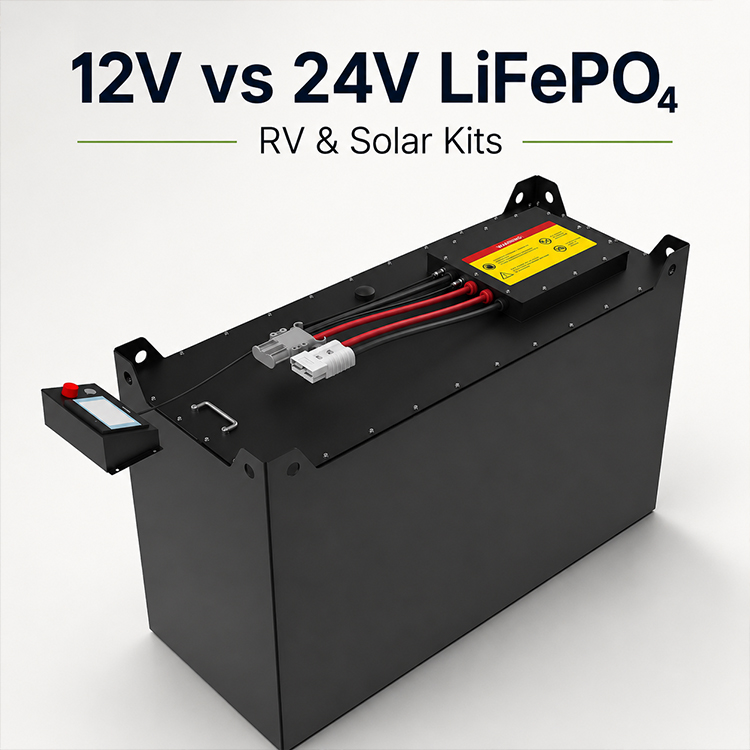
12V vs 24V LiFePO4 Batteries for RV and Solar Kits
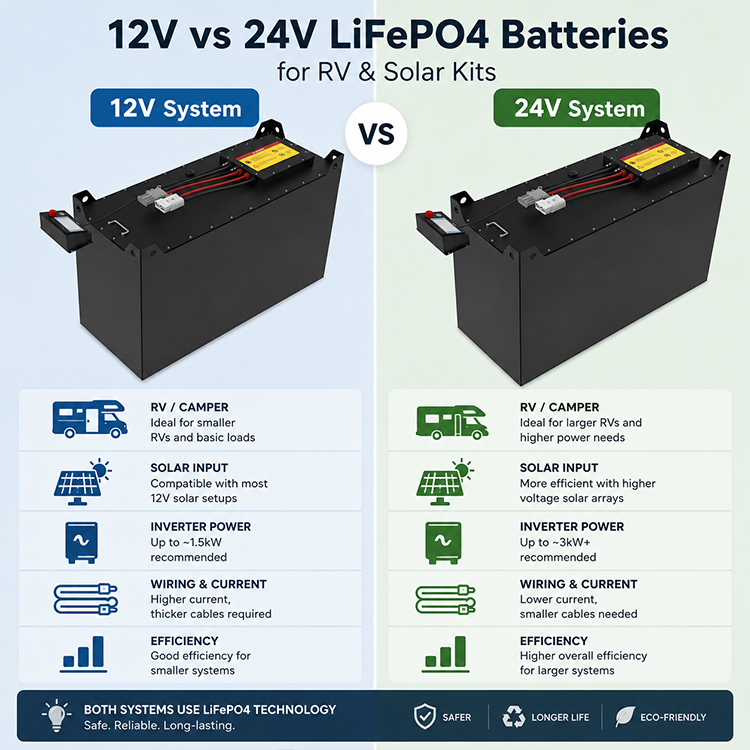
Most RV battery debates start with brand names. That is backwards. The real decision is voltage architecture: 12V for simple drop-in RV upgrades, 24V for higher-power solar kits, larger inverters, cleaner wiring, and fewer ugly current problems.
A 12V vs 24V LiFePO4 battery decision is not a branding choice, not a forum identity badge, and not a cute upgrade path; it changes cable size, inverter stress, charge controller sizing, BMS current, fuse behavior, alternator charging, and how much heat your system quietly makes behind a cabinet wall. So why do so many RV buyers treat it like picking a cooler color?
Here is the hard truth: most bad RV solar kits are not ruined by bad cells. They are ruined by lazy voltage planning.
LiFePO4 batteries, also called lithium iron phosphate batteries or LFP batteries, have become the default serious chemistry for RV and solar storage because they tolerate deep cycling, avoid nickel and cobalt, and fit the stop-start abuse of off-grid use better than old lead-acid banks. The International Energy Agency notes that LFP moved from a minor share to more than 40% of global EV battery demand by capacity in 2023, and its broader rise has been tied to lower cost and better durability in storage-style applications.
But chemistry is only half the story. Architecture is the other half.
If you are building a small camper, a 12V LiFePO4 battery system is often the cleanest answer. If you are running a serious inverter, large solar array, induction cooking, air conditioning, or long cable runs, a 24V LiFePO4 battery system starts to look less like an upgrade and more like basic electrical hygiene.
Table of Contents
12V Is Familiar. That Does Not Mean It Is Always Smart
The RV industry loves 12V because the RV industry inherited 12V.
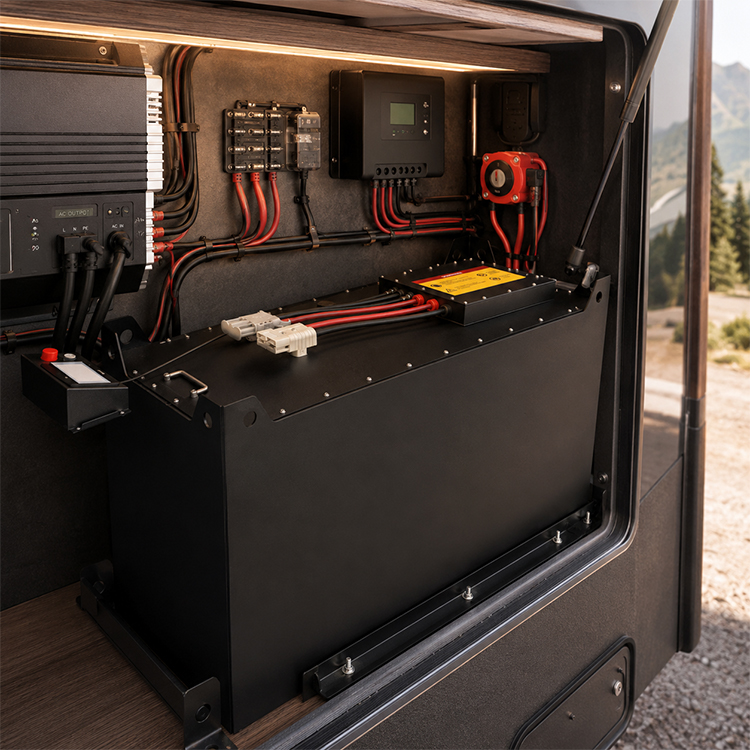
Lights, pumps, fans, USB chargers, propane furnace boards, slide controllers, tank sensors, and old converter chargers were built around 12V because vehicles were built around 12V. That makes a 12V RV battery system easy to understand. Four LiFePO4 cells in series give a nominal 12.8V pack. Drop in a 100Ah unit and you get about 1.28 kWh. Use a 200Ah unit and you get about 2.56 kWh.
Simple sells.
But current is the part the brochure hides. A 3,000W inverter on a 12V system can pull roughly 250A before conversion losses. Add inverter inefficiency, voltage sag, warm compartments, long cable runs, and cheap lugs, and the system starts acting like a space heater with a battery attached. I do not care how pretty the app screen looks. Current still wins.
That is why a 12V RV LiFePO4 Battery makes the most sense when the loads are modest: lighting, fridge control board, water pump, diesel heater, laptops, Starlink-style internet, small microwave use, and maybe a 1,000W to 2,000W inverter. Push beyond that, and 12V becomes possible but less elegant.
I said it.
24V Starts Looking Sensible When the Loads Stop Being Cute
A 24V RV LiFePO4 battery system usually means eight cells in series, giving a nominal 25.6V pack. The energy math can be identical to 12V. A 24V 100Ah battery stores about 2.56 kWh, just like a 12V 200Ah battery. The difference is current.
At 3,000W, a 24V system pulls roughly 125A before losses. That is half the current of 12V. Half the current usually means easier cable sizing, lower voltage drop, cooler conductors, smaller fuses, and less drama when the inverter wakes up under load.
This is where I get opinionated: if an RV solar kit is designed around 1,000W+ of panels, a 3,000W inverter, and daily electric cooking, 24V should be on the table from day one. Not after the owner melts a terminal. Not after the second “mystery shutdown.” Day one.
The 24V RV LiFePO4 Battery route is especially practical for van builders, expedition trucks, marine-style installs, and off-grid trailers where the inverter and battery bank are not sitting inches apart. Higher voltage does not magically fix sloppy wiring, but it gives the design more breathing room.
The Comparison That Actually Matters
Most comparison tables are too polite. This one is not.
Decision Point
12V LiFePO4 Battery System
24V LiFePO4 Battery System
Nominal pack voltage
12.8V
25.6V
Typical cell count
4 cells in series
8 cells in series
Best fit
Small to mid-size RVs, drop-in lead-acid replacement, simple DC loads
Larger solar kits, bigger inverters, long cable runs, heavier daily loads
Current at 3,000W load
About 250A before losses
About 125A before losses
Wiring pressure
Higher current means thicker cables and more voltage-drop risk
Lower current allows cleaner high-power design
RV appliance compatibility
Direct fit for many 12V RV appliances
Needs DC-DC conversion for 12V loads
Solar charge controller behavior
Higher battery-side current for the same solar wattage
Lower battery-side current for the same solar wattage
The short version is not “12V bad, 24V good.” That is childish. The real answer is that 12V is easier, while 24V is cleaner once the system gets hungry.
What the Data Says About LFP, Storage, and the Market
LFP is not popular by accident.
NREL’s 2024 Annual Technology Baseline for residential battery storage uses a representative 5 kW / 12.5 kWh system and notes that its storage model covers lithium-ion batteries including NMC and LFP, with LFP becoming the primary stationary-storage chemistry starting in 2021.
That matters for RV and solar buyers because stationary storage and mobile off-grid storage share the same pain points: repeated cycling, charge control, enclosure heat, safety paperwork, and real-world abuse. Nobody installing an RV LiFePO4 battery wants a chemistry that only behaves on a lab bench.
The IEA has also argued that LFP is lower-cost, less energy-dense, does not contain nickel or cobalt, and has lower flammability plus longer lifetime than some alternative lithium-ion chemistries in storage contexts.
And then there is price pressure. BloombergNEF reported that average lithium-ion battery pack prices fell 8% in 2025 to $108/kWh in its annual survey, down from $1,474/kWh in 2010.
Do not misread that. Your RV battery will not cost $108/kWh at retail. Finished packs include cells, BMS, casing, terminals, warranty risk, freight, certifications, distributor margin, and support. But the direction is clear: LFP is no longer a weird enthusiast product. It is industrial mainstream.
The Compliance Paper Trail Is Not Optional
Here is where cheap battery sellers get quiet.
Lithium batteries are regulated goods in transport. PHMSA says lithium cells and batteries offered for transportation must have passed UN Manual of Tests and Criteria Section 38.3 testing, and manufacturers must make test summary documents available upon request.
The legal language is not vague either. Under 49 CFR §173.185, each lithium cell or battery must be of a type proven to meet the UN 38.3 criteria before transport.
This is not paperwork theater. It is how distributors, OEM buyers, and serious RV kit builders separate factory-grade LiFePO4 batteries from “looks fine in a listing photo” inventory.
If you are sourcing for resale, fleet installation, or private label, ask for the UN38.3 test summary, MSDS/SDS, BMS spec, cycle-life test basis, cell grade statement, warranty terms, and charger compatibility. Then ask again when the model changes.
A professional RV LiFePO4 battery supplier should not act surprised by that request.
When I Would Choose 12V Without Apology
I would choose 12V for a conventional RV retrofit where the owner wants less weight, better usable capacity, and lower maintenance without rebuilding the entire electrical system.
That is the clean lane for 12V. Keep the existing 12V distribution. Use an appropriate lithium-compatible charger. Confirm alternator charging through a DC-DC charger. Size the inverter honestly. Replace weak cables. Fuse the battery properly. Do not stack four random batteries in parallel and call it engineering.
A 12V LiFePO4 battery also makes sense for smaller solar kits, especially 200W to 600W panel setups with modest daily consumption. Think fridge, fan, pump, lighting, phones, cameras, router, and a small inverter for short AC loads.
But if the owner says, “I want to run the air conditioner, induction cooktop, espresso machine, and 3,000W inverter,” I stop smiling.
At that point, the conversation changes.
When I Would Push Hard for 24V
I would push hard for 24V when the system has high inverter demand, higher solar wattage, or long conductor runs.
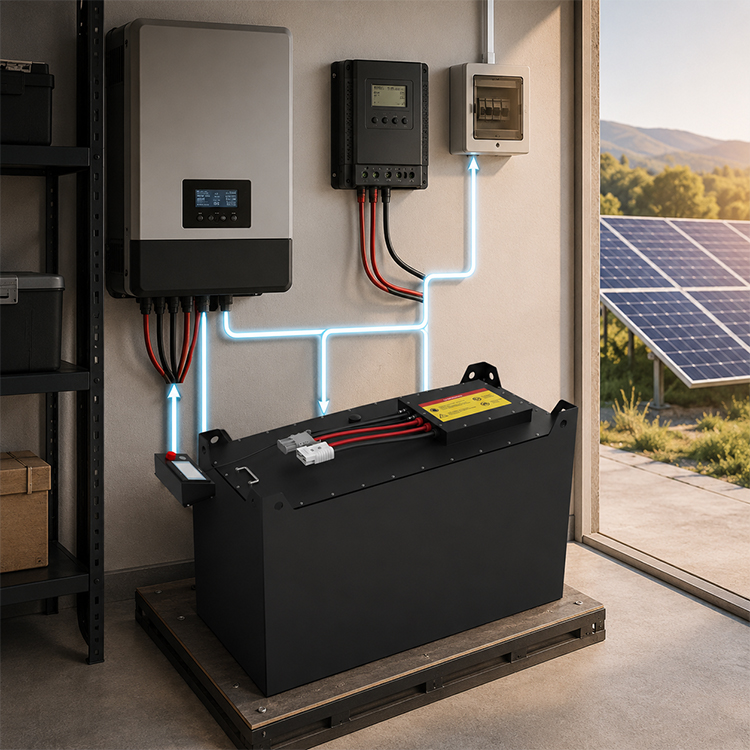
A 24V solar battery system makes charge-controller output current more manageable. For example, 1,200W of solar into 12V can mean about 100A on the battery side before losses. Into 24V, it is about 50A. That difference affects controller selection, heat, wiring, busbars, fuse sizing, and installation neatness.
This is why serious off-grid builders rarely obsess over battery voltage in isolation. They map the entire system: panels, MPPT controller, BMS current limit, inverter surge, DC loads, charger profile, alternator strategy, shore charging, thermal space, and service access.
If that sounds like too much work, use the RV & Off-Grid Battery Guides before ordering parts. Guessing is expensive.
The Sneaky Problem: 12V Loads Inside a 24V RV
The biggest objection to 24V is real: most RV house loads are still 12V.
That means a 24V system often needs a DC-DC converter to supply the 12V distribution panel. Good converters are reliable. Bad converters are little boxes of regret. You must size them for continuous load, fan noise, peak pump draw, fuse coordination, and where they will dump heat.
This is where 12V keeps its crown. If the RV already has a mature 12V electrical system, staying 12V can reduce conversion layers and service confusion.
But for a new build, I do not see this as a deal-breaker. I see it as a design decision. Use 24V for the power-heavy side. Convert cleanly for 12V loads. Label everything like a sober adult.
Cost: The Sticker Price Is Not the System Price
A 12V battery often looks cheaper on the product page. Sometimes it is. Sometimes it is a trap.
Compare system cost, not battery cost. A 24V build may reduce copper cost, busbar size, charge-controller stress, fuse size, and inverter current burden. A 12V build may reduce converter cost and installation complexity. The winner depends on the full bill of materials.
For distributors and OEM buyers, the better question is not “Which battery is cheaper?” It is “Which voltage platform creates fewer returns, fewer installation mistakes, and fewer support calls?”
That is why a custom quote can be smarter than picking a public catalog model. If a project needs odd dimensions, Bluetooth BMS, CAN/RS485 communication, private labeling, matched chargers, or pack-level documentation, use an OEM/ODM LiFePO4 battery review instead of forcing a generic SKU into a professional build.
My Rule of Thumb for RV and Solar Kit Buyers
Use 12V when the system is simple, the RV already runs on 12V, the inverter is modest, and you want a fast lithium upgrade.
Use 24V when the inverter is 2,000W or higher, solar input is climbing past hobby-kit territory, battery-to-inverter cables are not short, or the owner expects residential-style comfort from a mobile system.
And be honest about future loads. People always understate future loads. First it is lights and a fridge. Then it is Starlink, induction, e-bikes, air conditioning, a compressor fridge, water heating, and “just one more outlet near the bed.”
The battery did not fail. The plan did.
FAQs
Which is better for an RV, 12V or 24V LiFePO4 batteries?
A 12V LiFePO4 battery is better for RVs when the electrical system already uses 12V appliances, moderate inverter loads, short cable runs, and simple drop-in replacement, while 24V is better when the build has higher solar input, a larger inverter, or long wiring runs that make current loss expensive. After that first decision, look at the inverter. If it is 1,000W to 2,000W, 12V is usually workable. If it is 3,000W or more, 24V deserves serious attention.
Can I use 24V LiFePO4 batteries with 12V RV appliances?
A 24V LiFePO4 battery can power 12V RV appliances only through a properly sized DC-DC converter that steps 24V down to stable 12V for lights, pumps, fans, control boards, sensors, and other house loads. The converter should be sized for continuous amperage, not fantasy peak numbers. Cheap converters create noise, heat, and troubleshooting headaches.
Is a 24V solar battery system more efficient than a 12V system?
A 24V solar battery system is usually more efficient for medium and high-power solar kits because it cuts current roughly in half for the same wattage, reducing voltage drop, cable heat, and stress on charge-controller output wiring. The gain is not magic; it comes from physics. Lower current makes the same power easier to move.
How many LiFePO4 batteries do I need for an RV solar kit?
The number of LiFePO4 batteries needed for an RV solar kit depends on daily watt-hour consumption, inverter size, charging sources, reserve days, and whether the system is built around 12V, 24V, or another voltage. Start with loads, not batteries. A 12V 200Ah pack and a 24V 100Ah pack both store about 2.56 kWh, but they behave differently under high current.
Are LiFePO4 batteries safer than other lithium batteries?
LiFePO4 batteries are generally considered safer than many nickel-based lithium-ion chemistries because LFP chemistry has stronger thermal stability, lower flammability tendencies, no nickel or cobalt, and long cycle life, although installation quality, BMS design, charging profile, fusing, and transport compliance still decide real-world safety. Do not confuse safer chemistry with permission to install carelessly.
Final Thoughts: Build the System Before You Buy the Battery
Do not buy voltage first. Design the system first.
If your RV or solar kit is a straightforward 12V retrofit, choose a well-documented 12V LiFePO4 battery, match the charger, protect the alternator, and keep the inverter realistic. If your build is drifting toward high-watt solar, 3,000W AC loads, long cable runs, or off-grid comfort that looks suspiciously like a small apartment, stop pretending 12V is automatically simpler.
Choose 24V when the math says 24V.
For battery distributors, RV builders, solar kit sellers, and OEM buyers, the next step is not another forum debate. Send the load profile, voltage target, capacity requirement, dimensions, BMS needs, charger type, branding plan, and compliance requirements through the CoreSpark Battery contact page and get a pack recommendation built around the actual application.
Newsletter Updates
Enter your email address below and subscribe to our newsletter
BYingPower provides OEM, wholesale, and custom LiFePO4 battery packs for golf carts, RVs, forklifts, solar storage, marine power, and lead-acid replacement applications. We support battery brands, distributors, dealers, system integrators, and OEM buyers with reliable lithium battery solutions, smart BMS options, private-label services, and export documentation support.