Send us your application, voltage, capacity, battery size, quantity, and branding needs. BYingPower will review your project and recommend the right LiFePO4 battery solution for golf carts, RVs, marine systems, solar storage, forklifts, or lead-acid replacement.
Custom battery pack review for your application
OEM/ODM and private-label battery guidance
BMS, charger, terminals, heating, and packaging support
Faster quote path for samples and bulk orders
4th Floor, Building A, No. 2, Longjiang 2nd Road, Xie Keng, Qingxi Town, Dongguan Province,China.
Most RV lithium battery failures are not caused by the battery. They start with the converter, charger profile, cabling, or a lazy “drop-in replacement” assumption that nobody bothered to audit.
The RV industry sold “drop-in lithium” as if a 12.8V LiFePO4 battery could politely slide into every 2012-era converter compartment, ignore the charge algorithm, forgive undersized cabling, and somehow make the owner’s shore-power habits smarter overnight.
Who benefits when that myth survives?
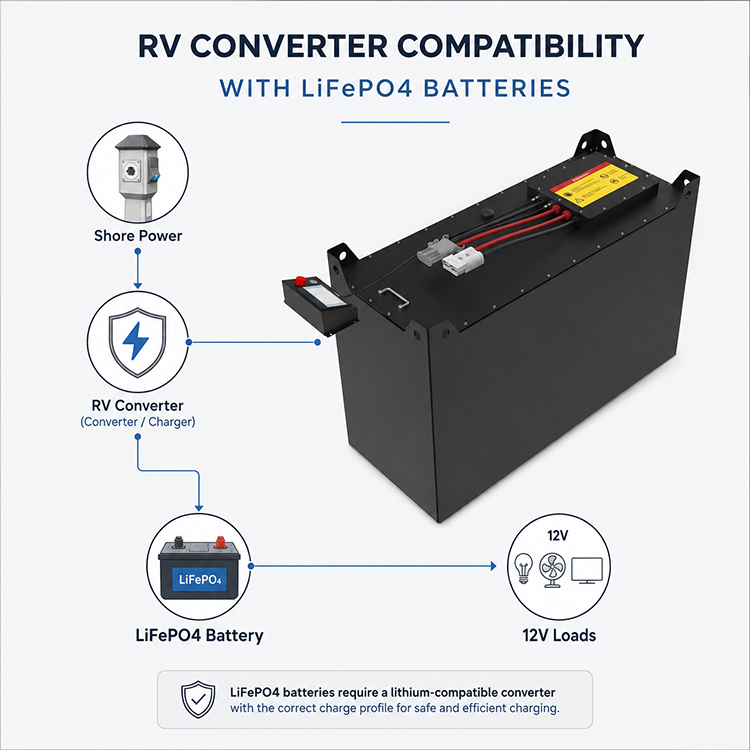
I’ll be blunt: the battery is usually blamed last, but tested first. The converter is often the quiet offender. A standard RV converter for lead-acid batteries may still power the 12V lights, pump, fan, furnace board, and control circuits. That does not mean it is a proper RV converter for lithium batteries.
LiFePO4 is not magic. It is chemistry with rules: LiFePO4, or lithium iron phosphate, uses a nominal 12.8V pack architecture in common RV systems, usually four cells in series, and its charging profile does not behave like flooded lead-acid, AGM, or gel. Battle Born publishes a common 12V LiFePO4 charging range of 14.2–14.6V for bulk/absorb and 13.6V float, while Victron lists 14.2V recommended charge voltage and 13.5V float for its 12.8V lithium battery line.
That voltage gap matters. A converter sitting around 13.6V may keep lights on and slowly add charge, but many LiFePO4 banks will never reach a true full charge, never balance well, or keep owners guessing when a 100Ah battery acts like a 70Ah battery.
Table of Contents
Why Converter Compatibility Became a Real RV Industry Issue
The timing is not random. RV electrical systems got more demanding while the old converter box stayed boring.
The RV Industry Association’s 2024 RV Industry Profile reported 333,733 wholesale RV shipments in 2024 with a retail value of $20.27 billion, and Indiana produced nearly 86% of RVs made in the U.S. and Canada. That means a huge installed base of trailers, motorhomes, and campers is now being upgraded by second owners, dealers, rental fleets, and off-grid builders who want lithium runtime without rebuilding the DC system.
This is where the ugly work starts.
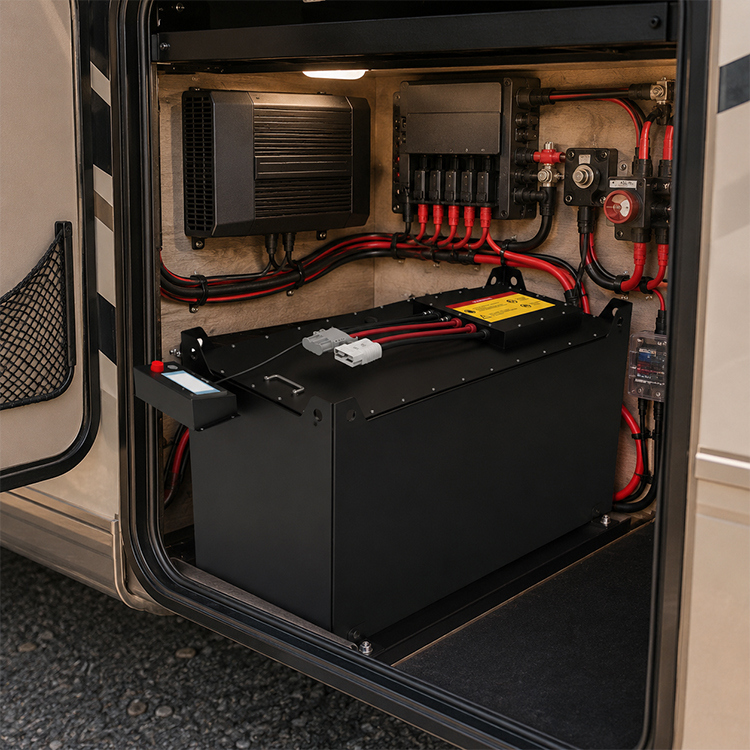
A LiFePO4 RV battery upgrade touches the converter, solar controller, alternator charging path, battery isolation, cable gauge, fusing, busbars, disconnect switch, BMS limits, and cold-temperature charging. If you are planning around 12V 100Ah, 200Ah, 300Ah, 460Ah, or 560Ah RV banks, start with a real battery category page like 12V RV LiFePO4 battery options rather than assuming every “12V lithium” listing has the same charging window.
The hard truth: a lithium compatible RV converter is not defined by the sticker on the battery. It is defined by what the converter actually does at the battery terminals.
Lead-Acid Converter vs LiFePO4 RV Battery Charger
Old converters were built for lead-acid habits. LiFePO4 batteries do not need the same float logic, do not want equalization, and do not respond to state of charge the same way because the voltage curve is flatter for much of the usable capacity.
A proper LiFePO4 RV battery charger should usually do three things well: reach the required bulk/absorption voltage, avoid lead-acid equalization, and stop treating float as a permanent life-support system. WFCO’s Auto-Detect system, for example, markets automatic selection between lead-acid and lithium ion charging profiles for RV converters, which shows how mainstream the profile problem has become.
Progressive Dynamics’ PD9300 LiFePO4 Charge Wizard documentation is even more revealing: it states that LiFePO4 charging voltage requirements are not fully standardized across manufacturers, notes 14.6VDC as an optimum LFP charging voltage while many manufacturers specify less, and shows a 14.4V charge mode with a 13.6V idle mode. That is exactly the sort of voltage behavior buyers should be reading before they install anything.
Converter / Charger Type
Typical Behavior
LiFePO4 Compatibility Verdict
What I Would Check First
Old single-voltage converter
Often holds around 13.6V
Works poorly or slowly for many LiFePO4 banks
Battery terminal voltage under shore power
Lead-acid multi-stage converter
Bulk, absorption, float, sometimes equalization
Risky if equalization or wrong voltage is active
Manual for AGM/Flooded/Gel/Lithium settings
Lithium-selectable RV converter
Dedicated LiFePO4/LFP mode
Usually compatible if voltage matches battery datasheet
Bulk/absorb voltage and float behavior
Auto-detect converter
Attempts to identify chemistry
Convenient, but still verify with a meter
Whether it actually enters lithium mode
Inverter/charger system
Programmable charging profile
Best for large banks if configured correctly
Charge voltage, current limit, low-temp cut-off
Solar controller only
Charges from PV, not shore power
Not a converter replacement
Whether shore-power charging still exists
This is not academic. CPSC warned in 2024 that even good lithium-ion batteries can cause fires when used with incompatible chargers, and one CPSC statement reported 156 fire and thermal incidents involving “universal” chargers for micromobility products during the first four and a half months of 2024. Different market, same lesson: charger matching is not paperwork; it is risk control.
The Compatibility Checklist I Trust
Ignore marketing first. Read voltage.
For a RV converter charger for LiFePO4 batteries, I want the converter or inverter/charger manual to answer these questions without vague language:
1. Does it have a LiFePO4 or LFP mode?
“Lithium ready” is not enough. Some units mean a true lithium profile. Others mean a higher fixed voltage. Others mean the sales team got excited.
Look for words like LiFePO4, LFP, lithium iron phosphate, bulk/absorption voltage, float voltage, and equalization disabled.
2. Can it reach the battery’s required charging voltage?
For many 12.8V LiFePO4 batteries, common bulk/absorb values fall around 14.2–14.6V, but the only number that counts is the battery manufacturer’s datasheet. A 13.6V converter may leave capacity on the table. A 14.8V lead-acid program may trip BMS high-voltage protection.
Bad both ways.
3. Does it force lead-acid equalization?
If yes, stop. Equalization is a lead-acid maintenance behavior, not a lithium feature. A converter that periodically pushes high-voltage equalization into a LiFePO4 bank is not my idea of “compatible.”
4. Is the output current sane for the battery bank?
A 55A converter on a 100Ah LiFePO4 battery can be fine if the BMS and wiring support it. A 100A charger feeding a bargain 100Ah battery with a limited BMS may be a different story.
This is where CoreSpark’s custom LiFePO4 OEM/ODM battery pack support matters for B2B buyers. Charger matching, BMS configuration, casing, terminals, and communication options should be part of pack design, not an afterthought added after a warranty complaint.
5. Does the battery have low-temperature charge protection?
LiFePO4 discharge below freezing is one issue; charging below freezing is the bigger trap. Many lithium manufacturers specify no charging below 0°C / 32°F unless the pack includes heating or BMS-based low-temperature charge cut-off. For cold-weather RVs, a heated battery or protected BMS is not a luxury feature. It is survival for the cells.
6. Are the cables, fuse, disconnect, and busbar rated for the new current?
This is where people get embarrassed. They obsess over amp-hours and forget copper.
A 12V 200Ah bank can feed a 2,000W inverter at roughly 167A before inverter losses. A 3,000W inverter can pull around 250A. Add surge loads, undersized lugs, poor crimps, and a disconnect switch that was never meant for the draw, and the converter is no longer the only weak link.
NHTSA recall filings around 2023–2024 nuCamp TAB 400, Cirrus 620, and Cirrus 820 trailers with lithium upgrade units identified a 250A battery disconnect switch where a 400A switch was needed; the filing described overheating risk and wire melting under sustained draw above the 250A rating.
The Safety Conversation Nobody Wants in the Sales Brochure
LiFePO4 has a better safety reputation than many nickel-rich lithium chemistries, but “safer” is not the same as “idiot-proof.”
Oak Ridge National Laboratory summarized a comparison study of large-format lithium-ion cells and found that LFP cells had a milder thermal runaway response than NCM cells under the study conditions, while also showing that overcharge behavior is still a real engineering issue.
That finding should make the industry more careful, not more casual.
The CPSC’s 2024 HTRC C240 warning is worth reading because it is not about RVs, yet it exposes the same lazy-charger problem. CPSC said those chargers could ignite or cause a connected battery to ignite, reported 32 fire or thermal incidents involving the C240 chargers, and cited 148 reports involving other HTRC products.
So when someone asks, “Do I need to change my RV converter for LiFePO4 batteries?” my answer is not polite. Maybe. And if you don’t know the converter model, charge voltage, float behavior, and BMS limits, you are guessing with a live electrical system.
How to Tell If an RV Converter Is Lithium Compatible
Start with the converter label. Then distrust it until you test it.
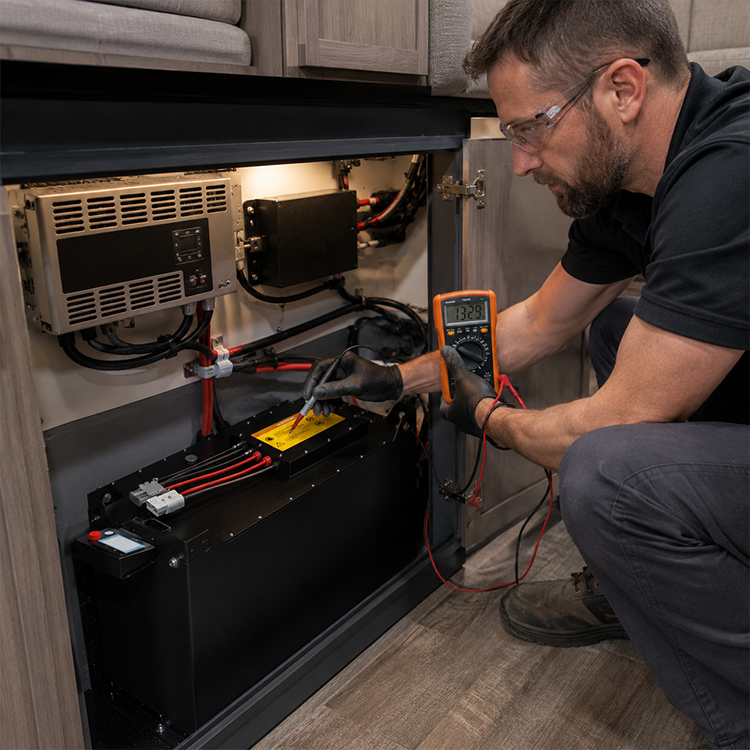
Find the model number on the converter, power center, or inverter/charger. Search the manual. Look for LiFePO4 mode, lithium profile, fixed voltage output, or programmable settings. Then plug into shore power and measure voltage at the battery terminals, not just at the converter output.
A useful field test looks like this:
Test Point
What You Want to See
What It May Mean If You Don’t
Converter manual
LiFePO4/LFP mode or programmable profile
Lead-acid-only charger may undercharge or mischarge
Battery terminal voltage during charge
Often around 14.2–14.6V, depending on battery spec
13.6V may never fully charge many banks
Float behavior
Disabled or low lithium-safe float
High or constant float may be wrong for the pack
Equalization
Disabled
Equalization mode is a red flag
Temperature compensation
Disabled unless battery maker says otherwise
Lead-acid temp compensation can be bad for lithium
BMS limit
Charge current and voltage match charger
BMS trips, heat, shutdowns, or short cycle complaints
Shore-power load test
Lights, fans, fridge controls stable while charging
Converter may be overloaded or poorly wired
For dealers and private-label buyers, the safer path is not guessing from forum posts. Build the battery and charging package together. CoreSpark’s RV LiFePO4 battery supply category and lead-acid replacement battery solutions are the kinds of internal pages I would connect from this article because the buyer is already thinking about replacement risk, not just cell chemistry.
My Hard Rule for the Best RV Converter for Lithium Batteries
The best RV converter for lithium batteries is not the one with the loudest “lithium ready” badge.
It is the one that matches the battery’s actual charge profile, supports the RV’s 12V load while charging, does not sneak in equalization, has enough amperage without abusing the BMS, and leaves room for how the RV is really used: long shore-power stays, generator charging, solar input, alternator input, cold mornings, and impatient owners.
For a small weekend trailer with one 12V 100Ah LiFePO4 battery, a 30A–45A lithium converter may be sensible. For a 400Ah–600Ah off-grid bank with a 2,000W or 3,000W inverter, I would rather see a properly programmed inverter/charger, a DC-DC alternator charger, and a solar controller that all agree with the battery limits.
Simple sells. Systems survive.
And if you are sourcing batteries for RV dealers, van builders, accessory distributors, or off-grid installers, study real project patterns before ordering containers. CoreSpark’s LiFePO4 battery case studies and project support page fits naturally here because compatibility is not just a consumer question; it is a supply-chain warranty question.
FAQs
Is my RV converter compatible with LiFePO4 batteries?
An RV converter is compatible with LiFePO4 batteries when its charging profile, voltage ceiling, current output, and float behavior match the battery manufacturer’s limits, typically around 14.2–14.6V bulk/absorb for a 12.8V bank, no equalization, and either no float or a low float near 13.5–13.6V.
Do not judge compatibility by the word “12V.” Judge it by the measured charging voltage, the manual’s battery profile, and the BMS requirements. If the converter only supports flooded, AGM, or gel profiles, assume it needs deeper verification.
Do I need to change my RV converter for LiFePO4 batteries?
You need to change your RV converter if it cannot provide a lithium-friendly profile, cannot reach the required bulk/absorption voltage, keeps equalizing, or forces a lead-acid float behavior that keeps the battery at the wrong state of charge for long storage or shore-power use.
You may not need to change it if the converter has a verified LiFePO4 mode, programmable voltage settings, or a manufacturer-approved profile for your exact battery. The practical answer comes from a manual and a voltmeter, not from a sales page.
Can a lead-acid RV converter charge a LiFePO4 battery?
A lead-acid RV converter can sometimes charge a LiFePO4 battery, but compatibility is incomplete when the converter stays near 13.6V, uses temperature compensation, or relies on float/equalization stages designed for flooded, AGM, or gel batteries rather than lithium iron phosphate chemistry.
In real use, that means the lights may work and the battery may gain some charge, while the owner still gets poor recharge speed, reduced usable capacity, BMS interruptions, or long-term imbalance complaints.
What is the best RV converter for lithium batteries?
The best RV converter for lithium batteries is one that matches the exact LiFePO4 charging limits on the battery datasheet, supports stable 12V DC loads while charging, provides enough amperage for the battery bank, and avoids lead-acid equalization or aggressive temperature-compensated charging.
For small RV banks, a lithium-selectable converter may be enough. For large off-grid systems, a programmable inverter/charger plus solar and DC-DC charging usually gives better control.
How do I tell if my RV converter is lithium compatible?
To tell if your RV converter is lithium compatible, read the label and manual for a LiFePO4, LFP, or lithium mode, then verify the actual output voltage with a meter at the battery terminals during shore-power charging under load.
For a 12.8V LiFePO4 bank, useful evidence includes a compatible bulk/absorb voltage, no equalization, sane float behavior, and converter amperage that stays within the battery BMS charge-current limit.
Your Next Step: Audit the Converter Before You Buy the Battery
Do not buy the battery first and investigate the converter later.
Write down the converter model, battery bank size, target amp-hours, inverter wattage, cable length, fuse rating, shore-power charging needs, solar controller model, and alternator charging plan. Then match the system around the LiFePO4 battery, not around wishful thinking.
If you are building an RV lithium product line, replacing lead-acid batteries for customers, or sourcing private-label packs, send the voltage, capacity, application, quantity, and charger requirements to CoreSpark through the battery project contact page. Ask for charger matching, BMS limits, low-temperature protection, and documentation before the first sample ships.
Newsletter Updates
Enter your email address below and subscribe to our newsletter
BYingPower provides OEM, wholesale, and custom LiFePO4 battery packs for golf carts, RVs, forklifts, solar storage, marine power, and lead-acid replacement applications. We support battery brands, distributors, dealers, system integrators, and OEM buyers with reliable lithium battery solutions, smart BMS options, private-label services, and export documentation support.