Send us your application, voltage, capacity, battery size, quantity, and branding needs. BYingPower will review your project and recommend the right LiFePO4 battery solution for golf carts, RVs, marine systems, solar storage, forklifts, or lead-acid replacement.
Custom battery pack review for your application
OEM/ODM and private-label battery guidance
BMS, charger, terminals, heating, and packaging support
Faster quote path for samples and bulk orders
4th Floor, Building A, No. 2, Longjiang 2nd Road, Xie Keng, Qingxi Town, Dongguan Province,China.
Charging Large LiFePO4 Banks from Solar and Generator
Charging large LiFePO4 banks from solar and generator power is not just about plugging in more amps. It is about voltage discipline, charge-source coordination, BMS limits, alternator protection, generator loading, and honest capacity math.
And when I say “undersize,” I do not mean they bought a solar controller that is 10A too small; I mean they built a 600Ah, 800Ah, or 1,000Ah LiFePO4 battery bank, then expected a scattered solar array and a tired generator charger to behave like a properly engineered charging system.
Why does this mistake keep happening?
Because LiFePO4 battery charging looks easy on paper. Lithium iron phosphate chemistry, LiFePO4, has a flatter voltage curve than lead-acid, accepts high current efficiently, and does not need the old-school absorption marathon that flooded batteries demanded. Nice story. Half true.
The other half is where systems fail.
A large LiFePO4 bank is not a “big phone battery.” It is an energy reservoir with serious current potential, tight voltage limits, and a Battery Management System that may shut the party down instantly if charging equipment gets sloppy. That matters whether you are charging LiFePO4 batteries with solar, a generator, shore power, or a mixed off-grid setup.
The market is moving fast, too. The U.S. Energy Information Administration reported that solar and battery storage were expected to account for 81% of planned U.S. utility-scale capacity additions in 2025, with battery storage alone expected to add 18.2 GW. That is not RV forum chatter; that is grid-scale momentum pushing better lithium charging practices into every corner of the industry. See the EIA’s own numbers here: solar and battery storage capacity additions in 2025.
For small systems, mistakes are annoying. For large LiFePO4 battery bank charging, mistakes get expensive.
Table of Contents
Solar Charging Lithium Battery Banks: Where the Free Power Lie Starts
Solar is beautiful.
But solar is not magic, and anyone selling it as “free charging forever” is leaving out clouds, panel angle, charge-controller losses, wire voltage drop, winter sun, dirty glass, shading, and the fact that your batteries do not care what the brochure promised.
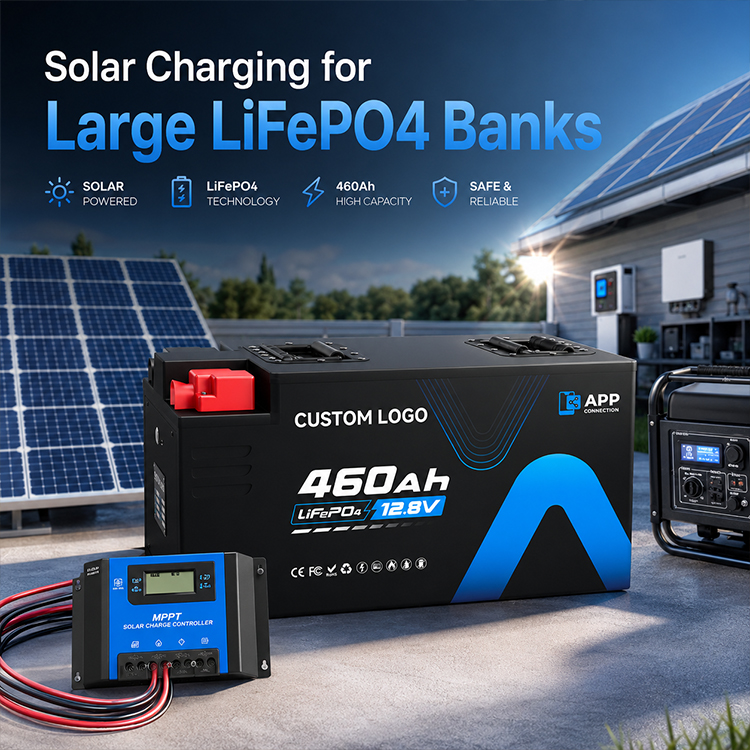
For a large LiFePO4 bank, I want the solar side designed around real daily watt-hours, not panel nameplate fantasy. A 1,200W array might look huge on a quote sheet. In field conditions, after heat, angle, MPPT conversion loss, wiring, and weather, the usable harvest can look brutally smaller.
If you are building around 12V loads, start by reviewing proper 12V LiFePO4 Battery options instead of stacking random drop-in batteries with different BMS limits. For higher-power inverter systems, especially where current becomes ugly, a 24V LiFePO4 Battery platform is usually cleaner, cooler, and less abusive to cables and busbars.
Here is the rule I use: design solar charging for recovery, not decoration.
A large bank should not merely “get some sun.” It should recover a meaningful percentage of daily consumption during realistic solar windows. If the bank is 10kWh and the average load is 4kWh per day, a tiny array is not resilience. It is theater.
The Voltage Settings I Actually Care About
For most 12.8V LiFePO4 packs, a common charge-voltage range is around 14.2V to 14.6V, depending on manufacturer limits and BMS design. For 25.6V systems, double it. For 51.2V systems, scale accordingly.
But I am not religious about always pushing to the top.
In daily off-grid use, charging to a slightly lower voltage can reduce stress, reduce balancing drama, and still deliver most usable capacity. The last few percent of state of charge are where many systems waste time while pretending to be “full.”
Hard truth: if your system needs 100% charge every single day to survive, the bank is too small, the charging is too weak, or the load plan is fantasy.
Charging Source
Best Use Case
Common Failure
My Preferred Strategy
Solar MPPT
Daily bulk charging from PV
Oversold panel output and weak wiring
Size array for real watt-hours, not sticker watts
Generator charger
Fast recovery during low sun
Charger too small or generator lightly loaded
Use high-output charging that loads generator efficiently
Shore power charger
Controlled full charge and balancing
Wrong lithium profile
Match voltage, current, and temperature rules
DC-DC charger
Vehicle or alternator-assisted charging
Alternator overheating
Use current-limited charging with temperature awareness
Hybrid inverter-charger
Integrated solar, AC, and battery control
Poor settings across sources
Program charge priority, voltage ceiling, and current limits carefully
Generator Charging LiFePO4 Battery Banks Without Burning Fuel Like an Amateur
Generators hate loafing.
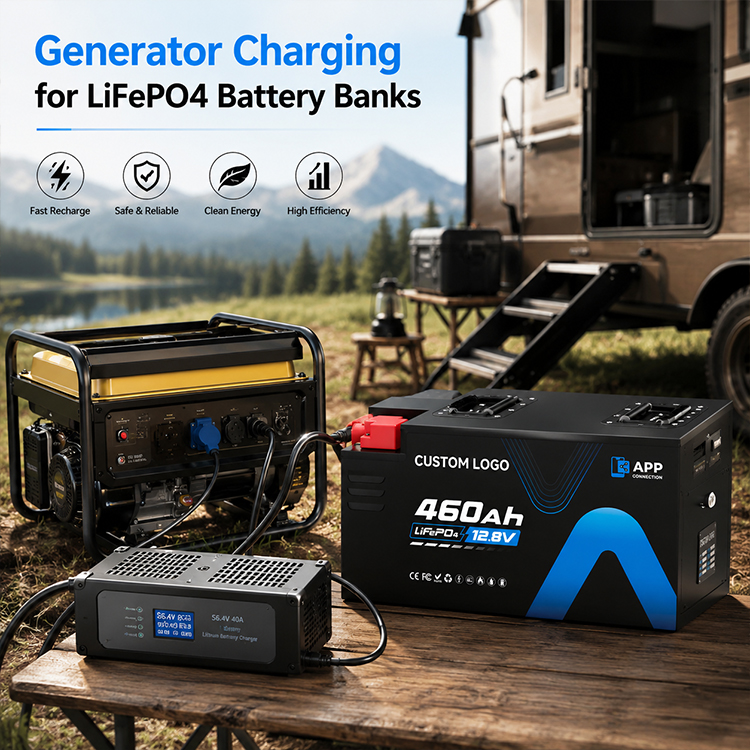
That is one of the most ignored facts in off grid battery charging. A generator running a tiny charger for eight hours is noise, heat, wear, and fuel turned into disappointment. Large LiFePO4 banks can accept high charge current, so the generator system should exploit that safely.
The trick is not “use the biggest charger possible.” The trick is matching charger output to:
Battery BMS maximum charge current
Cell temperature range
Generator continuous power rating
AC charger power factor
Cable and fuse limits
Heat management inside the battery compartment
I do not trust systems where the generator is treated as an emergency afterthought. If the solar side underperforms for three rainy days, the generator becomes the backbone. That backbone needs math.
A 5kWh LiFePO4 bank discharged to 30% state of charge needs roughly 3.5kWh to return near full, before conversion losses. With a 1,500W charger, that is not a quick top-up. With a properly matched 3,000W charger, it becomes a practical recovery window. But push beyond the battery’s charge-current rating and the BMS may cut off, the charger may fault, or the system may cycle in the dumbest possible way.
So, yes, generator charging LiFePO4 battery systems can be fast. But only when the AC charger, battery pack, BMS, wire size, fusing, and generator rating agree with each other.
That is why OEM pack design matters. For distributors, integrators, and builders who need voltage, capacity, BMS communication, heating, charger matching, and enclosure constraints aligned from the start, CoreSpark’s custom LFP battery pack engineering is the kind of internal page I would naturally put in front of a serious buyer.
The BMS Is Not Your Electrician
The BMS is a last line of defense.
I dislike the way lithium batteries are sold as if the BMS makes bad design safe. It does not. A BMS can disconnect charging when voltage, current, or temperature goes out of range, but it cannot fix poor cable routing, wet battery compartments, bargain-bin breakers, mismatched chargers, or installers who refuse to read charge profiles.
The safety side is not theoretical. The EPA’s battery energy storage guidance points to NFPA 855 and UL 9540/9540A as relevant standards for stationary battery energy storage systems, including fire protection and test methods. Read that again: standards exist because batteries are not decorative boxes. The EPA resource is here: Battery Energy Storage Systems: Main Considerations for Safe Installation and Incident Response.
And then there is Moss Landing.
In January 2025, the Moss Landing battery fire in California forced evacuations and became a public lesson in what happens when large lithium energy storage systems fail loudly. AP reported evacuations around the incident and concerns about toxic smoke, while the EPA later documented that the Moss Landing 300 system held about 100,000 lithium-ion batteries and that about 55% were damaged by fire. The sources are not rumor threads: AP’s Moss Landing fire report and the EPA’s Moss Landing Vistra Battery Fire Response.
Does that mean LiFePO4 is unsafe? No. It means large energy systems deserve adult supervision.
Temperature Is the Detail That Exposes Lazy Installations
LiFePO4 batteries generally should not be charged below freezing unless the pack has an approved low-temperature charging system, usually internal heating plus BMS control. This is not optional trivia. Charging cold lithium cells can damage them permanently.
For RV, marine, cabin, and mobile solar systems, this matters more than most people admit. A battery box that is fine in July can become a cell-damage chamber in January. If the system is used in campers, boats, or remote cabins, it is worth studying purpose-built RV LiFePO4 Battery designs and broader RV and off-grid battery guides before choosing pack size.
Solar Plus Generator Charging: The Setup I Actually Respect
A serious off-grid charging system has hierarchy.
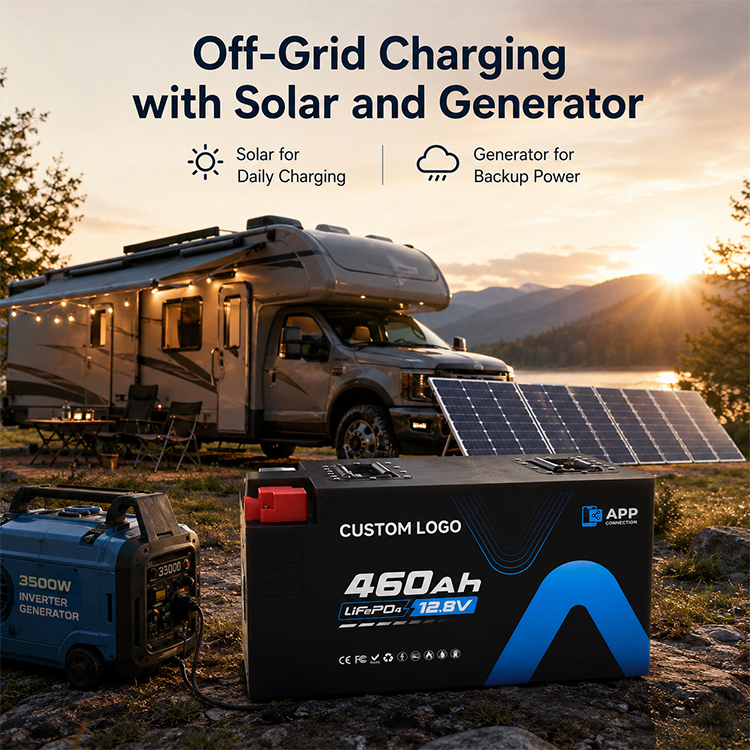
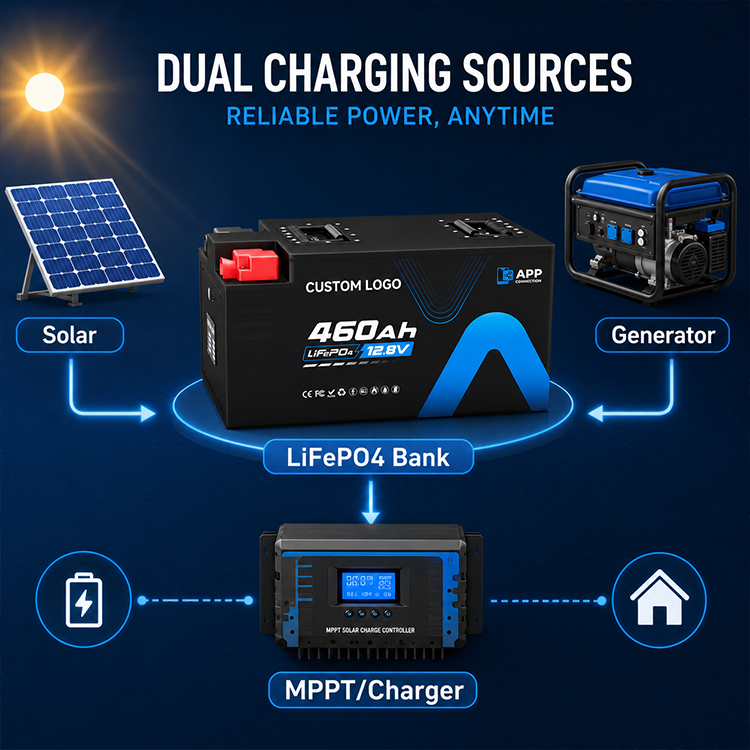
Solar should handle routine daily charging. The generator should handle recovery when weather or load spikes beat the solar forecast. Shore power, if available, should handle controlled top-balancing and maintenance checks. The battery bank should not be forced to compensate for lazy charging architecture.
For large LiFePO4 battery bank charging, I prefer this logic:
Solar MPPT performs bulk charging during daylight.
Generator charger is programmed for high-current recovery but stops before wasting hours chasing the last few percent.
Battery monitor tracks amp-hours and state of charge, not just voltage.
BMS is treated as protection, not control strategy.
Charge sources follow the same voltage ceiling and temperature rules.
Simple. Not easy.
The problem with many mixed systems is that every charger thinks it is the boss. The solar controller, inverter-charger, DC-DC charger, and generator charger all push their own profiles. One source hits absorption. Another keeps pushing. The BMS sees a high cell. Click. Charging stops. Then the owner blames the battery.
I blame the design.
If you are replacing AGM or flooded lead-acid, do not assume the old charging architecture is compatible. LiFePO4 is more efficient, but it is less forgiving of wrong voltage and cold charging. CoreSpark’s lead-acid replacement batteries page fits naturally here because the replacement decision is not only about capacity; it is about charger behavior, BMS limits, installation space, and duty cycle.
Why the Industry Is Quietly Moving Toward Bigger Lithium Banks
Money talks.
Reuters reported in April 2026 that U.S. battery storage installations rose 30% in 2025 to a record 58 GWh, with another 60 GWh expected in 2026, according to the U.S. Energy Storage Market Outlook Q1 2026 from Benchmark Mineral Intelligence and SEIA. Reuters also noted that cells represent roughly 40% of system costs and that supply-chain dependence still matters. Read the industry context here: Reuters on U.S. battery storage supply and demand.
That trend reaches smaller markets fast: RVs, marine power, telecom backup, mobile workshops, solar sheds, emergency trailers, and remote construction sites.
But here is my unpopular opinion: many buyers should spend less money on extra battery capacity and more money on proper charging.
A larger battery bank only hides a weak charging system for longer. Eventually the state of charge falls, the generator comes out, and the owner discovers the charger is too small, too slow, or incompatible. Capacity without recovery is just delayed failure.
A Practical Charging Blueprint for Large LiFePO4 Banks
Start with loads, not batteries.
Calculate daily watt-hours first: inverter loads, DC loads, surge loads, refrigeration, water pumps, induction cooking, air conditioning, communications gear, lighting, medical devices, tools, and standby draw. Then size the battery bank around autonomy. Then size the solar and generator around recovery.
For a professional system, I want these numbers documented:
Total bank voltage: 12.8V, 25.6V, 48V, or 51.2V
Total capacity in Ah and kWh
Maximum continuous charge current
Maximum continuous discharge current
Recommended charge voltage
Low-temperature charge cutoff
Solar array wattage and expected daily harvest
Generator charger wattage and AC input draw
Cable size, fuse rating, disconnect type, and busbar rating
BMS communication: Bluetooth, CAN, RS485, or closed-loop inverter protocol
This is also where 12V systems begin to show their limits. At 12V, a 3,000W inverter can pull current that makes wiring expensive and heat management annoying. At 24V or 48V, current drops for the same power output, which often means cleaner installation and less voltage sag.
Do not worship voltage. Use the voltage that fits the load.
FAQs
What is the best way to charge a large LiFePO4 battery bank from solar and generator?
The best way to charge a large LiFePO4 battery bank from solar and generator power is to let solar handle daily bulk charging while the generator provides controlled high-current recovery during poor weather or heavy load periods. Both sources must share correct lithium voltage limits, current limits, temperature protection, and BMS compatibility.
In practice, that means MPPT solar controllers, lithium-compatible AC chargers, proper fusing, oversized cabling, and a battery monitor that tracks state of charge. Do not rely on voltage alone; LiFePO4 voltage stays flat for much of the discharge curve.
Can I charge LiFePO4 batteries with solar panels directly?
You should not charge LiFePO4 batteries directly from solar panels because the battery needs a solar charge controller to regulate voltage, current, absorption behavior, and cutoff limits. A proper MPPT controller converts unstable panel output into a controlled lithium charging profile that protects the cells and the BMS.
Direct panel connection can overvoltage the battery, trigger BMS cutoff, damage cells, or create unsafe wiring conditions. For large banks, use a controller sized for array voltage, array current, battery voltage, and the manufacturer’s LiFePO4 charging profile.
What voltage should I use for LiFePO4 battery charging?
LiFePO4 battery charging voltage depends on system voltage and manufacturer specifications, but many 12.8V packs use an upper charge range around 14.2V to 14.6V, while 24V and 48V systems scale upward. The safest answer is always the voltage printed in the battery datasheet, not a forum default.
For daily cycling, many installers avoid pushing to the absolute upper limit unless balancing is needed. Lower top-charge voltage can reduce stress and still deliver most usable capacity, especially in solar and generator hybrid systems.
Is generator charging bad for LiFePO4 batteries?
Generator charging is not bad for LiFePO4 batteries when the charger is lithium-compatible, current-limited, correctly fused, and matched to the battery’s BMS and temperature limits. In fact, LiFePO4 banks often charge more efficiently from generators than lead-acid banks because they can accept higher current through most of the bulk phase.
The real problem is poor charger selection. A weak charger wastes fuel; an oversized charger may trip the BMS or overload the generator. A well-designed generator charging setup should recover energy quickly without chasing the final few percent for hours.
How big should my solar array be for a large LiFePO4 battery bank?
Your solar array should be sized around daily energy use, local sun hours, seasonal weather, and the recovery time you expect, not merely around battery capacity. A 10kWh LiFePO4 bank with 4kWh of daily load needs enough real-world solar harvest to replace that energy plus system losses.
As a rough planning method, divide daily watt-hours by realistic peak sun hours, then add margin for heat, panel angle, shading, dust, wiring, and MPPT losses. For off-grid systems, undersized solar usually leads to excessive generator runtime.
Your Next Steps
If you are charging a small LiFePO4 pack, you can get away with simple gear. If you are charging a large LiFePO4 bank from solar and generator power, stop guessing.
Map your loads. Confirm your battery voltage. Check the BMS charge-current limit. Match the MPPT, generator charger, cabling, fuses, and low-temperature protection before you buy more capacity. And if the system is for RV, marine, solar storage, private-label supply, or OEM integration, start with CoreSpark’s LiFePO4 battery product range and request a configuration review before turning an expensive battery bank into an expensive lesson.
Newsletter Updates
Enter your email address below and subscribe to our newsletter
BYingPower provides OEM, wholesale, and custom LiFePO4 battery packs for golf carts, RVs, forklifts, solar storage, marine power, and lead-acid replacement applications. We support battery brands, distributors, dealers, system integrators, and OEM buyers with reliable lithium battery solutions, smart BMS options, private-label services, and export documentation support.