Send us your application, voltage, capacity, battery size, quantity, and branding needs. BYingPower will review your project and recommend the right LiFePO4 battery solution for golf carts, RVs, marine systems, solar storage, forklifts, or lead-acid replacement.
Custom battery pack review for your application
OEM/ODM and private-label battery guidance
BMS, charger, terminals, heating, and packaging support
Faster quote path for samples and bulk orders
4th Floor, Building A, No. 2, Longjiang 2nd Road, Xie Keng, Qingxi Town, Dongguan Province,China.
How to Choose Between 48V and 51.2V Golf Cart Batteries
Most buyers search for 48V vs 51.2V golf cart batteries as if the answer is hidden in the label. It is not. The real answer lives in the controller, charger profile, BMS rating, peak current demand, and whether the pack is built for actual golf cart abuse.
They ask, “Should I buy 48V or 51.2V?” I think the better question is nastier: “Will this pack survive my controller, my charger, my hills, my passengers, and my lazy accessory wiring?”
Voltage is marketing.
But behind that label sits a very real electrical system, and if you ignore the difference between nominal voltage, full-charge voltage, BMS cut-off behavior, and charger compatibility, you can turn a smart lithium upgrade into a warranty fight that nobody wants to own.
So, which number should you trust?
Table of Contents
The Dirty Secret Behind 48V vs 51.2V Golf Cart Batteries
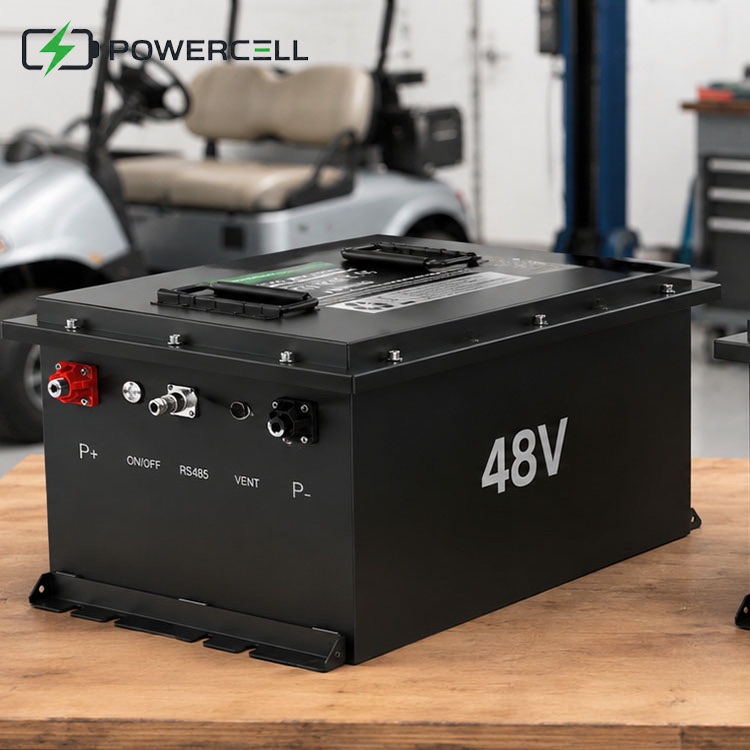
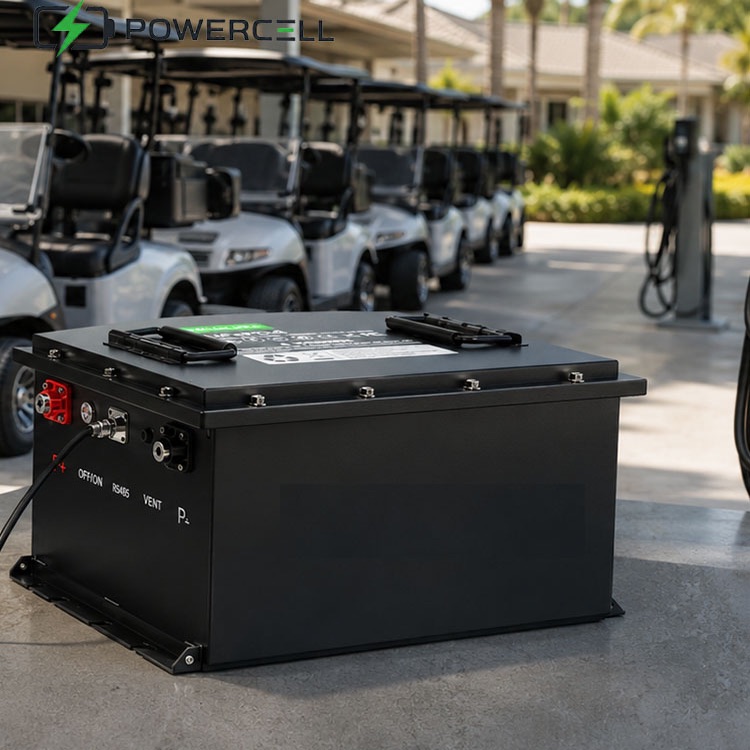
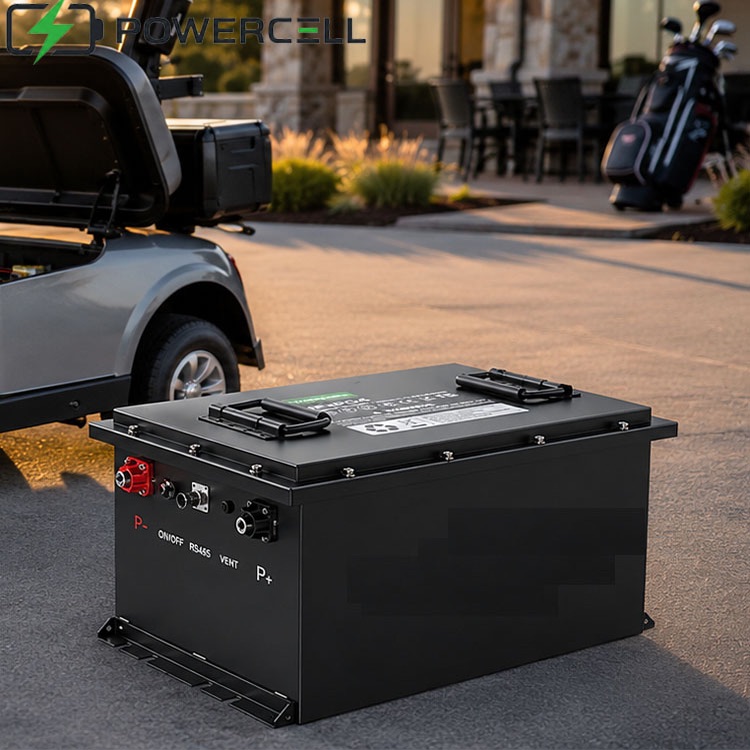
A 51.2V golf cart battery is usually a 16-series LiFePO4 pack. That means 16 lithium iron phosphate cells, each around 3.2V nominal, connected in series. Simple math: 16 × 3.2V = 51.2V.
That number is not branding fluff. It tells you something about the internal pack architecture.
A “48V golf cart battery,” on the other hand, can mean several things. It might mean a legacy 48V lead-acid system. It might mean a lithium replacement marketed for 48V carts. It might mean a pack designed to fit the voltage expectations of older controllers. And yes, sometimes sellers casually call a 51.2V LiFePO4 pack a 48V-class battery because the golf cart market still speaks in old lead-acid language.
That is where buyers get burned.
Battery University explains the baseline chemistry clearly: lead-acid cells are typically 2.0V nominal, while lithium phosphate cells are typically 3.2V nominal in series-pack design, which is why pack labels can look deceptively close while the actual charge behavior differs (Battery University series configuration guide).
Here is my hard opinion: if a supplier cannot explain whether their “48V lithium golf cart battery” is a true 48V-class pack, a 51.2V 16S LiFePO4 pack, or just a relabeled SKU for search traffic, I would not put it in a customer’s cart.
The Voltage Comparison Nobody Puts on the Sales Flyer
A golf cart battery voltage comparison should not stop at nominal voltage. That is amateur work. The full-charge voltage matters because controllers, onboard chargers, contactors, reducers, lights, audio systems, and street-legal kits all feel the top end.
Decision Point
48V Golf Cart Battery
51.2V Golf Cart Battery
Common meaning
Legacy 48V system or lithium pack sold for 48V carts
Usually 16S LiFePO4 architecture
Typical chemistry context
Lead-acid, lithium replacement, or mixed market labeling
LiFePO4 battery chemistry, chemical formula LiFePO4
Modern lithium conversions, dealer programs, higher usable energy builds
Main risk
Buyer assumes all “48V lithium” packs behave the same
Buyer ignores whether the cart accepts the higher full-charge voltage
Dealer question
“Is this truly compatible with the existing controller and charger?”
“Can every electrical component tolerate the 16S LiFePO4 voltage window?”
This is the point where some suppliers get slippery. They sell amp-hours like candy: 100Ah, 105Ah, 150Ah, 200Ah. Nice numbers. Easy numbers.
But amp-hours alone do not tell you whether the BMS can handle a hill climb with four passengers, oversized tires, a tired motor, and a driver who treats the accelerator like an on/off switch.
I have seen enough battery spec sheets to distrust the clean ones. If the sheet gives you capacity but hides peak discharge current, continuous current, charger voltage, cell configuration, operating temperature, and cut-off behavior, it is not a spec sheet. It is a brochure wearing a lab coat.
51.2V Is Often the Cleaner LiFePO4 Story
Here is the case for 51.2V.
When a battery is sold as a 51.2V golf cart battery, the supplier is usually being more technically honest about the LiFePO4 platform. A 16S LiFePO4 pack is a familiar architecture in modern lithium battery systems. It gives a stable voltage curve, good usable energy, and strong cycle-life potential when the BMS and charger are properly matched.
The International Energy Agency reported that LFP batteries supplied more than 40% of global EV battery demand by capacity in 2023, more than double their share in 2020, which tells us something important: LiFePO4 is no longer a cheap fringe chemistry. It is a mainstream industrial chemistry with scale behind it (IEA Global EV Outlook 2024).
That does not mean every golf cart LiFePO4 battery is good.
It means the chemistry has credibility. The execution still has to earn it.
For a dealer, installer, or fleet buyer, the 51.2V label can make technical conversations cleaner. You know the nominal voltage. You know the likely series count. You know the charger should be built around a lithium profile, not a lazy lead-acid float routine. And you can ask sharper questions about BMS current, Bluetooth monitoring, CAN/RS485 communication, LCD displays, heating options, casing, and documentation.
CoreSpark Battery’s OEM/ODM LiFePO4 battery pack development page makes this distinction useful for B2B buyers because custom voltage, BMS configuration, charger matching, testing, and documentation are exactly where serious golf cart programs succeed or fail.
When a 48V Golf Cart Battery Still Makes More Sense
Do not worship 51.2V blindly.
A 48V golf cart battery still makes sense when the existing cart platform is picky, old, or not worth rewiring. Some controllers are tolerant. Some are not. Some accessories are protected by reducers. Some are wired like a weekend crime scene. Some onboard chargers are easy to bypass. Some create a support headache.
But the big reason to stay closer to a 48V-class replacement is compatibility risk.
If the customer has a conservative utility cart, low-speed neighborhood vehicle, resort cart, or older Club Car, EZGO, or Yamaha build, the smart move may be a compatibility-first lithium conversion rather than a maximum-voltage conversion.
And here is where I get opinionated: the best lithium battery for golf cart use is not the biggest pack your sales team can quote. It is the pack least likely to create a callback.
Small callbacks are expensive. Big callbacks are ugly.
The U.S. Consumer Product Safety Commission has published multiple electric cart and charger recalls that should make this industry more humble. In 2018, Lester Electrical recalled about 19,000 Links Series chargers used with golf carts after reports of control boards overheating or burning (CPSC Lester charger recall). In 2020, Garia recalled about 1,000 golf and courtesy battery-powered electric vehicles because a fuse could overheat and melt while charging; the vehicles had been sold for $15,000 to $75,000 (CPSC Garia recall).
That is not internet panic. That is government recall history.
Charger Matching Is Where Cheap Lithium Conversions Get Exposed
The charger is not an accessory. It is part of the battery system.
A lead-acid charger often uses float charging behavior. Lithium does not like being treated like lead acid forever. Battery University notes that lead-acid chargers apply float charge, while lithium chemistry requires charge current to stop when fully charged; maintaining lithium systems on float can shorten life and may create safety issues in some systems (Battery University LiFePO4 charging guide).
That is why I do not trust “drop-in replacement” claims unless the supplier gives me the charger profile in writing.
A proper LiFePO4 golf cart battery upgrade should answer these questions before money changes hands:
Charger Questions I Would Ask Before Buying
What is the recommended charger voltage for this exact battery?
Is the charger included, optional, or assumed?
Does the charger stop charging correctly for LiFePO4?
Is the pack designed for onboard charging, external charging, or both?
Can the old lead-acid charger be used, or should it be replaced?
What happens if the BMS disconnects during charging?
Is there documentation for distributors, installers, and warranty claims?
If the answer is “it should work,” I hear “we have not tested it.”
For buyers replacing old lead-acid banks, CoreSpark Battery’s lead-acid replacement batteries category is the more relevant internal path than treating every golf cart as a blank-slate lithium build.
The BMS Is the Real Boss
The Battery Management System is where the battery either behaves professionally or embarrasses the seller.
A good BMS protects against over-voltage, under-voltage, over-current, short circuit, temperature extremes, and cell imbalance. A weak BMS turns a decent cell pack into a support liability. In golf carts, the BMS has to deal with motor surge, regenerative behavior on some systems, hill loads, cargo, passenger weight, and sometimes ugly accessory wiring.
This is why I care less about a pretty Bluetooth app than I care about continuous discharge rating and peak discharge rating.
A 51.2V 100Ah battery with a weak BMS can perform worse in the real world than a better-built 48V 105Ah pack with honest surge tolerance. The numbers on the case are not the same as the numbers under load.
In March 2024, CPSC announced a recall for about 500 Textron Tracker Off Road OX EV vehicles because water could get into the lithium-ion battery pack and pose a fire hazard; the remedy instructions included stopping use, not charging the vehicle, and parking outdoors at least 15 feet away from buildings or other vehicles until service was completed (CPSC Textron OX EV recall).
That case matters because it proves a point the industry dislikes admitting: lithium battery safety is not just chemistry. It is enclosure design, sealing, installation environment, charger behavior, service procedure, and user discipline.
The Hard Buying Rule: Match the System, Not the Label
If I were buying for one personal cart, I would start with the controller and charger. If I were buying for a dealer program, I would start with failure modes and warranty exposure. Different mindset. Better results.
For a single cart owner, a 51.2V LiFePO4 golf cart battery often makes sense when the controller accepts the voltage range, the charger is lithium-correct, the BMS is sized for peak current, and the pack physically fits without creative surgery.
For a dealer, a 48V golf cart battery may be easier to position when customers expect a simple lead-acid replacement and the goal is fewer installation variables. But if the dealer can control charger matching, documentation, and installation standards, the 51.2V platform usually gives a cleaner technical story.
For a fleet, I would compare cost per usable kWh, downtime, warranty procedure, charge time, maintenance reduction, and replacement repeatability. Not hype. Numbers.
The New York Fire Department reported that, as of August 29, 2024, lithium-ion batteries had caused 171 fires, 59 injuries, and three fatalities in New York City that year, and that nearly 60% of 2023 lithium-ion battery fires were caused by batteries that were not charging (FDNY lithium-ion battery warning). Golf cart batteries are not e-bike batteries, no. But the lesson transfers: battery quality, charging discipline, and system design matter even when the pack is parked.
My Practical Decision Framework
Use 51.2V when you want a modern 16S LiFePO4 platform, the controller supports the voltage, the charger is correct, the BMS can handle real peak current, and the seller provides documentation beyond a product title.
Use 48V when you are protecting compatibility with older systems, avoiding voltage-sensitive surprises, or replacing a lead-acid setup where the cart electronics are not worth redesigning.
Use neither until you verify the charger.
I would also check CoreSpark Battery’s golf cart battery guides before finalizing a conversion because golf cart lithium upgrades are rarely about the battery alone. Voltage reducers, BMS cut-off behavior, charger mismatch, and pack sizing all turn into practical installation problems.
Here is the boring checklist I would actually use:
Confirm cart voltage class: 36V, 48V, 51.2V, 72V, or 76.8V.
Confirm controller maximum input voltage.
Confirm motor current demand under hill and passenger load.
Confirm charger output voltage and lithium profile.
Confirm BMS continuous and peak current ratings.
Confirm pack dimensions, mounting, cable length, and terminal layout.
Confirm IP rating if the cart sees rain, washdowns, or outdoor storage.
Confirm Bluetooth, LCD, CAN, or RS485 needs before ordering.
Confirm warranty terms and what data is required for a claim.
Confirm recycling or end-of-life handling.
The EPA says discarded lithium-ion batteries are often likely to be hazardous waste because of ignitability and reactivity, and businesses may need to manage used lithium batteries under hazardous waste or universal waste rules (EPA lithium-ion battery recycling FAQ). The EPA also warns that lithium-ion batteries should not go into regular household trash or municipal recycling bins because they can become damaged and create fire hazards (EPA consumer lithium-ion battery FAQ).
So yes, end-of-life planning belongs in a battery buying guide. Dealers who ignore it are just pushing today’s cost into tomorrow’s problem.
FAQs
Is 51.2V better than 48V for a golf cart?
A 51.2V golf cart battery is usually better when the cart’s controller, charger, accessories, and wiring can safely support a 16S LiFePO4 voltage window, because it offers a cleaner lithium architecture and often more stable usable energy than old lead-acid-style systems. But “better” does not mean universal.
If the cart electronics are voltage-sensitive, a conservative 48V golf cart battery may be the safer replacement. The winner is the battery that matches the full system, not the one with the higher label.
Can I use a 51.2V battery in a 48V golf cart?
Yes, you can use a 51.2V battery in many 48V golf carts only if the controller, charger, wiring, contactor, DC converter, and accessories are rated for the pack’s full-charge voltage and peak discharge current, not just the nominal number printed on the old battery tray. Verification matters.
The danger is assuming “48V-class” means every part tolerates the same top-end voltage. A 16S LiFePO4 pack can charge higher than some buyers expect, so the controller and charger should be checked before installation.
What is the best lithium battery for golf cart use?
The best lithium battery for golf cart use is not simply the highest amp-hour pack; it is the pack whose voltage window, BMS peak-current rating, charger profile, physical dimensions, mounting method, communication options, and warranty terms match the cart’s controller and duty cycle. Fit beats hype.
For most professional buyers, I would prioritize LiFePO4 chemistry, a documented BMS, charger matching, realistic surge current ratings, waterproofing where needed, and supplier support. A cheap pack with vague specs is not a bargain. It is a future service ticket.
When should I choose a 48V golf cart battery instead of 51.2V?
A 48V golf cart battery makes more sense when the cart has strict legacy electronics, a voltage-sensitive controller, or a charger ecosystem that cannot safely support a 58.4V full-charge LiFePO4 profile without replacement or professional verification in writing before installation. Compatibility is the main reason.
This is especially true for older carts, rental fleets, budget-sensitive replacements, and repair shops that need predictable installs. A technically superior battery that creates controller faults is not superior in the field.
Why do sellers call 51.2V batteries “48V lithium batteries”?
Sellers often call 51.2V LiFePO4 batteries “48V lithium batteries” because the golf cart market still uses legacy 48V language from lead-acid systems, while modern 16S LiFePO4 packs have a 51.2V nominal rating that fits many 48V-class applications. It is shorthand, but it creates confusion.
That shorthand is acceptable only when the seller also publishes the actual nominal voltage, charge voltage, BMS rating, charger requirement, and compatibility limits. If those details are missing, the label is not helping you. It is hiding the real decision.
Your Next Steps
Do not buy by voltage label alone.
If you are choosing between 48V vs 51.2V golf cart batteries, send the supplier your cart brand, model year, controller rating, motor size, charger details, tire size, passenger load, terrain, and expected runtime. Ask for the exact battery voltage window, BMS continuous and peak current ratings, charger recommendation, installation notes, and warranty conditions.
If the answer comes back vague, walk away.
For dealers, fleet buyers, and private-label battery programs, the smarter move is to request a pack review through CoreSpark Battery’s custom LiFePO4 battery OEM/ODM support instead of forcing a generic SKU into a cart that may not forgive the mismatch.
Newsletter Updates
Enter your email address below and subscribe to our newsletter
BYingPower provides OEM, wholesale, and custom LiFePO4 battery packs for golf carts, RVs, forklifts, solar storage, marine power, and lead-acid replacement applications. We support battery brands, distributors, dealers, system integrators, and OEM buyers with reliable lithium battery solutions, smart BMS options, private-label services, and export documentation support.