Send us your application, voltage, capacity, battery size, quantity, and branding needs. BYingPower will review your project and recommend the right LiFePO4 battery solution for golf carts, RVs, marine systems, solar storage, forklifts, or lead-acid replacement.
Custom battery pack review for your application
OEM/ODM and private-label battery guidance
BMS, charger, terminals, heating, and packaging support
Faster quote path for samples and bulk orders
4th Floor, Building A, No. 2, Longjiang 2nd Road, Xie Keng, Qingxi Town, Dongguan Province,China.
Certifications for Exporting LiFePO4 Replacement Batteries
Exporting LiFePO4 replacement batteries is not just a shipping job. It is a documentation test. This guide explains which certificates matter, which ones buyers misunderstand, and why sloppy lithium battery export certification can stop a shipment cold.
The Ugly Truth About “Export-Ready” LiFePO4 Batteries
Paperwork kills deals.
If you are exporting LiFePO4 replacement batteries into the United States, the European Union, Australia, Canada, the Gulf, or any serious distributor channel, the buyer is not only buying a 12.8V 100Ah pack, a 25.6V module, or a 51.2V golf cart battery; they are buying a transport file, a legal declaration trail, and enough proof to keep the freight forwarder from turning the shipment into an expensive hostage situation.
So why do so many suppliers still treat LiFePO4 battery certification like a PDF decoration?
I’ll say the quiet part out loud: many “certified battery” claims in this industry are soft. Too soft. A factory may show a UN38.3 report, but the model number does not match. A sales rep may send an MSDS, but the document is five years old and written for a different cell chemistry. A buyer may ask for CE RoHS certified LiFePO4 batteries, but nobody checks whether the Declaration of Conformity actually names the right directives, standards, importer responsibility, or product family.
That is how shipments get delayed.
For buyers building a professional replacement battery program, start with the product class. If you are sourcing drop-in lithium alternatives for lead-acid markets, review the battery category first, not the certificate folder. CoreSpark’s lead acid replacement LiFePO4 battery range is the right internal starting point because replacement batteries create more documentation traps than simple catalog cells: casing, BMS, charger compatibility, terminal layout, label language, watt-hour rating, and packaging all matter.
Table of Contents
The Certification Stack Importers Actually Care About
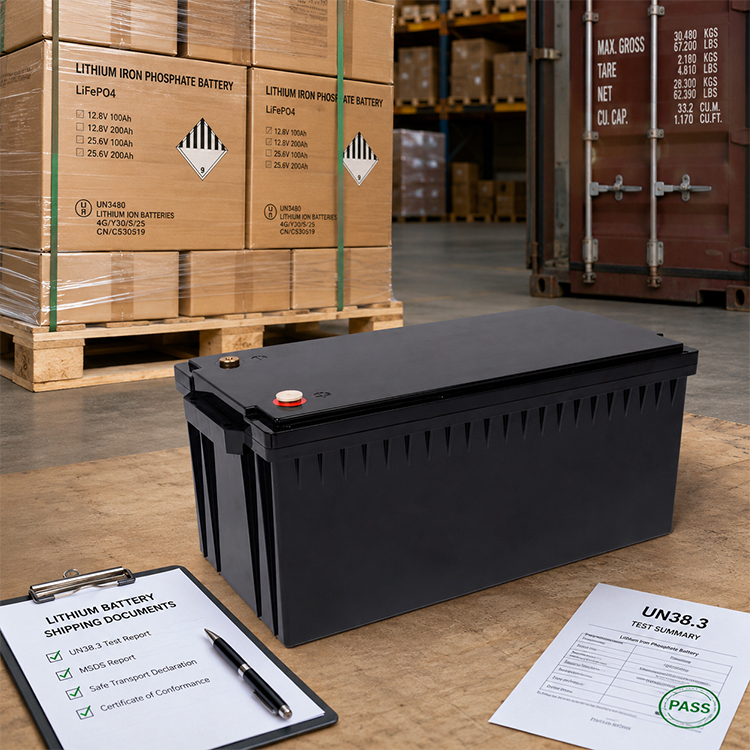
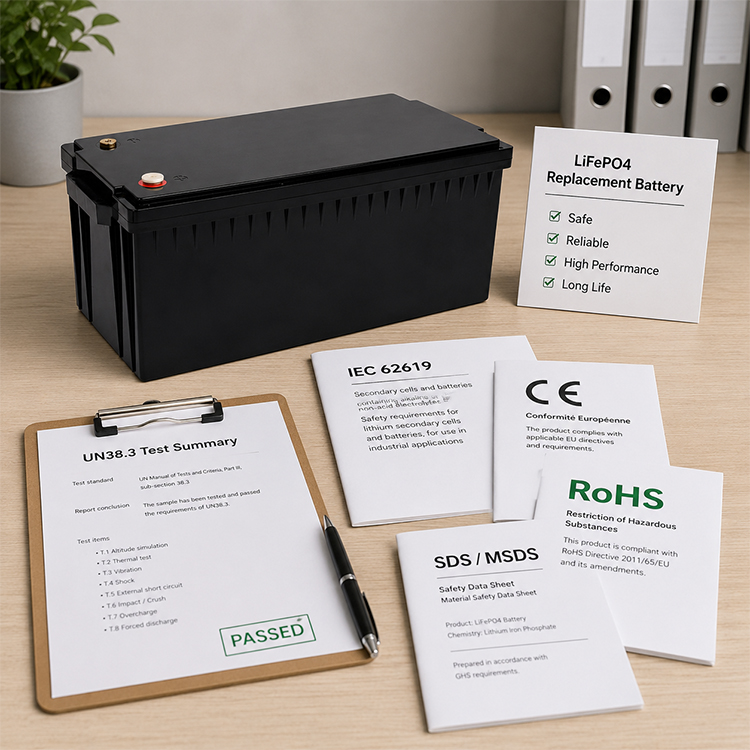
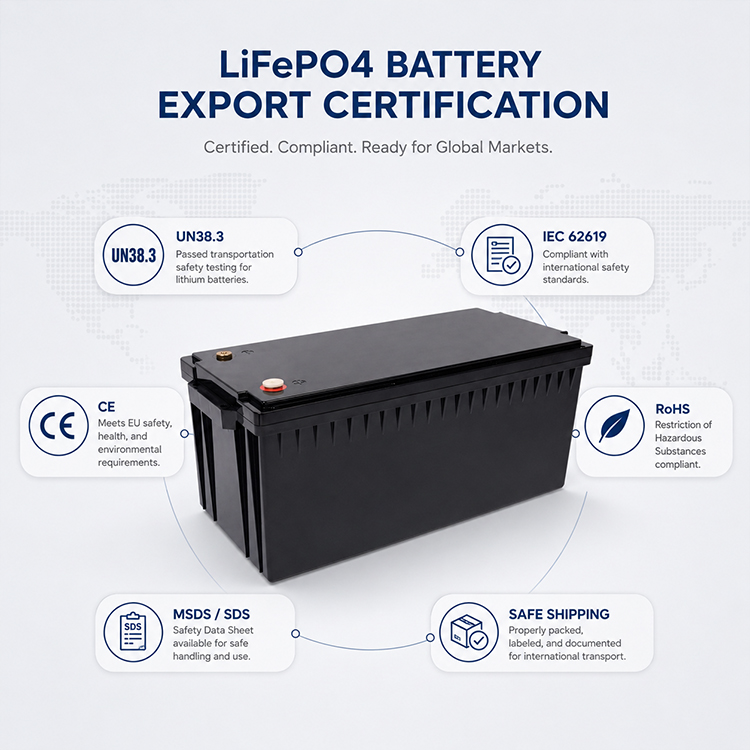
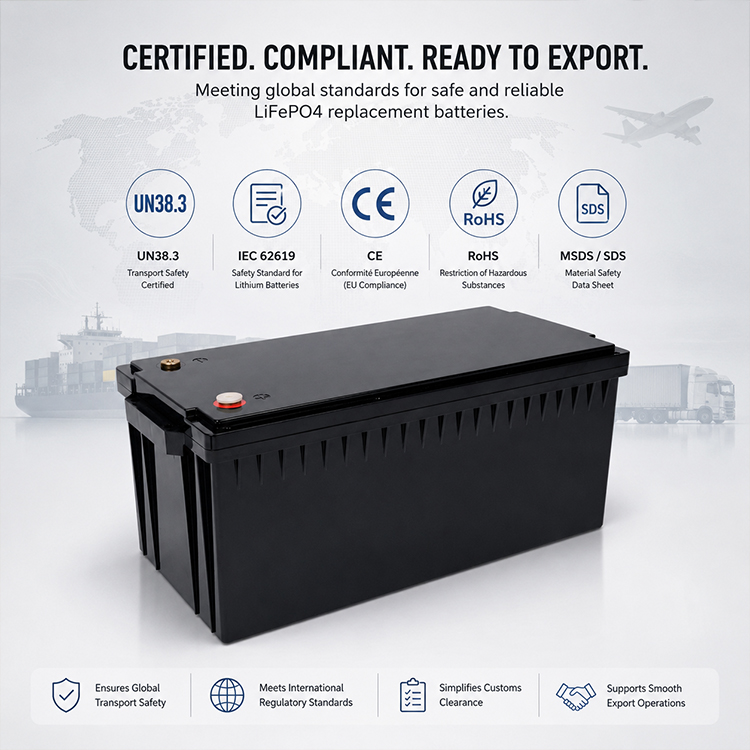
The minimum certification stack for exporting LiFePO4 replacement batteries usually includes UN38.3, SDS/MSDS, transport classification, packaging and labeling documents, IEC 62619 where industrial safety proof is required, and CE/RoHS documentation where the EU market is involved. PHMSA states that lithium batteries must undergo design tests under sub-section 38.3 of the UN Manual of Tests and Criteria, and its updated guidance covers the test summary requirement effective January 1, 2022 and revised May 10, 2024.
No shortcuts here.
UN38.3 certification for lithium batteries is the gatekeeper for transport. It is not a marketing badge. It is a model-level transport proof covering abuse conditions such as altitude simulation, thermal cycling, vibration, shock, external short circuit, impact or crush, overcharge, and forced discharge. If the UN38.3 test summary names a 12.8V 100Ah pack, do not assume it covers a 12.8V 300Ah pack with a different BMS, different cell layout, different enclosure, or different production site.
Here is the hard truth: the freight forwarder often cares less about your beautiful product brochure than about three boring things — UN number, watt-hour rating, and whether the declaration matches the box.
For OEM buyers, this is where engineering and paperwork meet. CoreSpark’s LiFePO4 OEM/ODM capabilities page is a natural internal reference because custom voltage, casing, BMS, terminals, Bluetooth, CAN/RS485, heating, and private-label packaging can change the compliance file. A modified battery is not magically covered by an old certificate just because the chemistry remains LiFePO4.
UN38.3, IEC 62619, CE, RoHS, MSDS: What Each Document Really Does
Most failed buyer conversations start with one bad question: “Do you have certification?”
Which one?
A serious importer should ask for document names, model numbers, issue dates, issuing lab, test standard version, chemistry, voltage, capacity, watt-hour rating, packaging method, and shipment mode. The difference between “battery installed in equipment,” “battery packed with equipment,” and “battery shipped alone” is not academic. It changes how the cargo is declared and handled.
Document / Certification
What It Proves
When Buyers Ask For It
Common Industry Abuse
UN38.3 Test Summary
The lithium battery model passed required transport safety tests under UN Manual of Tests and Criteria 38.3
Air, sea, rail, road, and courier movement of lithium batteries
Report does not match model, capacity, or pack design
SDS / MSDS
Chemical hazard, handling, storage, firefighting, and transport information
Old MSDS reused across different battery chemistries
IEC 62619
Safety requirements and tests for secondary lithium cells and batteries used in industrial applications
Forklift, golf cart, UPS, energy storage, marine, AGV, and industrial replacement markets
Supplier treats IEC 62619 as optional even when buyer’s market expects it
CE Declaration of Conformity
Manufacturer declares the product meets applicable EU requirements
EU and EEA sales channels
CE logo shown without a valid technical file or applicable directive list
RoHS Report / Declaration
Restricted substances compliance for electrical and electronic equipment
EU distribution, branded resale, retail platforms
RoHS certificate covers components, not the final battery pack
Packaging / Label Evidence
Correct marks, labels, quantity limits, short-circuit protection, and package configuration
Freight forwarder booking and dangerous goods review
Carton label does not match shipping declaration
IEC 62619 matters more than some exporters admit. The IEC describes IEC 62619:2022 as covering safety requirements and tests for secondary lithium cells and batteries used in industrial applications, including stationary uses such as UPS and energy storage, plus motive applications such as forklift trucks, golf carts, AGVs, railway vehicles, and marine vehicles.
But CE is not a trophy.
For EU sales, CE marking means the manufacturer indicates that the product meets applicable EU rules; the manufacturer must identify requirements, gather technical documentation, and sign an EU Declaration of Conformity where required.
RoHS is another trap. The European Commission says RoHS restricts hazardous substances in electrical and electronic equipment and currently restricts ten substances, including lead, cadmium, mercury, hexavalent chromium, PBB, PBDE, DEHP, BBP, DBP, and DIBP.
So a CE/RoHS logo on a carton is not enough. I want to see the DoC, the test report, the product identity, the responsible company, and the exact model family.
The Real-World Consequences of Lazy Lithium Battery Export Certification
Bad paperwork burns.
In September 2025, the FAA proposed a $60,000 civil penalty against LG Energy Solution after alleging that five lithium-ion batteries shipped from Seoul to Los Angeles were undeclared, improperly packaged, and improperly labeled; FedEx personnel discovered the shipment after it emitted heat, smoke, embers, and flames at an Irvine, California sorting facility.
That case should scare exporters. Not because every LiFePO4 replacement battery is waiting to ignite — LiFePO4 chemistry is known for better thermal stability than many cobalt-based lithium-ion chemistries — but because regulators do not care about your chemistry sales pitch when the shipment is undeclared, mislabeled, or packed badly.
Reuters reported that by September 9, 2025, the FAA had cited 50 lithium-ion battery smoke, fire, or extreme-heat incidents in the U.S. that year, including events that led to diversions, injuries, or aircraft damage.
And the rules are still tightening.
On March 27, 2026, ICAO announced new power-bank restrictions limiting those lithium battery-powered devices to two per passenger and prohibiting in-flight recharging, with the specifications effective the same day.
What does a passenger power-bank rule have to do with B2B LiFePO4 replacement batteries? More than buyers think. It shows where regulators are going: fewer assumptions, stricter handling, clearer declarations, and less patience for casual lithium battery paperwork.
Why Replacement Batteries Are More Dangerous to Certify Than Standard Packs
Replacement batteries look simple. They are not.
A 12V lead-acid replacement LiFePO4 battery may be sold as “drop-in,” but the compliance file must still reflect the real pack: 4S LiFePO4 cells, nominal 12.8V, BMS cutoff logic, short-circuit protection, maximum continuous discharge, peak discharge, enclosure material, terminal configuration, carton design, and shipping state of charge.
The cheap supplier answer is: “Same chemistry, same certificate.”
That is nonsense.
A replacement battery with Bluetooth, heating pads, a metal case, LCD display, CAN communication, or a custom private-label enclosure is not necessarily the same product in the eyes of a buyer, lab, platform, insurer, or freight reviewer. If you are building branded packs, use an engineering-backed program such as custom LiFePO4 battery pack development instead of chasing the lowest quote from a supplier who cannot explain the certificate boundary.
CoreSpark also publishes practical replacement-market content in its battery blog, including charger compatibility, lead-acid-to-lithium conversion, forklift conversion, RV converter compatibility, and sizing topics. That kind of content supports topical authority because certification is not isolated. It touches design, application, charging, labeling, and after-sales risk.
How to Export LiFePO4 Batteries Without Getting Trapped at the Freight Desk
If I were auditing a supplier before a serious order, I would ask for the export file before I negotiated final price.
Why?
Because the lowest price on a 48V 105Ah golf cart battery means nothing if the shipment fails the dangerous goods review. A delayed container, rejected air booking, or missing test summary can erase any savings in one afternoon. For commercial buyers, the better move is to verify documents while still discussing MOQ, lead time, and packaging design.
Use this export file checklist before you place a sample or bulk order:
Model-specific UN38.3 test summary matching voltage, capacity, model number, and manufacturer
SDS/MSDS written for LiFePO4 chemistry, not generic lithium-ion chemistry
Transport classification with UN3480 or UN3481 where applicable
Watt-hour rating calculation shown clearly on datasheet and carton label
IEC 62619 report or certificate for industrial, motive, UPS, ESS, golf cart, forklift, AGV, or marine markets
CE Declaration of Conformity for applicable EU market routes
RoHS report or declaration tied to the product or final assembly
Product label file with voltage, capacity, Wh, polarity, safety warnings, manufacturer/importer data where required
Packaging photos showing lithium battery marks, Class 9 label if required, short-circuit protection, and carton integrity
Air, sea, road, or courier shipping plan confirmed by the forwarder before production
For buyers comparing different replacement categories, the CoreSpark products page helps map documentation needs across golf cart, RV, forklift, solar, and lead-acid replacement batteries. A 12V RV battery and a 76.8V golf cart battery do not carry the same risk profile, even when both use LiFePO4 chemistry.
The Buyer’s Compliance Filter: What I Would Reject Immediately
I reject mismatched documents.
If the battery quote says “51.2V 100Ah,” the UN38.3 report says “48V 80Ah,” and the MSDS says “lithium cobalt oxide,” the supplier does not have a documentation problem. The supplier has a trust problem.
I would also reject these red flags:
UN38.3 report with no test summary page
Lab name hidden or unverifiable
Model number edited manually in a PDF
SDS older than the product design
CE certificate without Declaration of Conformity
RoHS document covering only cells, not pack-level assembly
No packaging photos before shipment
No carton label proof
No state-of-charge control for air shipments
“We always ship like this” as the main compliance answer
Professional importers should also review supplier track record. The CoreSpark case studies section is useful because project context matters: golf cart dealers, RV distributors, forklift equipment suppliers, and OEM buyers all face different documentation pressure.
FAQs
What certifications are required to export LiFePO4 batteries?
To export LiFePO4 batteries, suppliers typically need a model-specific UN38.3 test summary, SDS/MSDS, transport classification, correct UN number documentation, compliant packaging and labels, plus IEC 62619, CE, and RoHS documents when required by the target market, application, or buyer channel.
For replacement batteries, do not accept a generic folder. Match every document to the actual model, voltage, capacity, casing, BMS, and shipment configuration. The phrase “lithium battery export certification” sounds simple, but the real work is document alignment.
Is UN38.3 certification mandatory for LiFePO4 battery shipping?
UN38.3 certification is the core transport requirement showing that a lithium battery type has passed safety tests under the UN Manual of Tests and Criteria, and it is normally expected before lithium batteries are offered for air, sea, road, or rail transport.
The key phrase is “battery type.” If the tested type is not the same as the production model, a freight forwarder, importer, marketplace, or regulator may reject the document. A 12.8V 100Ah replacement battery certificate should not be casually used for a 24V, 48V, or 51.2V redesign.
Do LiFePO4 batteries need IEC 62619 certification?
IEC 62619 is commonly requested for industrial LiFePO4 batteries because it covers safety requirements and tests for secondary lithium cells and batteries used in industrial applications such as UPS systems, energy storage, forklifts, golf carts, AGVs, marine vehicles, and similar non-road uses.
For consumer-style small packs, IEC 62619 may not always be the buyer’s first request. For B2B replacement markets, I would treat it as a serious credibility document, especially when the battery enters equipment fleets, distributor channels, insurance-reviewed projects, or private-label programs.
Is an MSDS enough to export LiFePO4 batteries?
An MSDS or SDS alone is not enough to export LiFePO4 batteries because it describes chemical hazards, handling, storage, firefighting, and transport information, but it does not prove the battery passed UN38.3 transport testing or meets destination-market electrical safety requirements.
I see this mistake constantly. A supplier sends an MSDS and says, “Certification complete.” No. The MSDS is one document in the file, not the file itself. Buyers still need the test summary, classification, labeling, packaging, and application-specific compliance evidence.
What is the difference between CE and RoHS for LiFePO4 batteries?
CE is a manufacturer declaration that a product meets applicable EU safety, health, and environmental requirements, while RoHS focuses on restricting hazardous substances in electrical and electronic equipment, including substances such as lead, mercury, cadmium, hexavalent chromium, flame retardants, and certain phthalates.
For EU buyers, CE and RoHS should not be treated as interchangeable. Ask for the Declaration of Conformity, referenced standards, product identification, RoHS report or declaration, and technical file support. A printed CE logo without supporting documents is weak evidence.
How do I verify LiFePO4 replacement battery compliance before ordering?
To verify LiFePO4 replacement battery compliance before ordering, compare the quotation, datasheet, UN38.3 test summary, SDS/MSDS, IEC 62619 document, CE/RoHS file, carton label, and packaging photos against the same exact model number, voltage, capacity, and BMS configuration.
Then send the file to your freight forwarder before production. Not after. A dangerous goods review before deposit payment is cheaper than a blocked shipment, a relabeling bill, or an angry distributor waiting for stock.
Your Next Steps: Audit the Battery File Before You Quote
Do not buy the battery first and ask for documents later.
Send the supplier a compliance checklist with the exact model, target country, shipment mode, application, voltage, capacity, watt-hour rating, branding needs, carton requirements, and buyer channel. Then ask for the full export file before confirming price, MOQ, or private-label packaging.
If you are sourcing lead-acid replacement, RV, golf cart, forklift, marine, solar, or OEM LiFePO4 packs, start by reviewing CoreSpark’s LiFePO4 replacement battery options and OEM/ODM battery engineering support. And if the project is already moving, use the contact page to request model-specific certification documents before you lock the shipment plan.
Newsletter Updates
Enter your email address below and subscribe to our newsletter
BYingPower provides OEM, wholesale, and custom LiFePO4 battery packs for golf carts, RVs, forklifts, solar storage, marine power, and lead-acid replacement applications. We support battery brands, distributors, dealers, system integrators, and OEM buyers with reliable lithium battery solutions, smart BMS options, private-label services, and export documentation support.