Send us your application, voltage, capacity, battery size, quantity, and branding needs. BYingPower will review your project and recommend the right LiFePO4 battery solution for golf carts, RVs, marine systems, solar storage, forklifts, or lead-acid replacement.
Custom battery pack review for your application
OEM/ODM and private-label battery guidance
BMS, charger, terminals, heating, and packaging support
Faster quote path for samples and bulk orders
4th Floor, Building A, No. 2, Longjiang 2nd Road, Xie Keng, Qingxi Town, Dongguan Province,China.
A blunt, data-backed guide to forklift battery weight, counterbalance rules, lithium retrofit traps, OSHA 1910.178 requirements, and the battery weight chart buyers should use before approving a replacement pack.
In electric forklifts, the battery is not just an energy box hiding under the seat; it is part of the truck’s physics, part of its rated capacity, part of its data-plate promise, and, when specified badly, part of the accident report nobody wants to read. So why do buyers still shop by voltage first?
I’ll say the unpopular thing: a “48V forklift battery” quote without verified battery weight is not a quote. It is a guess dressed up as procurement.
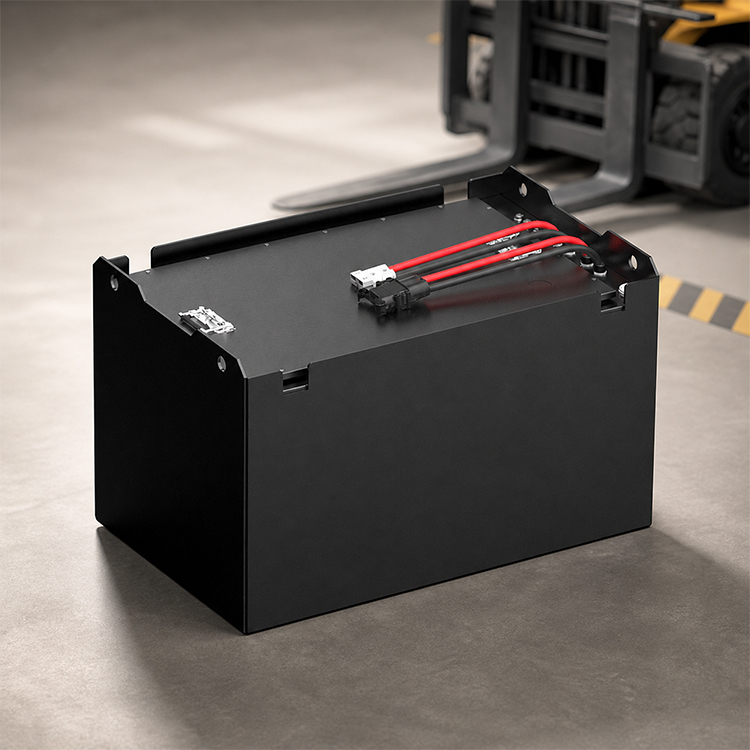
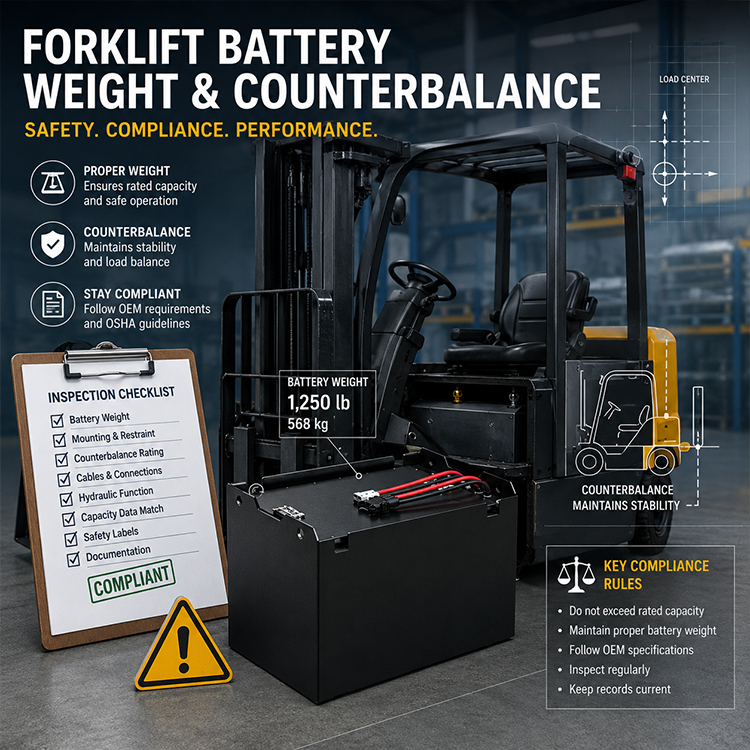
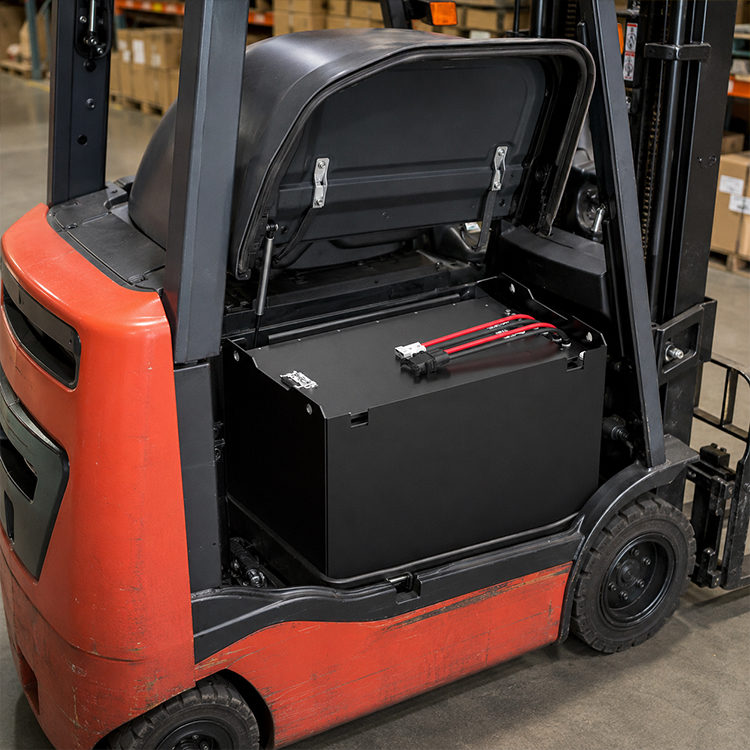
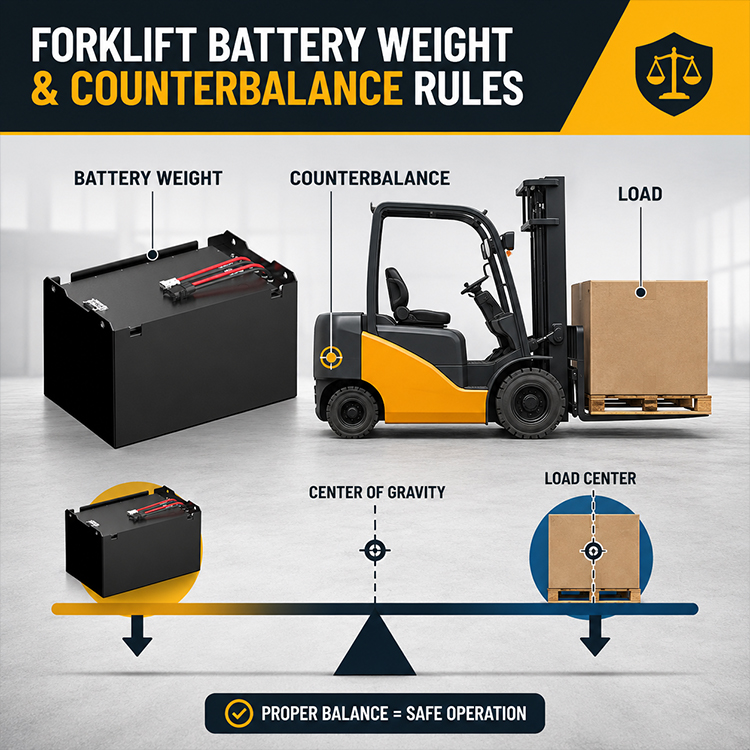
Forklift battery weight affects three things at once: traction, braking behavior, and counterbalance. The third one is where people get hurt. A counterbalance forklift is designed so the rear mass of the truck helps offset the load carried out front. In an electric lift truck, the battery often provides a meaningful share of that rear ballast. Replace a heavy lead-acid battery with a lighter LiFePO4 pack without ballast planning, and the forklift may still move. It may still lift. But at the edge of the load chart, it is no longer the same machine.
That is the hard truth.
The U.S. Occupational Safety and Health Administration makes the compliance issue very plain: modifications affecting capacity or safe operation require manufacturer approval, and additional counterweighting cannot be done unless approved by the truck manufacturer under OSHA’s powered industrial truck standard.
For buyers planning a lithium upgrade, CoreSpark’s forklift battery pack range is the right internal starting point because the category shows real industrial configurations across 24V, 36V, 48V, 51.2V, 72V, 80V, 100Ah, 300Ah, 600Ah, and larger custom platforms. But the battery catalog should never outrank the forklift data plate. Never.
Table of Contents
The Forklift Battery Weight Chart Buyers Actually Need
A forklift battery weight chart is only useful if it is treated as a screening tool, not a purchase authorization. The final number must come from the forklift data plate, OEM manual, battery compartment drawing, and the supplier’s signed technical sheet.
Here is my working chart for early-stage buying discussions:
Forklift Battery Class
Common Voltage
Typical Lead-Acid Battery Weight
Typical Lithium / LiFePO4 Weight Situation
Counterbalance Risk
Small walkie / light warehouse truck
24V / 25.6V
400–1,500 lb
Often much lighter unless built with ballast
Medium if replacing lead-acid directly
Mid-size electric rider forklift
36V / 38.4V
1,200–2,500 lb
LFP may need engineered ballast
High if truck rated capacity depends on old battery mass
Standard warehouse counterbalance forklift
48V / 51.2V
1,800–3,800 lb
Common lithium conversion zone; weight matching is mandatory
Very high
Heavy-duty electric forklift
72V / 76.8V / 80V
3,000–6,000+ lb
Custom casing, BMS, charger, ballast, and data review needed
Severe
AGV / autonomous forklift
24V–80V
Varies by chassis
Often custom LFP with CAN/RS485 communication
Depends on OEM design envelope
These ranges are not permission slips. They are red flags.
I have seen enough battery spec sheets to know the sales trap: the lithium pack looks beautiful on paper because it is lighter, charges faster, and claims 3,000–5,000 cycles, but nobody writes “this truck may lose rated-capacity compliance if the minimum battery weight is ignored” in 28-point type. Why would they?
The safer process is boring, and boring wins. Photograph the forklift data plate. Record the minimum and maximum battery weight. Measure the tray. Confirm connector rating. Confirm charger voltage. Confirm the old battery’s actual weight, not just its label. Then match the replacement battery and fixed ballast to the machine.
CoreSpark’s lead-acid to lithium forklift conversion checklist already makes the same point: lead-acid to lithium conversion is a voltage, ballast, charger, BMS, safety, and compliance decision, not a drop-in swap. That internal link belongs early in any buyer education path.
Counterbalance Rules: The Physics Does Not Care About Your Purchase Order
OSHA’s operator training material explains forklift stability through the “stability triangle,” formed by the two front wheels and the rear axle pivot point. If the combined center of gravity moves outside that triangle, the truck becomes unstable and may tip; OSHA also notes that counterweight location is one of the factors affecting stability.
That sounds academic until a fleet manager swaps chemistry.
A lead-acid forklift battery is heavy because lead is heavy. A LiFePO4 battery uses lithium iron phosphate chemistry, often written as LFP, and normally delivers useful energy with less mass. That is good for golf carts, RVs, solar storage, and many mobile systems. But on a counterbalanced forklift, “lighter” can become “underweight.”
Bad swap. Big risk.
OSHA even gives a simple load-moment example: a 3,000 lb truck rated at a 24-inch load center has a 72,000 inch-pound allowable load moment, and longer loads reduce allowable weight because the center of gravity moves outward. That same logic is why battery weight cannot be casually changed; shift the truck-side moment and the entire rating conversation changes.
My Rule for Lithium Forklift Battery Counterbalance
If the lithium pack plus fixed ballast does not meet the forklift manufacturer’s minimum battery weight, do not install it.
And no, loose steel plates thrown into the battery tray are not engineering. They are evidence.
Ballast should be fixed, documented, corrosion-resistant, service-safe, and reviewed against the truck’s battery compartment structure. The updated pack should not interfere with ventilation, cabling, connectors, battery restraints, covers, service access, or operator protection. If the truck needs additional counterweighting beyond the battery compartment, get written manufacturer approval or qualified engineering approval where allowed by OSHA interpretation.
OSHA’s 1997 interpretation letter says employers must seek manufacturer approval for modifications affecting capacity and safe operation; if the original manufacturer no longer exists or refuses, OSHA may accept approval from a Qualified Registered Professional Engineer after proper safety analysis and data-plate updates. That matters for forklift battery counterweight requirements because battery mass is not cosmetic.
What the Injury Data Says When the Sales Brochure Gets Quiet
Forklifts are not harmless warehouse furniture.
The National Safety Council, using U.S. Bureau of Labor Statistics data, reports that forklifts were the source of 84 work-related deaths in 2024 and 25,110 DART cases in 2023–2024. DART means injuries involving days away from work, job restriction, or transfer. That is not an abstract safety lecture; it is a labor-cost, insurance, downtime, and human-damage problem. Read the NSC forklift injury data before signing off on a casual retrofit.
NIOSH has also published fatal forklift case studies showing the ugly repeat patterns: overturns, workers struck by forklifts, falls from forks or platforms, damaged equipment, poor surfaces, bad procedures, and weak training. Its conclusion is blunt: the three common fatal patterns are forklift overturns, workers on foot being struck, and workers falling from forklifts. See the CDC/NIOSH report on workers who operate or work near forklifts.
So when someone says, “It’s only the battery,” I hear something else.
I hear: “We may be changing the mass distribution of a machine that already belongs to one of the nastier injury categories in industrial work, and we may be doing it without updated markings, training, or a documented stability review.” Is that dramatic?
No. It is sober.
Lead-Acid vs Lithium: The Counterbalance Trade Nobody Likes Discussing
Lead-acid is dirty, heavy, maintenance-hungry, and still oddly forgiving. Lithium is cleaner, faster, smarter, and less tolerant of lazy specification.
That is the trade.
A lead-acid forklift battery can demand watering, equalization, acid handling, ventilation planning, PPE, eyewash access, and longer charge/cool windows. Lithium iron phosphate removes much of that maintenance burden, but it introduces BMS logic, charger matching, communication protocols, thermal limits, fault codes, and transport documentation.
For fleets moving from flooded lead-acid to LFP, CoreSpark’s lead acid replacement batteries page fits naturally because it frames the broader replacement story: lower maintenance, cleaner operation, and longer service intervals. But in forklift applications, the pitch must always be filtered through counterbalance.
What Must Be Verified Before a Forklift Battery Replacement
Here is the checklist I would force into the purchase file:
Forklift make, model, serial number
Rated capacity and load center
Minimum battery weight
Maximum battery weight
Battery compartment L × W × H
Old battery chemistry, voltage, Ah, kWh, and measured weight
Replacement battery actual weight
Fixed ballast design, if needed
Battery restraint method
Connector type and continuous amp rating
Charger voltage, profile, and current
BMS protections: overvoltage, undervoltage, overcurrent, short circuit, high temperature, low temperature
CAN, RS485, Bluetooth, display, or OEM communication requirement
Updated training and emergency procedures
Updated data plate or capacity marking where required
Short checklist. Expensive misses.
For custom fleet work, CoreSpark’s OEM/ODM LiFePO4 battery engineering page is the better internal destination than a generic product page because forklift projects often require custom voltage, capacity, BMS, casing, terminals, communication, charger matching, and documentation support.
The Counterbalance Failure Pattern I Watch For
Most bad forklift battery replacements follow the same script.
First, the buyer asks for “same voltage.” Then the supplier quotes a lithium battery with attractive cycle life and fast charging. Then the maintenance team discovers the pack is physically smaller or hundreds of pounds lighter. Then someone suggests adding ballast after the fact. Then the documentation gets vague.
That sequence is not a procurement process. It is a liability funnel.
The better path starts with CoreSpark’s Forklift Battery Solutions hub, especially if the buyer is researching lithium forklift batteries, charging, maintenance, replacement planning, and LiFePO4 options before asking for a quotation.
The Hard Rule for Buyers
Do not approve a forklift battery based only on voltage and amp-hours.
A 48V 600Ah lithium forklift battery and a 48V 600Ah lead-acid battery can be radically different in mass, discharge curve, charge behavior, physical footprint, BMS behavior, and maintenance profile. The forklift does not care that both say “48V.” It cares where the center of gravity lands when the forks are raised, the load is moving, the floor is uneven, and the operator brakes late.
FAQs
What is forklift battery weight?
Forklift battery weight is the actual mass of the battery installed in an electric forklift, and it matters because the battery often functions as part of the truck’s counterbalance system, affecting stability, rated capacity, data-plate compliance, tire load, and safe braking. In plain terms, the battery is both power source and ballast.
Most buyers ask about forklift battery weight because they are replacing lead-acid with lithium. That is exactly where the danger appears. Lithium can be lighter, so the replacement pack may need fixed ballast to meet the forklift manufacturer’s minimum battery weight requirement.
How much does a forklift battery weigh?
A forklift battery commonly weighs from several hundred pounds to more than 6,000 pounds, depending on voltage, capacity, chemistry, truck class, and whether it is a small 24V warehouse battery or a large 80V industrial counterbalance battery. The exact approved range must come from the forklift data plate.
As a screening estimate, 24V lead-acid packs often sit around 400–1,500 lb, 36V packs around 1,200–2,500 lb, 48V packs around 1,800–3,800 lb, and heavy 72V/80V packs may reach 3,000–6,000+ lb. Never buy from estimates alone.
Can a lithium forklift battery be too light?
A lithium forklift battery can absolutely be too light if its actual weight plus fixed ballast falls below the forklift manufacturer’s minimum battery weight, because the truck’s rated capacity and stability assumptions may depend on battery mass inside the compartment. Lighter is not automatically safer in counterbalance forklifts.
This is the most common mistake in lithium forklift battery counterbalance planning. Buyers celebrate lower weight, then discover that the original lead-acid battery was part of the truck’s rear ballast. Match the voltage, yes. But match the minimum weight first.
What are forklift battery counterweight requirements?
Forklift battery counterweight requirements are the manufacturer-defined weight rules that tell buyers the minimum and maximum battery mass allowed in the truck, usually shown on the forklift data plate or OEM documentation, so the machine maintains proper stability, rated capacity, and safe operation. These requirements must be verified before replacement.
If a new lithium battery is underweight, engineered ballast may be required. If the change affects capacity or safe operation, OSHA’s powered industrial truck rules require proper approval and updated markings where applicable.
Is lead-acid or lithium better for electric forklift battery weight?
Lead-acid is usually heavier and naturally useful for counterbalance, while lithium iron phosphate is usually lighter, cleaner, faster charging, and lower maintenance but may require ballast or custom casing to meet the forklift’s minimum battery weight. The better choice depends on duty cycle, compliance, and verified truck fit.
For single-shift, low-use fleets, lead-acid may still make financial sense. For multi-shift warehouses, lithium often wins on uptime, opportunity charging, and maintenance reduction. But if the lithium pack does not satisfy counterbalance rules, the business case collapses.
What should I check before replacing a forklift battery?
Before replacing a forklift battery, check the forklift data plate, rated capacity, load center, voltage, battery compartment dimensions, minimum and maximum battery weight, connector rating, charger compatibility, old battery weight, new battery weight, BMS limits, and whether updated approval or markings are required. This is the minimum safe-buying file.
I would also demand photos: truck plate, old battery label, charger label, connector, tray, restraint system, and cable route. No photos, no serious quote. That rule saves money and arguments.
Your Next Steps: Do Not Buy the Battery Until the Weight Is Proven
Forklift battery weight is not a minor specification. It is one of the numbers that decides whether a replacement battery is a safe industrial component or an expensive mistake with a polished casing.
Before approving a lead-acid replacement, lithium forklift battery conversion, or custom LiFePO4 forklift pack, send your forklift model, data-plate photo, battery compartment dimensions, voltage, old battery weight, charger label, operating shift pattern, and target capacity to a supplier that can document the full fit.
If your fleet is evaluating 24V, 36V, 48V, 51.2V, 72V, 76.8V, or 80V lithium forklift batteries, start with CoreSpark’s custom forklift battery pack options and request a weight-matched recommendation before asking for price. Price comes after physics. Always.
Newsletter Updates
Enter your email address below and subscribe to our newsletter
BYingPower provides OEM, wholesale, and custom LiFePO4 battery packs for golf carts, RVs, forklifts, solar storage, marine power, and lead-acid replacement applications. We support battery brands, distributors, dealers, system integrators, and OEM buyers with reliable lithium battery solutions, smart BMS options, private-label services, and export documentation support.