Send us your application, voltage, capacity, battery size, quantity, and branding needs. BYingPower will review your project and recommend the right LiFePO4 battery solution for golf carts, RVs, marine systems, solar storage, forklifts, or lead-acid replacement.
Custom battery pack review for your application
OEM/ODM and private-label battery guidance
BMS, charger, terminals, heating, and packaging support
Faster quote path for samples and bulk orders
4th Floor, Building A, No. 2, Longjiang 2nd Road, Xie Keng, Qingxi Town, Dongguan Province,China.
12V LiFePO4 Battery Sizing for Lead-Acid Replacement
Replacing lead-acid with LiFePO4 is not a one-to-one amp-hour swap. This guide explains the sizing math, hidden failure points, and practical selection rules for RV, marine, solar, UPS, and distributor battery programs.
When I review a 12V LiFePO4 battery replacement project, I do not start with the old lead-acid label, because that label usually tells me what the battery could do in a gentle lab test, not what it actually delivered under inverter load, cold mornings, aging plates, loose terminals, and impatient charging habits. So why do so many buyers still treat “100Ah” as a universal truth?
Here is the hard truth: amp-hours are not a sizing method. They are a sticker. A 100Ah flooded lead-acid battery and a 100Ah lithium iron phosphate battery may sit in the same tray, but they do not behave like the same machine.
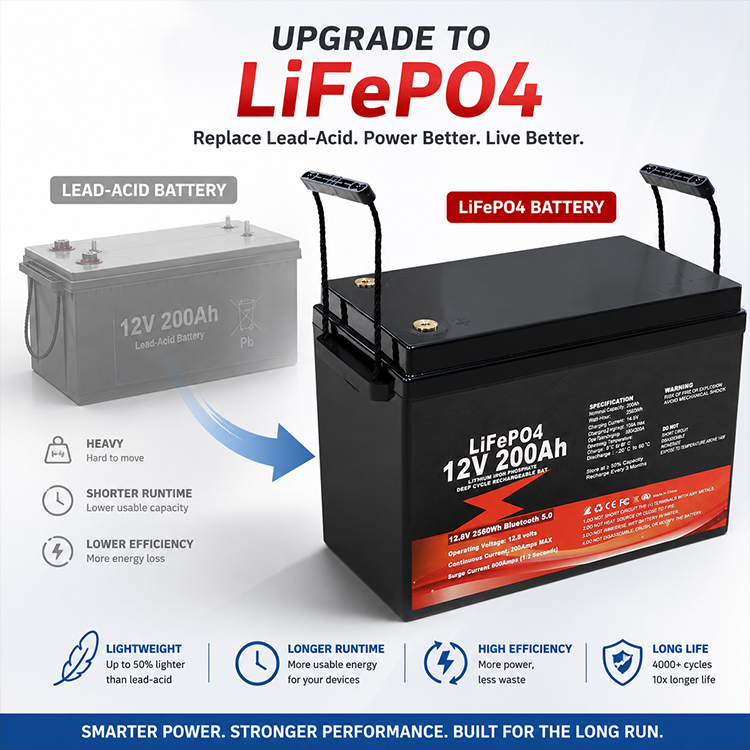
Lead-acid voltage sags. Capacity falls under higher current. Usable depth of discharge is often limited if the customer wants decent life. LiFePO4, by contrast, holds a flatter voltage curve, tolerates deeper daily discharge, and usually gives more usable energy from the same printed Ah rating. That is why a serious LiFePO4 battery replacement conversation has to include load profile, discharge current, charger compatibility, BMS limit, cable size, installation space, and temperature protection.
CoreSpark’s own product structure confirms the replacement logic: the site separates 12V LiFePO4 Battery models from Lead Acid Replacement Batteries, and the listed 12V range runs from small 7Ah-style packs to 100Ah, 200Ah, 300Ah, 460Ah, 560Ah, and 600Ah battery categories for RV, marine, solar, and backup power use.
Table of Contents
The Sizing Math Buyers Actually Need
The clean formula is simple:
Usable Watt-hours = Battery Voltage × Ah Rating × Usable Depth of Discharge × System Efficiency
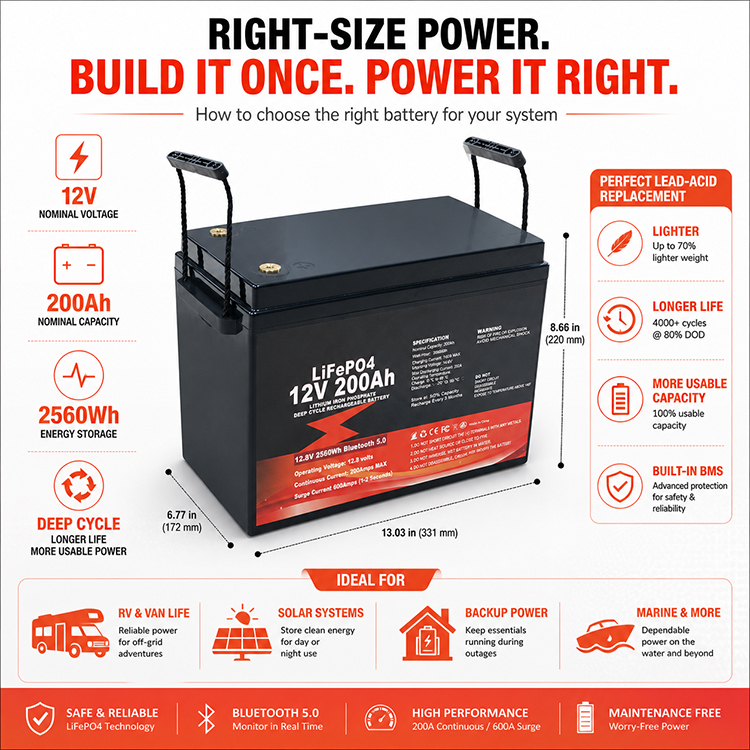
For a 12V lithium battery upgrade, use 12.8V as the nominal LiFePO4 voltage. A 12.8V 100Ah LiFePO4 battery stores about 1,280Wh before system losses. If you allow 90% usable depth of discharge and assume 90% inverter efficiency, your practical AC-side energy is roughly:
12.8V × 100Ah × 0.90 × 0.90 = 1,036Wh
That number matters more than the sales label.
Now compare that with a 12V 100Ah lead-acid battery. In many deep-cycle applications, users only plan around 50% usable capacity because repeated deep discharge punishes lead-acid life. That gives a working estimate near:
12V × 100Ah × 0.50 = 600Wh
Not identical. Not close.
This is why a 100Ah LiFePO4 battery can often feel like it replaced a much larger lead-acid bank. But I would not approve that swap blindly. If the system has a 2,000W inverter, the battery must also handle current:
2,000W ÷ 12.8V ÷ 0.90 = about 174A DC
That means the BMS, fuse, cables, terminals, and busbars must all be sized for the job. A battery with a 100A continuous BMS may have enough energy on paper and still be wrong for a high-surge inverter.
Lead-Acid vs LiFePO4: The Replacement Table No Buyer Should Skip
The industry likes neat equivalency charts. I don’t. A “100Ah lead-acid equals 50Ah lithium” rule works only when the load is modest, the inverter is small, and the customer is honest about runtime. In real replacement markets, people add a fridge, a diesel heater fan, Starlink, LED lighting, a coffee maker, and then ask why the battery cuts out at breakfast.
Why the Recycling Data Makes the Decision Less Simple
Lead-acid is old, dirty, heavy, and weirdly successful at recycling. A 2025 Nature Communications paper reported that 99% of lead-acid batteries are recycled in the USA, while lithium-ion batteries are recycled globally at only 2%–47%, despite having higher economic value in recovered materials. That is not a small footnote. It is one reason buyers should stop pretending every lithium upgrade is automatically cleaner in every context. Read the data in Nature Communications on battery recycling supply chains.
But the story cuts both ways. The U.S. Department of Energy has specifically identified the need to improve the economics of recycling LFP-based batteries, noting the growing market share of LFP battery packs and the need to reduce the cost of producing recycled LFP cathode materials. That matters for LiFePO4 because the chemistry avoids nickel and cobalt, which helps on material sourcing but can make recycling economics less attractive. See the DOE’s battery recycling funding notice on improving lithium iron phosphate battery recycling economics.
So yes, I like LiFePO4 for many lead acid battery replacement jobs. But I do not sell it as moral magic. The better argument is operational: longer cycle life, lower maintenance, stable voltage, lighter weight, and better usable capacity when the system is sized correctly.
The Fire-Risk Conversation Nobody Wants in the Sales Call
Lithium is safer when engineered well. It is not safe because a brochure says “safe.”
The 2025 Moss Landing battery plant fire in California forced evacuations and put battery storage safety into mainstream news again. AP reported that the fire at one of the world’s largest battery storage plants led to the evacuation of up to 1,500 people, raised concerns about toxic smoke, and renewed discussion around thermal runaway. The same report noted that lithium iron phosphate batteries are highly stable but still carry fire risk at scale. Read the AP coverage of the Moss Landing lithium battery plant fire.
That does not mean a 12V LiFePO4 RV battery should be treated like a grid-scale battery block. It means sizing and protection matter. BMS current limits matter. Charging below 0°C matters. Cable lugs matter. Fuse placement matters. Charger matching matters.
CoreSpark’s OEM/ODM battery capability page gets this part right by focusing on custom voltage, capacity, BMS, casing, terminal layout, charger matching, testing, documentation, Bluetooth, CAN/RS485, heating options, and low-temperature protection. That is the right supplier conversation, not “Can I get the cheapest 100Ah case?”
The Real 12V LiFePO4 Battery Sizing Workflow
Step 1: Convert the Load Into Watt-Hours
Start with daily consumption. Not vibes. Not “small fridge.” Actual watts and hours.
A 45W fridge running 12 hours per day uses 540Wh. A 20W lighting load for 5 hours uses 100Wh. A 60W laptop charger for 3 hours uses 180Wh. A 1,000W kettle for 10 minutes uses about 167Wh.
Total: 987Wh per day before inverter and wiring losses.
For that use case, a 12V 100Ah LiFePO4 battery is workable. A 12V 50Ah LiFePO4 battery is tight. A 12V 200Ah LiFePO4 battery gives a more comfortable margin, especially if the user wants two cloudy days or hates watching a battery monitor like a stock ticker.
Step 2: Size for Current, Not Just Capacity
This is where cheap replacements fail.
A battery may have enough energy but not enough discharge current. If the load includes a 1,500W inverter, the current draw can exceed 130A at 12.8V after inverter losses. If the battery’s BMS allows only 100A continuous discharge, the system may shut down even though the state of charge looks fine.
For high-current 12V lithium battery upgrade projects, I want to know:
Inverter continuous wattage
Inverter surge wattage
BMS continuous discharge rating
BMS peak discharge rating and duration
Fuse rating
Cable gauge and cable length
Terminal type
Heat buildup inside the box
Small details. Big failures.
Step 3: Match the Charger Before the Battery Ships
A lead-acid charger may not fully charge LiFePO4, may hold float voltage too long, or may trigger odd BMS behavior depending on the charge profile. Some replacements tolerate old charging systems better than others, but I do not call a charger “compatible” until I know absorption voltage, float behavior, equalization mode, temperature compensation, and alternator charging path.
For RV and mobile power buyers, the safer route is often a lithium-ready charger, a DC-DC charger, and a solar controller with a LiFePO4 profile. CoreSpark already has a Lead-Acid Replacement Guides category where charger compatibility fits naturally as supporting content, and that internal link should be used whenever the article discusses “drop-in” risk.
Step 4: Decide Whether the Customer Needs Heating
LiFePO4 chemistry does not like charging below freezing unless the pack has proper low-temperature protection or heating. Discharge is usually less sensitive than charging, but winter RV, marine, telecom, and off-grid customers should not ignore this.
For northern markets, I would rather overspec a heated 12V LiFePO4 battery than deal with warranty complaints after a customer charges a frozen pack from an alternator or solar controller.
Step 5: Leave Capacity Margin
I use a rough field rule: after calculating real daily Wh demand, add 20%–30% margin for aging, cold weather, inverter loss, forgotten loads, and customer behavior. People always add more devices later. Always.
If the math says 1,000Wh per day, I would rather spec around 1,300Wh to 1,500Wh usable. For a 12V system, that often pushes the buyer toward a 100Ah or 200Ah LiFePO4 battery depending on autonomy requirements.
Application Notes: RV, Marine, Solar, UPS, and Dealer Programs
For RV buyers, the main mistake is ignoring charging. A 12V RV LiFePO4 Battery replacement should be checked against converter output, alternator behavior, solar controller settings, and inverter draw. A battery that survives on a bench may fail in a vehicle with mixed charging sources.
For marine buyers, vibration, water exposure, terminal security, and continuous discharge matter. A trolling motor or cabin power bank should not be sized from Ah alone. Peak current and waterproofing may decide the project.
For solar storage, cycle count and BMS communication become more important. A 12V solar battery bank that cycles daily needs stronger design discipline than a backup battery used twice a year.
For distributors and OEM buyers, I would push the conversation toward private-label quality control, repeat-order consistency, testing documents, and support for BMS configuration. CoreSpark’s custom LiFePO4 battery pack engineering page is a good internal anchor for that commercial audience because replacement buyers are not only asking for a battery; they are asking for a lower-return product line.
FAQs
What size LiFePO4 battery replaces a 100Ah lead-acid battery?
A 50Ah to 100Ah LiFePO4 battery typically replaces a 100Ah lead-acid battery depending on usable depth of discharge, inverter load, cold-temperature operation, and discharge current, because many lead-acid batteries deliver only about half their nameplate capacity in deep-cycle service.
In light-duty backup power, 50Ah LiFePO4 may be enough. In RV, marine, solar, or inverter-heavy use, I usually prefer 100Ah because the extra current headroom and runtime margin reduce nuisance shutdowns.
Can I replace lead-acid with LiFePO4 without changing the charger?
A lead-acid charger can sometimes charge a LiFePO4 battery, but it should not be assumed compatible until absorption voltage, float voltage, equalization mode, temperature compensation, and alternator behavior are checked against the battery manufacturer’s charging specification and BMS protection limits.
The most common problem is not instant failure. It is partial charging, BMS cutoff, poor state-of-charge accuracy, or long-term customer dissatisfaction. For clean replacement work, use a lithium-ready charger or get written confirmation from the battery supplier.
Why does LiFePO4 feel stronger than lead-acid at the same Ah rating?
LiFePO4 feels stronger than lead-acid at the same Ah rating because it usually provides deeper usable discharge, flatter voltage under load, lower voltage sag, and better high-current behavior, so more of the battery’s rated capacity remains usable in real devices and inverter-based systems.
This is why “100Ah vs 100Ah” misleads buyers. The better comparison is usable watt-hours under the actual load, not nameplate amp-hours in isolation.
How do I calculate 12V LiFePO4 battery sizing?
To calculate 12V LiFePO4 battery sizing, list every load in watts, multiply each load by runtime hours, add the daily watt-hours, divide by inverter efficiency if AC power is used, then select a battery with enough usable watt-hours and enough BMS current for the highest load.
For example, a 1,000Wh daily load should not be matched to exactly 1,000Wh of battery. Add margin. Check current. Check charger. Then choose 100Ah, 200Ah, 300Ah, or higher based on runtime and expansion plans.
Is LiFePO4 always better than lead-acid?
LiFePO4 is usually better for deep-cycle replacement when weight, usable capacity, cycle life, and maintenance matter, but lead-acid can still make sense for low-cost standby use, simple charging systems, extreme cold environments, or markets with mature recycling and very price-sensitive buyers.
That is the unpopular answer. Lithium wins many jobs, not every job.
Final Thoughts: Send the Load Sheet Before You Buy
The safest LiFePO4 battery replacement is not the one with the biggest Ah number. It is the one matched to the load, charger, temperature, BMS current, installation space, and buyer behavior.
So here is the move: before choosing a 12V LiFePO4 battery, write down the old lead-acid model, daily watt-hour demand, inverter size, charger model, operating temperature, available battery space, and expected runtime. Then send that information to CoreSpark through the custom LiFePO4 battery quote page and ask for a sizing recommendation built around the actual application, not a guess.
Newsletter Updates
Enter your email address below and subscribe to our newsletter
BYingPower provides OEM, wholesale, and custom LiFePO4 battery packs for golf carts, RVs, forklifts, solar storage, marine power, and lead-acid replacement applications. We support battery brands, distributors, dealers, system integrators, and OEM buyers with reliable lithium battery solutions, smart BMS options, private-label services, and export documentation support.