Send us your application, voltage, capacity, battery size, quantity, and branding needs. BYingPower will review your project and recommend the right LiFePO4 battery solution for golf carts, RVs, marine systems, solar storage, forklifts, or lead-acid replacement.
Custom battery pack review for your application
OEM/ODM and private-label battery guidance
BMS, charger, terminals, heating, and packaging support
Faster quote path for samples and bulk orders
4th Floor, Building A, No. 2, Longjiang 2nd Road, Xie Keng, Qingxi Town, Dongguan Province,China.
A golf cart voltage reducer looks like a small accessory, but on a lithium conversion it becomes a stress test for the entire electrical system. Here is what dealers, installers, and serious buyers should know before wiring lights, USB ports, horns, audio systems, or street-legal kits into a LiFePO4 cart.
The Small Box That Reveals a Bad Lithium Conversion
This part matters.
A golf cart voltage reducer is usually treated like a cheap add-on, tossed into the cart after the battery sale, but in lithium golf carts it is often the first place where lazy installation, weak documentation, poor fuse discipline, and bad accessory planning show up as melted wires, nuisance BMS shutdowns, dead lights, or warranty arguments nobody budgeted for.
Why would a $30–$100 component expose a $1,000–$3,000 lithium upgrade?
Because lithium does not forgive sloppy thinking.
I have seen too many golf cart conversions where the battery was beautiful, the charger was acceptable, the Bluetooth app looked fancy, and then somebody powered the 12V accessories like it was still 2009 and the cart had a tired lead-acid bank under the seat. That is not a small mistake. It is a system mistake.
If you are upgrading a cart through a proper lithium golf cart battery lineup, the reducer conversation should happen before the install, not after the customer calls because the horn works but the headlights flicker. CoreSpark’s own site frames golf cart batteries around voltage platforms such as 25.6V, 48V, 51.2V, and 76.8V, which is exactly the right starting point for accessory planning.
Table of Contents
What a Golf Cart Voltage Reducer Actually Does
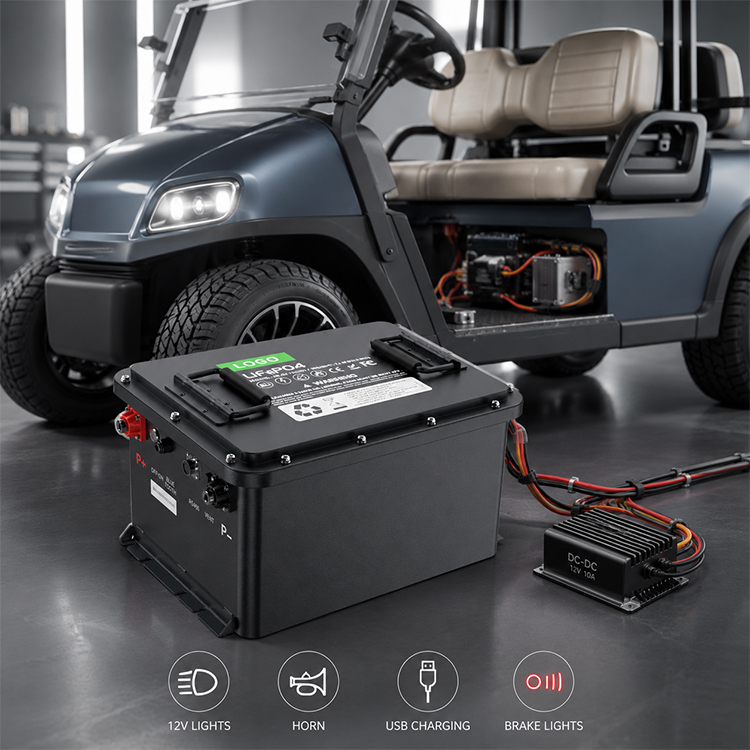
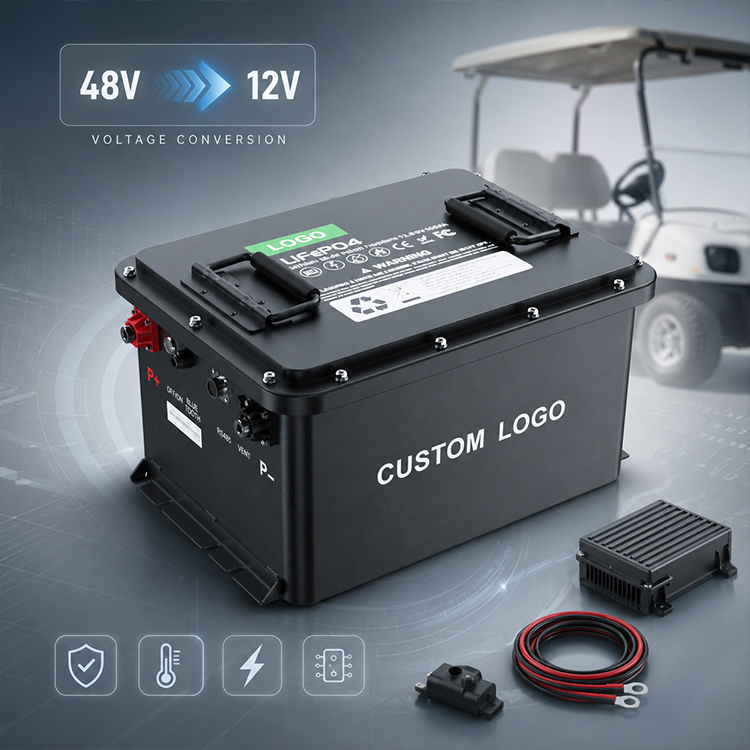
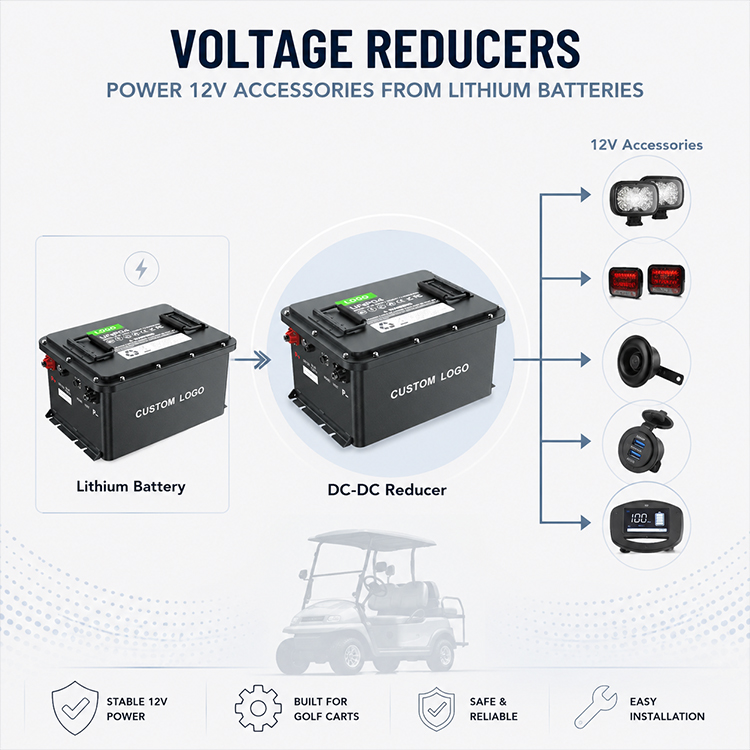
A golf cart voltage reducer is a DC-DC converter that steps down the cart’s high-voltage battery pack to a stable 12V output for accessories. In plain English: it takes a 36V, 48V, 51.2V, 60V, 72V, or 76.8V lithium battery system and feeds low-voltage gear like LED lights, horns, brake lights, turn signals, USB chargers, dashboards, fans, GPS trackers, and audio equipment.
That sounds basic.
It is not.
A 48V to 12V converter golf cart setup must deal with three realities at once: the actual battery voltage range, the accessory current draw, and the installation environment. A nominal 51.2V LiFePO4 pack, for example, is not sitting at exactly 51.2V all day. A 16S LiFePO4 battery can be around 58.4V near full charge, and the reducer must tolerate that input without overheating or producing dirty 12V output.
Here is the hard truth: the “best voltage reducer for lithium golf cart” is not the one with the loudest Amazon title. It is the one that matches the pack voltage, has enough current headroom, uses proper protection, survives heat and vibration, and is wired by someone who understands that 12V accessories are still capable of starting fires.
Lithium Changed the Rules, Whether Installers Admit It or Not
Lead-acid carts trained the market badly.
For years, people tapped two 6V batteries, one 12V battery, or part of a lead-acid bank to run accessories. Was it best practice? No. Did it “work” long enough for the customer to leave the shop? Often, yes.
Lithium is different.
A lithium battery reducer should not be treated as optional when the cart runs 12V accessories. Tapping into a lithium pack, bypassing the BMS logic, or wiring accessories without a fused DC-DC converter is the kind of shortcut that looks clever until the cart comes back with an intermittent fault nobody can reproduce.
If the cart uses a 48V or 51.2V lithium system, start by reviewing the correct battery platform. A dealer quoting a standard 48V conversion should compare the cart against the 48V Golf Cart Battery category, while many LiFePO4 systems marketed as “48V” are technically closer to 51.2V Golf Cart Battery architecture because of the 16S LiFePO4 cell arrangement. CoreSpark’s catalog includes both 48V and 51.2V golf cart battery categories, which matches the real language gap between customer search behavior and battery engineering.
And yes, that language gap matters.
A customer says “48V.” The installer hears “easy job.” The BMS hears “show me the actual load.”
The Data That Makes Me Conservative
I do not use micromobility fire data to scare golf cart buyers. That would be cheap.
But I do use it to remind dealers that lithium battery systems fail as systems: charger mismatch, bad wiring, unknown cells, poor thermal handling, weak protection, and careless accessory integration. The CPSC’s 2026 micromobility hazard report reported 533 micromobility fatalities from 2017 through 2024, with reported fatalities rising from 5 in 2017 to 135 in 2024; the same report listed lithium-ion battery-related fire fatalities in e-scooters, self-balancing scooters, and e-bikes. Golf carts are not e-bikes, but the warning is still useful: lithium electrical systems deserve disciplined integration, not accessory-store improvisation.
Chargers are another ugly lesson. The CPSC warning on “universal” micromobility chargers said incompatible chargers may fit a device and still be unsafe, and the agency received 156 reports of fire and thermal incidents involving universal chargers from January 1, 2023 through May 16, 2024. That is not a golf cart voltage reducer case, but it proves a point installers love to ignore: electrical compatibility is more than connector fit.
Then there is the street-legal angle. The NHTSA interpretation on low-speed vehicles says an LSV must have a speed capability no higher than 25 mph and a gross vehicle weight rating under 3,000 pounds, and Standard No. 500 includes requirements such as lamps, mirrors, seat belts, and a windshield. Translation: if your lithium golf cart is getting lights, brake lights, turn signals, horn, and road-use accessories, the 12V system is no longer decorative. It is part of the vehicle’s safety package.
How to Size a 12V Voltage Reducer for a Golf Cart
Start with watts.
A reducer is usually sold by amperage: 10A, 20A, 30A, 40A, 60A. But accessories consume watts, and the 12V side of the system needs margin.
The math is simple:
Accessory watts ÷ 12V = estimated amps
A 240W 12V accessory load needs about 20A. A 360W load needs about 30A. A 480W load needs about 40A. But I do not like sizing reducers right at the edge. Heat, wiring losses, voltage drop, startup surge, audio peaks, and cheap spec sheets all punish tight sizing.
Here is the field table I would use before approving a lithium golf cart voltage reducer.
Accessory Load
Typical Planning Draw
Reducer Choice I Would Consider
Installer Warning
Basic LED headlights and tail lights
3A–8A
12V 10A–20A
Still fuse the branch circuit
Lights, horn, brake lights, USB ports
10A–18A
12V 20A–30A
Do not share messy grounds
Street-legal kit with turn signals and mirrors with lights
Most private owners underbuy the reducer. Most sloppy installers under-fuse it. Both are bad.
If the cart already has a heavy accessory package, I would not guess. I would build the accessory current budget the same way dealers should size the battery: identify the cart, calculate demand, verify peak load, and document the install. CoreSpark’s guide on how to size lithium golf cart batteries for dealers uses that same logic for the main pack: voltage first, then usable watt-hours, peak current, charger match, and documentation.
Dealer-Grade Reducer Specs: What I Would Actually Look For
The reducer does not need to be glamorous. It needs to be honest.
A proper golf cart DC DC converter should list input voltage range, output voltage, output current, continuous power, peak current if any, waterproof rating, over-current protection, over-temperature protection, short-circuit protection, efficiency, operating temperature, and wiring instructions. If the listing hides half of that, I treat it as a warning.
Here is the no-nonsense spec comparison.
Feature
Cheap Shortcut
Dealer-Grade Standard
Why It Matters
Input voltage
“48V” with no range
Wide input range covering full lithium charge voltage
A 51.2V pack may charge near 58.4V
Output
Vague 12V
Regulated 12V–13.8V DC
Accessories hate unstable voltage
Current rating
Sized exactly to load
25%–50% headroom
Heat and surge loads reduce real margin
Protection
Unknown
Over-current, short-circuit, thermal protection
Prevents a small fault becoming a big claim
Grounding
Random frame ground
Clean negative return and planned grounding
Reduces flicker, noise, and fault chasing
Fuse strategy
One oversized fuse, maybe
Input fuse plus fused 12V distribution
Protects both converter and accessory circuits
Mounting
Zip-tied near heat
Ventilated, dry, serviceable location
Heat kills electronics quietly
Documentation
None
Wiring diagram, load notes, fuse sizes
Makes service possible six months later
This is where I get opinionated: a reducer without a fuse plan is not an installation. It is a bet.
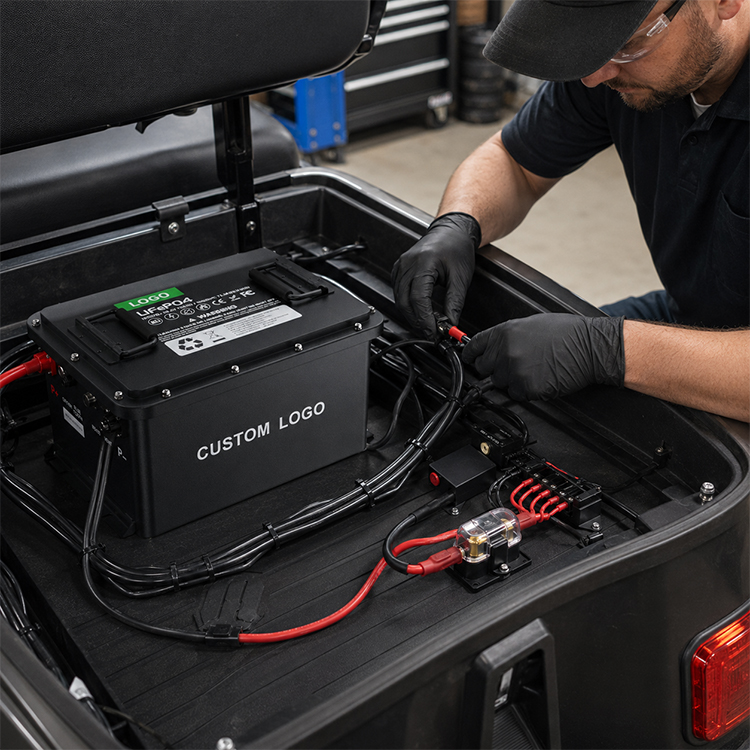
How to Install a Voltage Reducer on a Lithium Golf Cart Without Creating a Comeback
I am not going to pretend every cart is the same. Club Car, EZGO, Yamaha, lifted neighborhood carts, resort utility carts, and fleet vehicles all bring different wiring histories. Some have been modified three times by three different people with three different ideas of “good enough.”
Still, the clean installation pattern is consistent.
Step 1: Confirm the Battery Platform
Identify whether the cart is 36V, 48V, 51.2V, 72V, or 76.8V. Do not rely only on what the customer says. Check the controller label, charger output, existing battery wiring, BMS documentation, and cart model. For lead-acid conversions, CoreSpark’s lead-acid replacement batteries category is contextually relevant because many accessory wiring mistakes come from old lead-acid habits being dragged into lithium installs.
Step 2: Choose the Reducer Before Wiring Accessories
Pick the reducer based on the full 12V accessory load. If the cart has headlights, tail lights, brake lights, horn, USB, Bluetooth display, stereo, underglow, fans, or a GPS tracker, add them up. Do not let a 10A converter carry a 25A lifestyle.
Step 3: Fuse the Input Close to the Battery
The input side should have fuse protection near the battery positive connection. Not halfway across the cart. Not “inside the loom somewhere.” Near the source.
A fuse protects the wire, not your feelings.
Step 4: Use a 12V Fuse Panel for Accessories
Run the reducer output into a fused 12V distribution panel. Give lights, horn, USB, audio, and other accessories their own circuits where possible. This makes troubleshooting boring. Boring is good.
Step 5: Consider Key-Switched Activation
Many reducers have a trigger or remote wire. Use it correctly. If the reducer stays awake all the time, small standby loads can drain the pack over days or weeks. A key-switched reducer setup is cleaner for many carts, especially customer-owned neighborhood vehicles.
Step 6: Test Under Load
Measure 12V output with all accessories on. Turn the lights on. Hit the horn. Trigger brake lights. Run the fan. Push the audio. Watch for voltage drop, heat, flicker, noise, or converter shutdown.
Do not hand the cart back after testing one LED strip in silence.
The Bigger Risk: Accessory Loads Are Now Part of Battery Strategy
This is the part dealers miss.
The reducer is not isolated from the battery sale. It is part of the battery system. A poor reducer install can make a good LiFePO4 pack look unreliable, especially when the BMS protects itself and the customer describes the symptom badly.
Customers do not say, “My 12V accessory circuit may have caused a transient load issue.”
They say, “Your lithium battery has a problem.”
That is why OEM and dealer programs should standardize reducers, chargers, fuse sizing, cable routing, documentation, and accessory packages. If a dealer is developing private-label lithium golf cart kits, I would connect this planning directly with OEM/ODM LiFePO4 battery pack engineering, because CoreSpark lists custom voltage, capacity, BMS, casing, terminals, connectors, display, communication, heating, and charger matching as part of its OEM/ODM capability.
For importers and distributors, documentation is not office clutter either. The PHMSA Lithium Battery Guide for Shippers was updated for the May 10, 2024 HM-215Q requirements and addresses shipping lithium cells and batteries across transport modes. If you sell lithium golf cart systems at scale, paperwork, labeling, Wh ratings, test summaries, and battery configuration details eventually become commercial survival tools.
My Hard Buying Rules for a Lithium Golf Cart Voltage Reducer
I would rather overspec a reducer than apologize for a melted accessory harness.
Here is my short list:
Match the reducer input range to the actual lithium pack voltage, not just the advertised cart voltage.
Use a dedicated 12V voltage reducer for golf cart accessories instead of tapping the battery pack.
Size for total accessory load plus margin.
Fuse the input and distribute the 12V output through protected circuits.
Mount the reducer away from heat, water pooling, moving parts, and sharp edges.
Avoid mystery converters with no real current rating, no thermal protection, and no wiring diagram.
Test under full accessory load before delivery.
Document the installation so the next technician is not forced to become a detective.
And one more thing: do not let the accessory kit dictate the battery system. The battery system comes first. The reducer supports it.
FAQs
What is a voltage reducer for a lithium golf cart?
A voltage reducer for a lithium golf cart is a DC-DC converter that takes the cart’s high-voltage traction battery, commonly 36V, 48V, 51.2V, or 72V nominal, and supplies regulated 12V power for accessories such as lights, horns, USB ports, displays, fans, and audio systems. It prevents 12V devices from being connected directly to unsafe pack voltage. In a clean lithium conversion, the reducer is planned with the battery, charger, fuse panel, and accessory load.
Do I need a voltage reducer on a lithium golf cart?
You need a voltage reducer on a lithium golf cart when any accessory requires 12V power and the cart’s main battery pack is higher than 12V, because the reducer supplies stable accessory voltage without tapping individual batteries or stressing one section of the lithium pack. Most carts with lights, horns, brake lights, USB ports, stereos, or street-legal kits need one. Without it, accessory wiring becomes risky and unreliable.
What size voltage reducer do I need for a lithium golf cart?
Most lithium golf carts need a 20A to 40A 12V voltage reducer, but the right size depends on the combined accessory load, with lights, horn, brake switches, USB outlets, GPS, fans, and sound systems added together before a safety margin is applied. A light-only cart may survive on 20A. A cart with audio, fans, or street-legal accessories may need 30A, 40A, or more.
Can I wire 12V accessories directly to a lithium golf cart battery?
You should not wire 12V accessories directly to a 48V or 51.2V lithium golf cart battery because most accessories are designed for 12V, and connecting them to traction-pack voltage can destroy electronics, melt wiring, trigger BMS protection, or create a fire risk. The cleaner method is a fused golf cart DC DC converter feeding a 12V accessory panel. Direct wiring is not a professional shortcut; it is a liability.
How do you install a voltage reducer on a lithium golf cart?
To install a voltage reducer on a lithium golf cart, connect the converter input to the correct pack positive and negative through proper fuse protection, route the 12V output to a fused accessory panel, use appropriate wire gauge, and verify voltage under load before driving. Many builds also use a key-switched trigger wire so the reducer does not drain the battery while parked. Always follow the battery and converter wiring documentation.
What is the best voltage reducer for a lithium golf cart?
The best voltage reducer for a lithium golf cart is a properly rated DC-DC converter with a wide input range, stable 12V output, enough amperage headroom, short-circuit protection, over-current protection, thermal protection, weather resistance, and clear wiring documentation. Brand matters less than electrical fit. A 30A reducer with honest specs is better than a “60A” unit with no test data, no protection details, and no installation support.
Your Next Steps
Do not buy the reducer last.
If you are building, selling, or upgrading lithium golf carts, specify the 12V voltage reducer at the same time you choose the battery pack, charger, BMS rating, cable layout, and accessory package. For dealers and distributors, standardize the reducer and fuse panel across repeat installs. For serious buyers, ask for the input voltage range, output amperage, fuse plan, accessory current budget, and wiring diagram before anyone touches the cart.
And if your project needs a matched LiFePO4 battery platform, charger guidance, BMS review, or private-label lithium golf cart battery planning, start with CoreSpark’s golf cart battery solutions or send the technical requirements through the custom LiFePO4 battery quote page. A clean lithium cart is not built by guessing. It is built by matching every part before the first wire is cut.
Newsletter Updates
Enter your email address below and subscribe to our newsletter
BYingPower provides OEM, wholesale, and custom LiFePO4 battery packs for golf carts, RVs, forklifts, solar storage, marine power, and lead-acid replacement applications. We support battery brands, distributors, dealers, system integrators, and OEM buyers with reliable lithium battery solutions, smart BMS options, private-label services, and export documentation support.