Send us your application, voltage, capacity, battery size, quantity, and branding needs. BYingPower will review your project and recommend the right LiFePO4 battery solution for golf carts, RVs, marine systems, solar storage, forklifts, or lead-acid replacement.
Custom battery pack review for your application
OEM/ODM and private-label battery guidance
BMS, charger, terminals, heating, and packaging support
Faster quote path for samples and bulk orders
4th Floor, Building A, No. 2, Longjiang 2nd Road, Xie Keng, Qingxi Town, Dongguan Province,China.
How to Build Parallel LiFePO4 Battery Banks Safely
Parallel LiFePO4 battery banks are not dangerous because LiFePO4 chemistry is weak. They become dangerous when installers mix packs, skip branch fuses, ignore current sharing, or treat a BMS like a magic shield. Here is the hard, practical guide.
Most battery fires do not start with drama. They start with laziness.
A parallel LiFePO4 battery bank looks simple because every positive terminal joins the positive bus, every negative terminal joins the negative bus, and the system voltage stays the same while amp-hour capacity increases; but that clean drawing hides current imbalance, BMS trip behavior, weak crimping, undersized fuses, charger mismatch, and the ugly little fact that one bad battery can quietly turn the rest of the bank into unpaid labor.
So why do people still wire these banks like Lego?
Because the industry sells “expandable lithium power” better than it explains failure modes.
And here is my hard opinion: LiFePO4 is one of the safer lithium chemistries, but “safer chemistry” does not excuse sloppy electrical design. A lithium iron phosphate battery bank still stores a brutal amount of energy. A 12.8V 400Ah bank holds about 5.12kWh. A 24V 400Ah bank holds about 10.24kWh. A 51.2V 400Ah bank holds about 20.48kWh. That is not a camping accessory. That is a controlled energy system.
Table of Contents
The First Rule: Parallel Batteries Must Be Near Twins
Parallel LiFePO4 batteries should match in voltage, chemistry, capacity, age, internal resistance, BMS rating, and state of charge before connection. If they do not, current will not divide politely. It will follow the lowest-resistance path first, and the battery with the easier path gets punished.
Small sentence. Big bill.
Before connecting packs, I would not accept “close enough” from an installer. I want measured open-circuit voltage. I want pack documentation. I want BMS continuous-discharge ratings. I want charger voltage settings. And I want every battery rested long enough that surface charge is not lying to the meter. Would you trust a fuel gauge while someone is still pouring gasoline into the tank?
For most 12.8V LiFePO4 batteries, the nominal chemistry is 4 cells in series: 3.2V × 4 = 12.8V. A 24V LiFePO4 battery is usually 8 cells in series, or 25.6V nominal. A 48V-class LiFePO4 system is often 16 cells in series, or 51.2V nominal. If you are building an RV, marine, solar, or mobile bank, start by choosing the correct base voltage rather than forcing a weak design to work later. CoreSpark’s 12V LiFePO4 battery range fits small RV, marine, camping, and backup applications, while its 24V LiFePO4 battery options make more sense when inverter current starts getting high.
Here is the insider trap: people chase amp-hours first. Professionals chase current, heat, and failure isolation first.
Why Parallel LiFePO4 Battery Bank Wiring Fails
The wiring usually fails before the chemistry does.
A parallel bank can fail because one battery carries more current than the others, one cable has lower resistance, one fuse is oversized, one BMS disconnects under load, or one charger pushes the bank into a voltage region where weaker packs fall out of balance. The bad build often runs fine on day one. That is the dangerous part.
Heat tells truth.
If one cable, lug, fuse holder, or battery terminal is warmer than its neighbors under load, the system is already talking; and if the installer ignores that thermal clue because the inverter still turns on, the bank may spend months accumulating damage before the failure finally looks “sudden.” Is that really a sudden failure, or just a delayed confession?
The U.S. Department of Energy’s 2024 Energy Storage Safety Strategic Plan makes a point the DIY market often misses: residential backup systems, mobile energy storage, and fielded lithium systems need application-specific safety guidance, and test conditions do not always reproduce real-world abuse. That matters for parallel LiFePO4 battery bank wiring because real systems see vibration, temperature swings, charger mismatch, rushed maintenance, and owner modifications.
I do not care how clean the product photo looks. I care what happens after 300 cycles, one loose lug, and a cold morning charge attempt.
The Non-Negotiable Wiring Layout
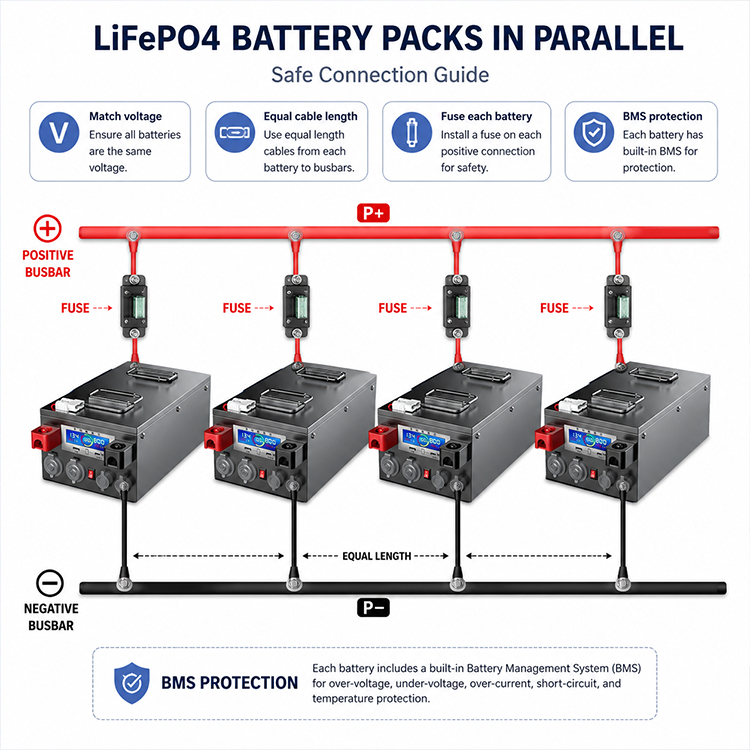
A safer parallel LiFePO4 battery bank should use a real busbar system, equal-length cables, matching cable gauge, correct torque, branch-level fusing, and a main disconnect. The inverter and charger should connect to the busbars, not randomly to the nearest battery terminals.
Do not stack six lugs on one battery post and call it engineering.
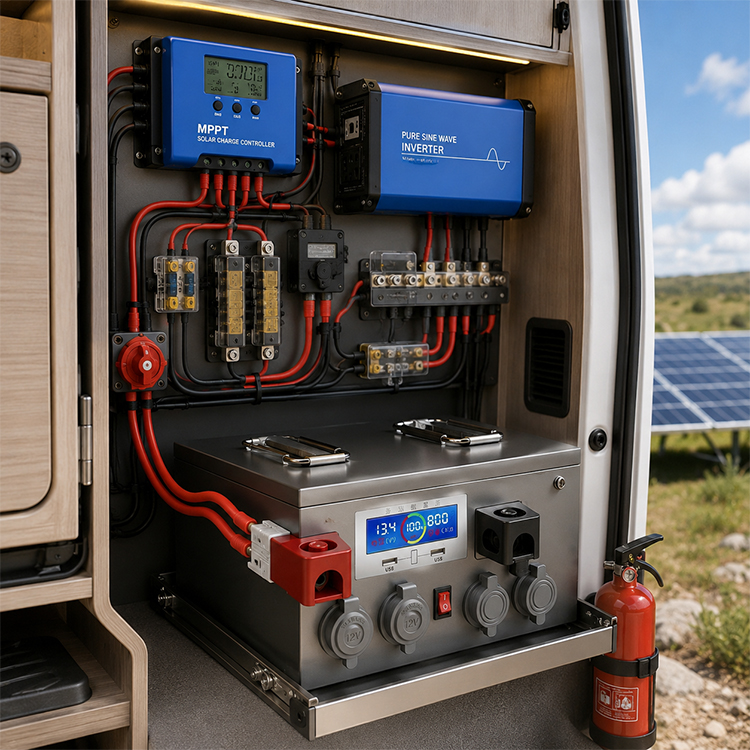
For small banks, the diagonal connection method is better than pulling both positive and negative from the same battery. But once the bank grows, use busbars. Clean busbars reduce resistance differences and make fault isolation easier. For RV and off-grid applications, that is why a purpose-built RV LiFePO4 battery system should be planned around the inverter, charger, solar controller, DC loads, and installation space before the batteries are bolted down.
Parallel Bank Design Point
Safer Practice
Red Flag
Why It Matters
Battery matching
Same voltage, capacity, chemistry, age, and BMS family
Mixing old and new packs
Reduces uneven current sharing
Pre-connection voltage
Balance packs before paralleling; keep voltage difference very small
Connecting one full battery to one low battery
Prevents surge current between packs
Cable layout
Equal-length, equal-gauge cables to busbars
Short cable on one battery, long cable on another
Prevents one battery from carrying too much current
Protection
Fuse each battery branch plus main fuse
Only one main fuse after the whole bank
Isolates a failed battery or cable
BMS planning
Sum current ratings, then derate
Assuming all BMS units share current perfectly
Avoids cascade shutdown under load
Charging
Charger profile matched to LiFePO4
Lead-acid charger with equalization mode
Prevents overvoltage and nuisance BMS trips
Temperature
Low-temperature charge protection
Charging below 0°C without heating
Lithium plating risk is not a marketing myth
Inspection
Torque check and thermal scan under load
“It worked yesterday” maintenance logic
Finds resistance problems early
The BMS Is Not Your Electrician
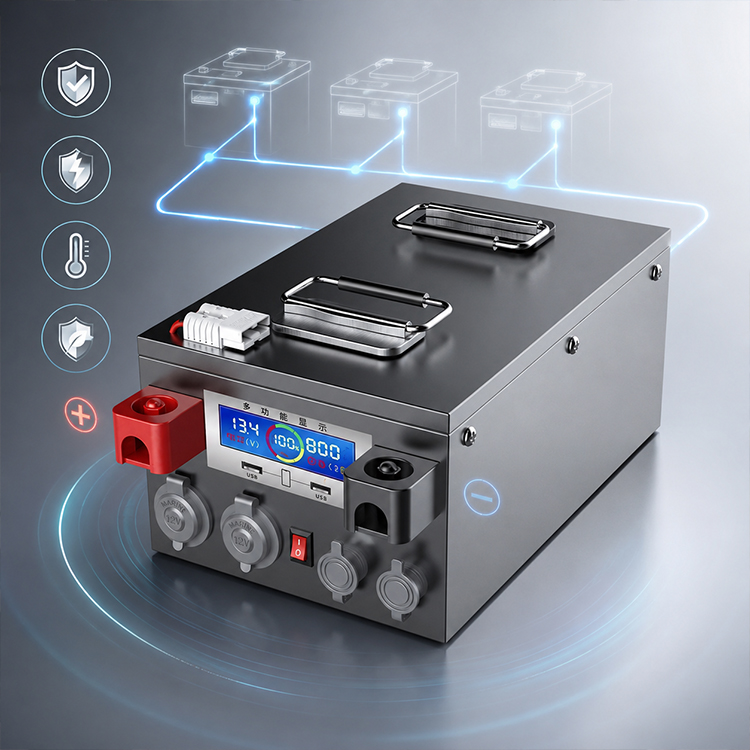
A LiFePO4 BMS protects the battery pack from overvoltage, undervoltage, overcurrent, short circuit, and unsafe temperature conditions. It is not a substitute for proper cable sizing, fusing, charger settings, pack matching, or system-level design.
Read that again.
The BMS is the last line of defense, not the design plan.
I see too much marketing that treats “built-in BMS” like a magical safety certificate. No. A BMS can disconnect. It can also disconnect at the worst possible moment. Imagine four batteries in parallel feeding a 3,000W inverter. One BMS trips. The remaining three batteries instantly carry more current. Another trips. Then another. Now the inverter screams, cables heat, voltage collapses, and the owner blames “bad lithium batteries.”
No. Bad design.
This is where custom pack review matters. A serious supplier should discuss discharge current, peak surge, charge current, communication needs, Bluetooth monitoring, CAN, RS485, heating, enclosure design, and charger compatibility. CoreSpark’s OEM/ODM LiFePO4 battery pack engineering is the kind of page I would route buyers to when the system is no longer a simple drop-in replacement.
The Case for Branch Fusing: One Battery, One Fuse
Every battery in a parallel LiFePO4 bank should have its own properly rated fuse or breaker near the positive terminal. This is not optional in a professional build. It is how you stop one failed cable or one internal battery fault from turning the rest of the bank into a feed source.
People hate fuses because fuses expose bad assumptions.
A common amateur build uses four batteries in parallel, one main fuse near the inverter, and no branch protection. That protects the inverter cable, maybe. It does not isolate a fault between batteries. If Battery #2 develops a cable fault, Batteries #1, #3, and #4 may feed that fault. That is how “low-voltage DC” becomes nasty.
The U.S. Consumer Product Safety Commission’s 2026 micromobility injury and fatality report is not about RV battery banks, but the warning is still useful: lithium-ion battery fire incidents repeatedly involve charging, homemade packs, repair-shop modifications, and poorly controlled battery systems. Different market. Same lesson. When lithium energy is handled casually, the bill comes due.
Battery Balancing Before Connection
Battery balancing in a parallel LiFePO4 battery bank means bringing each battery to a similar state of charge and voltage before wiring them together, so one pack does not dump current into another at connection. This should be done with a proper LiFePO4 charger, a rested-voltage check, and manufacturer-approved procedures.
For 12V-class packs, I like a conservative approach: fully charge each battery individually with the correct LiFePO4 charger, let them rest, verify voltage, and only then parallel them. Many manufacturers allow small voltage differences, but if a supplier cannot tell you its recommended pre-parallel voltage tolerance, that supplier has not earned your trust.
The number matters.
A 0.1V difference on lead-acid may feel boring. On LiFePO4, voltage curves are flat through much of the state-of-charge range, so voltage alone can hide meaningful capacity differences. That is why parallel banks should not mix random 100Ah, 200Ah, 280Ah, and 300Ah packs unless the manufacturer explicitly supports that configuration.
If you are replacing lead-acid batteries, the temptation is to reuse everything: charger, cables, fuse blocks, tray, and habits. Bad move. CoreSpark’s lead-acid replacement battery category is relevant here because a real conversion should confirm voltage, BMS rating, charger profile, compartment size, terminals, and load current before the sale.
Charging a Parallel LiFePO4 Battery Bank Without Cooking It
The charger must match LiFePO4 chemistry. Not “lithium-ish.” Not “AGM mode because it works.” Not “the old converter has been fine for years.”
A typical LiFePO4 charging profile avoids lead-acid equalization, uses appropriate absorption voltage, limits charge current, and stops floating aggressively. Exact voltage settings depend on the battery manufacturer, cell count, and BMS design. For a 12.8V pack, many systems charge near 14.2V–14.6V, but the correct number is the battery maker’s number, not a forum vote.
And temperature changes everything.
Charging LiFePO4 below 0°C can damage cells if the battery does not have low-temperature charge protection or internal heating. Discharging in cold weather is usually less risky than charging in cold weather, but do not confuse “it turned on” with “it was safe.”
The fire world is paying attention to this broader lithium problem. Reuters reported that the 2025 Moss Landing battery storage fire involved Vistra’s 3,000MW facility, evacuation orders, and a mitigation system that did not work as designed. That was utility-scale storage, not a van build. Still, it shows the same uncomfortable truth: once lithium battery systems fail energetically, response is complicated.
So design for prevention.
Parallel vs Series-Parallel: Do Not Confuse the Two
Parallel wiring increases capacity while keeping voltage the same. Series wiring increases voltage while keeping amp-hour capacity the same. Series-parallel wiring does both, but it multiplies the ways a system can go wrong.
A 4P 12V battery bank is not the same risk profile as a 2S2P 24V bank.
When you place batteries in series, every battery string must behave together. When you place series strings in parallel, string imbalance becomes a bigger issue. This is where many DIY builds become suspicious. They start with “I found four cheap batteries” and end with a wiring diagram that would make a warranty department vanish.
For higher-voltage applications, I would usually rather see a properly designed native 24V or 51.2V pack than a messy pile of smaller batteries forced into series-parallel duty. Fewer interconnects. Fewer mismatch points. Cleaner BMS coordination.
If the buyer is a distributor, RV integrator, or fleet operator, I would document the installation as a project, not a shopping cart. CoreSpark’s LiFePO4 battery case studies position that kind of project review around application requirements, working current, charging method, installation space, BMS protection, and validation before bulk orders. That is the right conversation.
The Safety Checklist I Would Actually Use
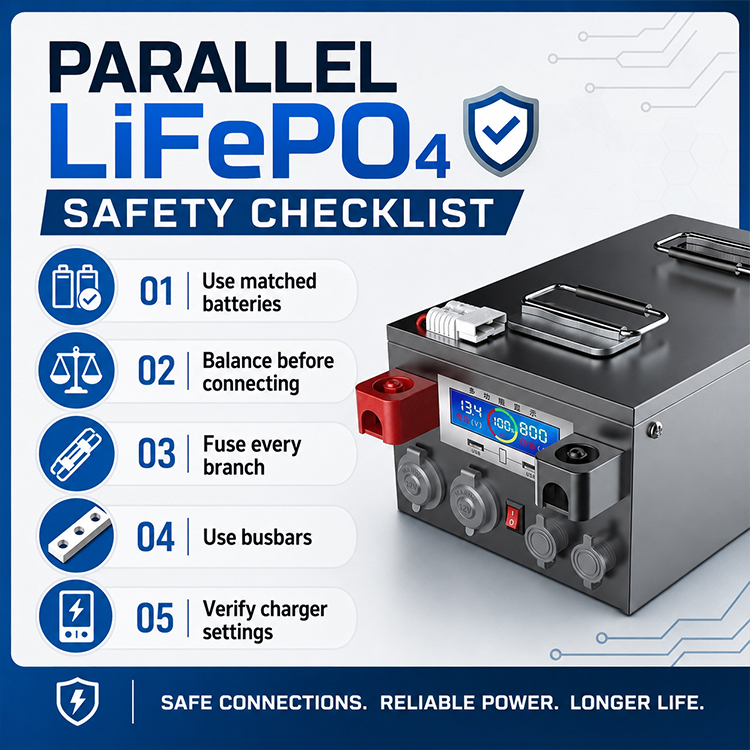
Before energizing a parallel LiFePO4 battery bank, I would check the following:
All batteries are same model, voltage, capacity, chemistry, and compatible BMS design.
Each battery has been charged and balanced according to manufacturer instructions.
Rested voltages are measured and recorded before parallel connection.
Each battery branch has its own fuse or breaker near the battery.
Busbars are properly rated for continuous and surge current.
Cables are equal length, equal gauge, and correctly crimped.
The inverter surge current does not exceed bank or BMS limits.
The charger profile is LiFePO4-specific.
Solar charge controller settings match battery requirements.
Low-temperature charge protection is active where needed.
The enclosure has ventilation, physical protection, and strain relief.
A main disconnect is reachable.
The system is tested under load and checked for heat.
Documentation is stored with the system.
Boring saves money.
The legal trend also points in this direction. New York City’s official 2024 enforcement notice on Local Law 39 requires micromobility devices and batteries sold, leased, or rented in the city to be certified to relevant UL standards. Again, this is not the same as an RV LiFePO4 bank. But it shows where regulators are moving: documented testing, certified components, and less tolerance for mystery batteries.
Common Mistakes That Make Parallel Banks Unsafe
Mistake 1: Mixing Battery Ages
A two-year-old 100Ah LiFePO4 battery and a new 100Ah LiFePO4 battery may not share current evenly. Internal resistance changes with use, temperature, and cycle history. The new pack often does more work. The old pack may hit cutoff first. The bank looks larger than it behaves.
Mistake 2: Trusting Bluetooth Too Much
Bluetooth battery apps are useful, but they are not a commissioning protocol. I want a multimeter, clamp meter, torque tool, thermal camera if available, and real load testing. App data can lag, omit branch current, or hide unequal sharing.
Mistake 3: Oversizing the Inverter
A 12V inverter system pulling 3,000W can demand roughly 250A before losses. Add surge current, cable loss, and battery imbalance, and now the “simple” system becomes a heat machine. In many cases, moving to 24V or 48V-class architecture is cleaner.
Mistake 4: No Maintenance Schedule
Lithium is lower maintenance than flooded lead-acid. It is not maintenance-free in the real world. Vibration loosens hardware. Corrosion happens. Cable insulation rubs. Firmware settings get changed. Owners add loads.
Mistake 5: Buying by Amp-Hour Only
Amp-hours are only part of the story. A 12V 300Ah battery with a 100A BMS is not the same practical power source as one with a 200A BMS. Continuous current, surge rating, charge current, low-temp behavior, communication, certification, and warranty terms matter.
FAQs
Can I connect LiFePO4 batteries in parallel?
Yes, you can connect LiFePO4 batteries in parallel when the batteries are the same voltage, chemistry, capacity, age, and BMS type, and when each pack is balanced before connection. The safest setup uses equal-length cables, busbars, branch fuses, correct charger settings, and manufacturer-approved parallel limits.
Parallel connection keeps voltage the same and increases available amp-hours. Four 12.8V 100Ah batteries in parallel create a 12.8V 400Ah bank. The danger is not the math. The danger is assuming current will divide equally without good wiring.
How many LiFePO4 batteries can I put in parallel?
The number of LiFePO4 batteries you can put in parallel depends on the manufacturer’s limit, BMS design, cable sizing, fuse rating, charger capacity, and load current. Many brands specify a maximum parallel count, and that limit should be treated as a hard engineering boundary, not a suggestion.
If a manufacturer says “up to four in parallel,” do not build eight because someone online did it once. Beyond a certain point, communication-enabled rack batteries, a higher-voltage architecture, or a custom-engineered pack becomes smarter than adding more 12V blocks.
Do parallel LiFePO4 batteries need balancing?
Parallel LiFePO4 batteries need balancing before connection because mismatched voltage or state of charge can cause high equalization current between packs. The safest method is to charge each battery with the correct LiFePO4 charger, let it rest, verify voltage, and connect only batteries that fall within manufacturer-approved tolerance.
After connection, parallel batteries tend to stay closer in voltage, but that does not mean individual cells inside each pack are perfectly balanced. Each battery’s internal BMS still matters, and periodic inspection is still worth doing.
Should each battery in a parallel bank have its own fuse?
Each battery in a parallel LiFePO4 battery bank should have its own fuse or breaker close to the positive terminal because branch protection isolates faults before other batteries feed into the failed branch. A single main fuse protects the main cable, but it may not protect battery-to-battery fault paths.
This is one of the most common shortcuts I dislike. Branch fusing adds cost and space. It also turns a potential bank-wide event into a more isolated failure.
Can I mix 100Ah and 200Ah LiFePO4 batteries in parallel?
Mixing 100Ah and 200Ah LiFePO4 batteries in parallel is usually a bad idea unless the battery manufacturer explicitly allows it and provides wiring, charging, and current-sharing guidance. Different capacities often mean different internal resistance, BMS limits, cycle history, and charge behavior.
Yes, it may appear to work. That is not the same as working safely for years. In professional systems, predictable behavior beats improvised capacity.
What is the best wiring method for parallel LiFePO4 batteries?
The best wiring method for parallel LiFePO4 batteries is a busbar-based layout with equal-length, equal-gauge battery cables, one fuse per battery branch, and inverter or charger connections made at the main positive and negative busbars. This design improves current sharing and makes inspection easier.
For very small two-battery systems, diagonal takeoff can be acceptable. For larger banks, busbars are cleaner, safer, and easier to troubleshoot.
Can I use a lead-acid charger for a LiFePO4 battery bank?
You should not use a lead-acid charger for a LiFePO4 battery bank unless the battery manufacturer confirms the charger profile is compatible and equalization is disabled. LiFePO4 batteries require different voltage behavior, and lead-acid charging modes can trigger BMS protection or damage the system over time.
The charger is not an accessory. It is part of the battery system. Treat it that way.
Your Next Steps
Build the bank on paper before you build it with copper.
List your system voltage, inverter wattage, peak surge, charger output, solar controller settings, expected runtime, installation temperature, cable length, fuse size, and battery model. Then ask whether the batteries, BMS units, wiring, and protection devices still make sense as one system.
If you are sourcing LiFePO4 batteries for RV, marine, solar, wholesale, or OEM projects, send the actual voltage, capacity, load current, charger, installation space, and quantity requirements to CoreSpark Battery through its custom LiFePO4 battery quote page. Do not ask for “a battery.” Ask for a battery bank that can survive the way it will really be used.
Newsletter Updates
Enter your email address below and subscribe to our newsletter
BYingPower provides OEM, wholesale, and custom LiFePO4 battery packs for golf carts, RVs, forklifts, solar storage, marine power, and lead-acid replacement applications. We support battery brands, distributors, dealers, system integrators, and OEM buyers with reliable lithium battery solutions, smart BMS options, private-label services, and export documentation support.