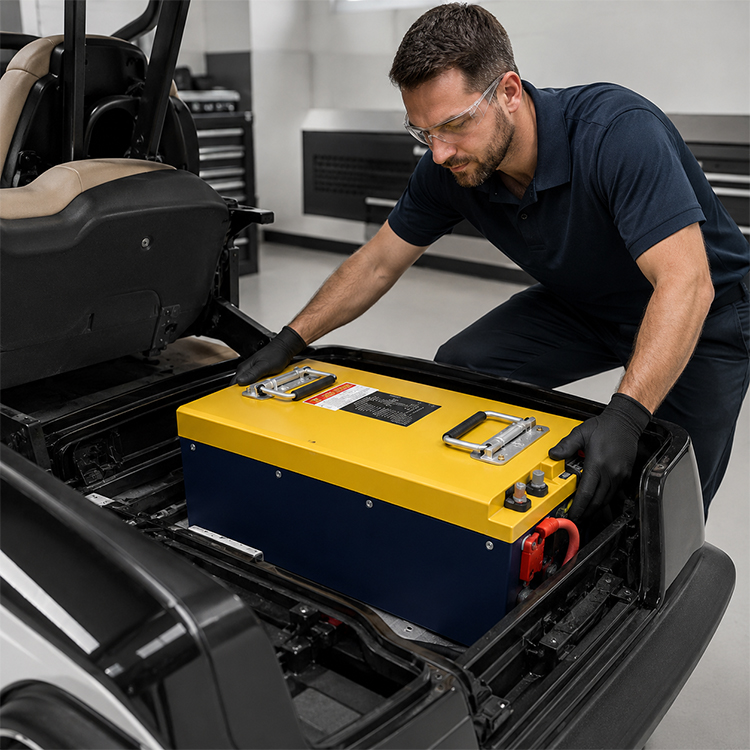
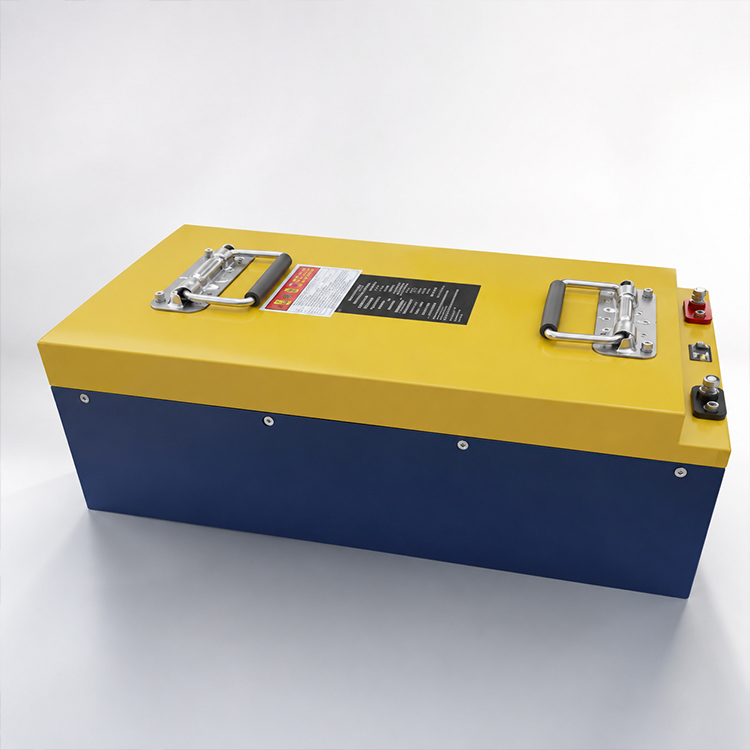
Send us your application, voltage, capacity, battery size, quantity, and branding needs. BYingPower will review your project and recommend the right LiFePO4 battery solution for golf carts, RVs, marine systems, solar storage, forklifts, or lead-acid replacement.
Custom battery pack review for your application
OEM/ODM and private-label battery guidance
BMS, charger, terminals, heating, and packaging support
Faster quote path for samples and bulk orders
4th Floor, Building A, No. 2, Longjiang 2nd Road, Xie Keng, Qingxi Town, Dongguan Province,China.
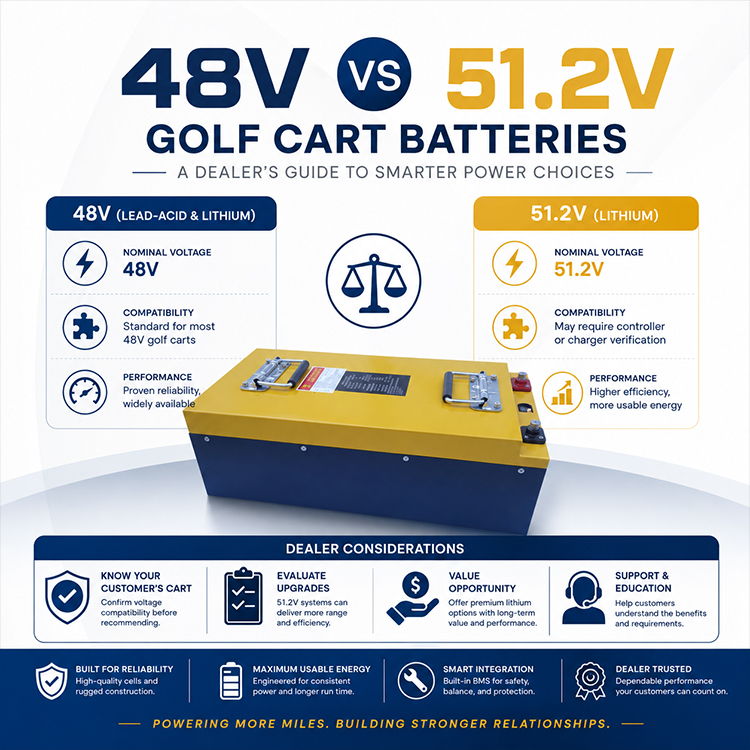
Most buyers ask for “48V golf cart batteries,” but the smarter dealer knows that 51.2V LiFePO4 packs often tell the real technical story. Here is the hard, practical guide to selling the right battery without inheriting the wrong warranty problem.
The Dirty Little Voltage Secret Dealers Need to Stop Dodging
Here’s the truth.
Most customers who ask for 48V golf cart batteries are not asking a clean engineering question; they are repeating the voltage language printed on an old lead-acid system, a charger label, a cart controller, or a competitor’s sloppy product listing, and that means the dealer has to translate street language into electrical reality before money changes hands. So who carries the blame when the battery fits the sales pitch but not the cart?
We do.
That is the hard truth in this business. Dealers do not lose margin because customers misunderstand voltage. Dealers lose margin because they let that misunderstanding survive until installation day.
A “48V” golf cart can mean several things in the field. It may mean a 48V lead-acid system built from six 8V batteries or four 12V batteries. It may mean a lithium pack marketed as 48V. Or it may mean a true 51.2V LiFePO4 battery built from 16 cells in series, each nominally 3.2V.
48V vs 51.2V Golf Cart Batteries: The Dealer Math That Actually Matters
A 51.2V LiFePO4 golf cart battery is usually a 16S pack: 16 cells × 3.2V nominal = 51.2V. A true 48.0V LiFePO4 pack is usually 15S: 15 cells × 3.2V nominal = 48.0V.
Small gap? Not really.
That 3.2V nominal difference changes charger compatibility, controller behavior, full-charge voltage, energy labeling, and the way a customer experiences hill climbing under load, especially when the cart is carrying four passengers, lifted tires, rear seats, coolers, and the usual “it only rides around the neighborhood” nonsense we hear before a 200A peak demand event.
Here is the useful dealer view:
Battery Type
Common Cell Layout
Nominal Voltage
Approx. Full Charge
Dealer Risk
Best Fit
Lead-acid “48V” cart pack
4×12V or 6×8V lead-acid
48V
Often around 57V+ depending on charger profile
Sulfation, watering, weight, voltage sag
Budget replacement customers
15S LiFePO4 pack
15×3.2V cells
48.0V
About 54.75V
May feel closer to conservative legacy systems, but less common in golf cart lithium marketing
Sensitive controller/changer retrofit cases
16S LiFePO4 pack
16×3.2V cells
51.2V
About 58.4V
Requires correct charger and BMS match
Most modern lithium upgrade programs
“48V lithium” marketing label
Often 16S LiFePO4
Often 51.2V actual nominal
About 58.4V
Customer confusion if spec sheet is vague
Dealer education opportunity
The industry loves loose voltage language because loose language sells fast. But fast sales can become slow returns.
When we position a 51.2V golf cart battery as “the real 48V lithium upgrade,” we need to explain why: it mirrors the operating window many 48V lead-acid carts already tolerate, while giving customers lower weight, stronger voltage stability, and less maintenance. But we must also check the charger, controller, motor condition, cable condition, and BMS current rating.
No shortcuts.
Why LiFePO4 Is Winning, But Not Because Dealers Suddenly Became Smarter
LiFePO4 is not winning because the golf cart trade became enlightened overnight. It is winning because the economics finally became hard to ignore.
The International Energy Agency reported that EV battery demand reached more than 750 GWh in 2023, up 40% from 2022, and that lithium iron phosphate chemistry has become one of the mature battery chemistries helping reduce dependence on cobalt and nickel; the same supply-chain pressure is pushing LiFePO4 credibility into lower-speed electric vehicles, golf carts, utility carts, RVs, and industrial replacements through the back door of buyer familiarity.
Then prices moved.
In 2024, lithium-ion battery pack prices fell 20%, the biggest drop since 2017, according to the IEA’s Global EV Outlook 2025 battery section. That does not mean every dealer gets cheaper landed inventory tomorrow morning, but it does mean customers are becoming less tolerant of $2,000 lead-acid maintenance cycles dressed up as “traditional value.”
I’ve seen the pattern too often: a dealer hesitates, waits for lithium prices to “settle,” loses the early fleet customers, and then enters the market later by copying the same weak spec sheet everyone else uses.
Bad move.
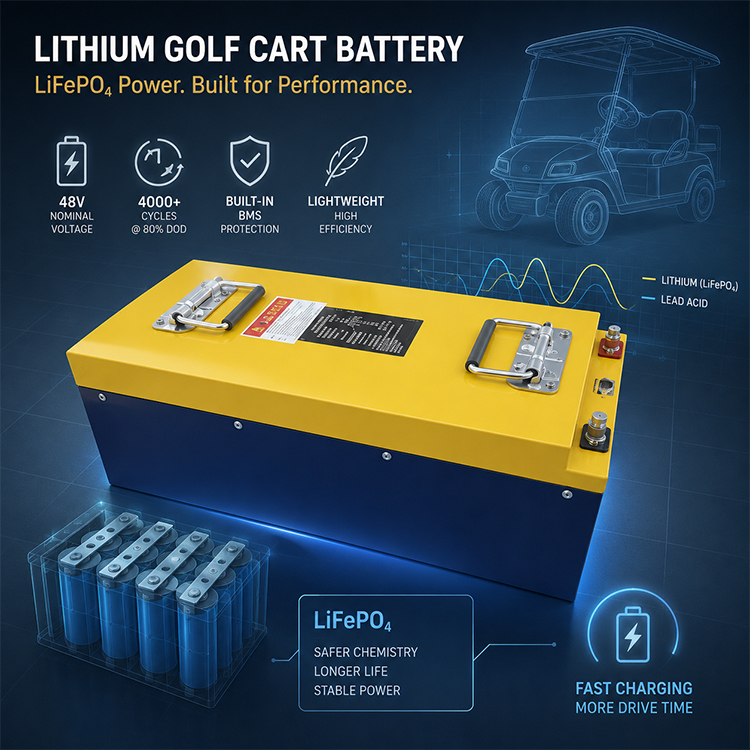
LiFePO4 golf cart battery buyers are not only buying range. They are buying fewer service calls, no watering, less corrosion, flatter discharge voltage, Bluetooth diagnostics, faster charging potential, and the emotional pleasure of not opening a battery compartment that looks like a chemistry experiment from 2006.
But dealers should not oversell it. A weak BMS, mismatched charger, or mystery-cell pack can turn a premium lithium sale into a reputation tax.
For buyers who need configuration support, not just a carton with terminals, point them toward CoreSpark’s OEM/ODM LiFePO4 battery customization instead of pretending every cart in the field deserves the same pack.
The Safety Conversation: Say It Before the Customer’s Insurance Company Does
Battery fires are not a golf-cart-only story. That is exactly why dealers should pay attention.
The FDNY reported 277 lithium-ion battery fires in New York City during 2024, compared with 268 in 2023, while lithium-ion battery deaths fell from 18 in 2023 to six in 2024 after stronger education and enforcement efforts; the uncomfortable lesson is simple: education changes outcomes, but only when sellers stop treating safety as brochure filler.
And do not pretend recalls only happen to low-end brands nobody knows. In September 2025, the U.S. Consumer Product Safety Commission announced an Anker power bank recall covering about 481,000 units after 33 fire and explosion reports, four minor burn injuries, and one report of substantial property damage; that is portable electronics, yes, but the dealer takeaway is larger: lithium products are judged by documentation, traceability, and failure response, not just chemistry.
This is why I distrust “cheap 48V lithium battery” pitches with no serious paper trail.
A dealer should ask for UN38.3 documentation, MSDS/SDS, cell source clarity, BMS current ratings, charger pairing, warranty terms, and pack-level production consistency. PHMSA states that lithium cells and batteries offered for transportation must pass UN Manual of Tests and Criteria Section 38.3 design tests, and manufacturers must make test summary documents available upon request; that is not marketing language, that is the baseline for moving lithium batteries through a serious supply chain. See PHMSA’s lithium battery transport guidance.
So yes, LiFePO4 is safer than many higher-energy lithium chemistries in normal use. But “safer” is not the same as “immune to stupidity.”
The Dealer Stocking Strategy: Stop Selling Voltage, Start Selling Fit
If I were building a dealer program today, I would not organize inventory around “cheap,” “better,” and “best.” That is retail-store thinking, and it trains buyers to negotiate against you.
I would organize it around application risk.
Stock a 51.2V LiFePO4 Golf Cart Battery as the Mainstream Upgrade
For most lithium golf cart conversions, a 51.2V LiFePO4 battery is the cleanest product story. It has simple math, strong energy labeling, wide market recognition, and enough operating voltage to satisfy buyers upgrading from tired lead-acid packs.
This is where dealers can win.
A 51.2V 100Ah pack gives about 5.12 kWh of nominal energy. A 51.2V 105Ah pack gives about 5.376 kWh. These numbers are easier to sell than vague promises like “longer range” because serious buyers, fleet managers, and technical customers want visible math.
Use the 51.2V golf cart battery category for customers who ask about stronger lithium upgrades, Bluetooth BMS, 100Ah/105Ah pack sizes, and dealer-ready replacement programs.
Keep 48V Golf Cart Batteries for Compatibility-Sensitive Conversations
A 48V golf cart battery category still matters because customers search that phrase. Google sees it. Customers say it. Dealers quote it.
But internally, your sales team should ask: does “48V” mean the customer’s legacy cart system, the lithium pack label, or an actual 15S lithium configuration?
That question saves money.
Use the 48V golf cart battery page for search intent capture, then educate the buyer into the correct spec. A professional dealer does not fight customer language; a professional dealer uses it as the door into a better technical conversation.
Build a Warranty Wall Around Chargers and BMS Specs
Here is where I get opinionated: dealers should refuse installs when the charger is unknown, the controller is already failing, or the customer insists on reusing corroded cables because “they still work.”
They do not work. They merely have not failed loudly yet.
A lithium golf cart battery dealer guide should include minimum checks before sale: charger output profile, controller voltage tolerance, peak discharge current, continuous discharge current, cable gauge, terminal torque, mounting space, waterproofing expectations, and whether the cart has accessories pulling from the main pack without a DC-DC converter.
This is also where CoreSpark’s case studies can support trust-building for B2B buyers who want to see application logic before placing bulk orders.
The Buyer Translation Script I’d Give Every Dealer
Customers do not want a lecture on 15S and 16S. They want to know whether the cart will run.
So say this:
“Your cart is called 48V, but many lithium replacements are actually 51.2V nominal because they use 16 LiFePO4 cells. That is normal. What matters is whether the charger, controller, BMS, and battery size match your cart.”
That sentence will save you.
Then ask five questions:
What cart brand and model is it: Club Car, EZGO, Yamaha, ICON, Advanced EV, Evolution, or another platform?
Is the current pack lead-acid or lithium?
What is the charger output voltage and chemistry profile?
What accessories are installed: lights, stereo, lift kit, rear seat, winch, GPS, refrigerator, or DC converter?
Is the buyer replacing one cart, a neighborhood group, a rental fleet, or a dealer inventory batch?
The answer changes the battery.
48V vs 51.2V Dealer Decision Table
Dealer Situation
Recommend 48V Language
Recommend 51.2V Language
Why It Matters
Customer searches “48V golf cart batteries”
Yes, use it in title, quote, and category navigation
Explain that many lithium upgrades are 51.2V nominal
Captures search demand without hiding technical truth
Customer has old lead-acid cart
Yes, because the cart is known as 48V
Usually yes, if charger/controller compatibility checks pass
Best upgrade story for weight reduction and lower service
Customer asks for exact replacement only
Maybe
Only after confirming voltage window
Avoids forced upsell perception
Dealer stocking standard lithium upgrades
Use 48V as customer-facing search term
Stock 51.2V as core LiFePO4 option
Matches buyer language and pack engineering
Fleet or resort buyer
Mention 48V legacy compatibility
Lead with 51.2V energy math, BMS, and service reduction
Fleet buyers care about downtime and repeatability
Unknown charger or modified cart
Do not promise
Do not promise
Inspection first, sale second
The dealer who wins this category will not be the loudest lithium evangelist. It will be the dealer with the cleanest intake process.
What I’d Watch in 2026: LFP Supply, China Dependency, and Dealer Margins
The next squeeze will not be chemistry. It will be trust.
Reuters reported that more than 90% of LFP materials and components still came from China, citing battery expert Shirley Meng of the University of Chicago and Argonne National Laboratory, while Ford targeted lower LFP cell costs through a $3.5 billion Michigan plant using CATL technology. Read Reuters’ report on LFP batteries narrowing the gap with nickel-cobalt chemistries.
That matters for golf cart dealers because your buyer may not know CATL, BYD, EVE, CALB, Gotion, or REPT by name, but they will feel the result of cell-grade consistency, pack assembly quality, documentation discipline, and support response.
Cheap packs will keep appearing.
Some will be fine. Some will be trash. Most will look similar in a product photo.
That is why a dealer should not buy only by voltage and Ah rating. A 51.2V 100Ah LiFePO4 golf cart battery from a supplier with weak BMS documentation is not equal to a 51.2V 100Ah pack from a manufacturer that can support OEM/ODM requirements, export documents, charger matching, private label packaging, and repeat batch consistency.
The spec sheet is not the product. The supply chain is the product.
FAQs
What is the difference between 48V and 51.2V golf cart batteries?
The difference between 48V and 51.2V golf cart batteries is usually cell configuration: a true 48V LiFePO4 pack often uses 15 cells in series, while a 51.2V LiFePO4 pack uses 16 cells at 3.2V nominal each, creating a higher nominal voltage and different charging window.
In dealer language, “48V” is often the customer-facing term, while “51.2V” is the technical LiFePO4 pack reality. Before selling either one, confirm the cart controller, charger profile, BMS current rating, battery tray size, and accessory wiring.
Can a 51.2V lithium battery replace a 48V golf cart battery?
A 51.2V lithium battery can often replace a 48V golf cart battery when the cart controller, charger, cables, and accessories are compatible with the LiFePO4 pack’s voltage range, current output, and charging profile, but it should never be sold as a blind drop-in without checking the system first.
Many 48V lead-acid carts already operate across a voltage range that overlaps with 16S LiFePO4 packs. Still, the charger is the usual trap. A lead-acid charger may not terminate correctly for LiFePO4 chemistry, and that can shorten pack life or trigger BMS protection.
Are 48V golf cart batteries still worth stocking?
48V golf cart batteries are still worth stocking because customers search, request, and recognize the 48V label, even when the best lithium replacement is technically a 51.2V LiFePO4 pack designed for modern upgrade programs and stronger energy labeling.
Dealers should use 48V as a search and sales entry point, not as the final technical answer. The smarter move is to stock products that match real cart platforms while training sales staff to explain why 51.2V is common in LiFePO4 golf cart battery systems.
What BMS rating should dealers look for in a LiFePO4 golf cart battery?
A dealer should look for a LiFePO4 golf cart battery BMS rating that matches the cart’s continuous load, peak acceleration demand, controller draw, terrain, passenger weight, and accessory load, with enough margin to prevent nuisance shutdowns during hills or hard starts.
Do not sell only from the Ah number. A 100Ah pack with a weak BMS may disappoint more than a smaller pack with a properly matched discharge system. For lifted carts, four-seat conversions, utility vehicles, and fleet use, BMS current rating can matter more than the headline capacity.
How should dealers explain 48V vs 51.2V lithium golf cart batteries to customers?
Dealers should explain 48V vs 51.2V lithium golf cart batteries by saying that 48V is often the cart’s legacy system name, while 51.2V is the normal nominal voltage of a 16-cell LiFePO4 battery pack used in many lithium upgrades.
Keep it simple. Tell the customer that the label matters less than the match. Then verify charger compatibility, controller tolerance, battery size, discharge current, and warranty terms. That turns a confusing voltage conversation into a professional buying process.
Your Next Steps: Build the Battery Program Before the Market Forces You To
If you sell golf cart batteries, stop treating 48V vs 51.2V as a product-page detail.
Make it part of your sales process. Train staff to ask about cart model, charger type, controller limits, accessories, and expected use. Stock around real installation risk, not just search volume. And when a customer wants lithium pricing for one cart or a dealer wants private-label supply, send the project through a structured review instead of guessing from a photo.
BYingPower provides OEM, wholesale, and custom LiFePO4 battery packs for golf carts, RVs, forklifts, solar storage, marine power, and lead-acid replacement applications. We support battery brands, distributors, dealers, system integrators, and OEM buyers with reliable lithium battery solutions, smart BMS options, private-label services, and export documentation support.